[ Scorecard block goes here. Delete this line after inserting it. ]
The short version
Good. Genuinely built on chakki atta with zero maida, no chemical preservatives, no emulsifiers, no colour. Protein and fibre are among the highest in the packaged bread aisle, and the label is honest about how it gets there.
Watch. Sodium is ordinary bread-level, not reduced. The loaf adds wheat gluten, which rules it out for anyone avoiding gluten, and the preservative-free recipe means it spoils in days, not weeks.
Bottom line. One of the few packaged breads in India where the front of pack and the formulation say the same thing. A real upgrade over the category, still a bread you portion.
To understand why this loaf is unusual, you have to understand what most of its shelfmates are doing. The Indian packaged bread aisle runs on a quiet substitution. A loaf is sold as “whole wheat,” “multigrain,” or “atta bread,” but the first and largest ingredient is refined wheat flour, maida, with whole wheat added in a minority share for fibre on the label and credibility on the front.
The brown colour that signals health to a shopper is frequently not bran at all. It is caramelised sugar or added colour, engineered to look like the thing the bread is not. This is legal, because “whole wheat” is not a protected term the way “100% whole wheat” implies, and it is common, because maida bakes into a softer, longer-lasting, cheaper loaf than atta does.
The Health Factory built its entire identity on refusing that substitution, and the name of the product is the argument: Zero Maida. The question this review answers is not whether that sounds good. It is whether the pack, the ingredient list, and the nutrition panel all tell the same story when you read them against each other. They mostly do, which is rare enough to be worth walking through in detail.
What’s actually in it
The ingredient list is eight items: Chakki Fresh Atta (whole wheat flour), yeast, wheat gluten, rice bran oil, cane sugar, iodised salt, cultured wheat flour, and cultured glucose. The number itself is the first signal.
A mainstream packaged brown bread routinely runs to twelve or more ingredients, and the additions are almost always the same cast: an emulsifier such as DATEM or mono- and diglycerides to soften the crumb and extend freshness, a chemical preservative such as calcium propionate to hold off mould, a dough conditioner, and sometimes caramel colour. This loaf carries none of those. What is absent is as much the point as what is present.
Read in order of weight, the formulation logic is clean and legible. Chakki atta is the entire grain base, which is where the fibre and most of the protein originate, and because it is the only flour, there is no refined filler diluting it. Yeast does the leavening.
The third ingredient, wheat gluten, is the one that needs explaining, because it is doing real work: whole wheat flour has its starch wrapped in bran and germ, which interrupts the gluten network and makes atta-only dough bake dense and tight.
Adding isolated wheat gluten rebuilds that network, which is how this loaf stays soft on 100% atta where a home cook’s atta bread often turns into a brick. It also lifts the protein, which matters later.
The rest is small. Rice bran oil appears for crumb softness, and the total fat of 1.33g per 100g confirms the quantity is genuinely minor rather than a hidden load. Cane sugar, at 1.94g of added sugar per 100g, is mostly food for the yeast rather than sweetness for you. The clever part is the two cultured ingredients.
Cultured wheat flour and cultured glucose are not sweeteners or fillers; they are fermentation products, flour and glucose fermented by food-safe bacteria that produce natural acids and compounds which suppress mould. They are the reason this bread can skip a synthetic preservative and still not turn green on day two. That trade has a cost, paid in shelf life, which the “how to eat this” section returns to.
Ingredients to watch
Wheat gluten
The structural fix that lets the loaf stay soft on pure atta, and the one hard exclusion on the pack. Added gluten is concentrated wheat protein, so this bread is not a borderline risk for anyone with celiac disease or a diagnosed gluten sensitivity. It is a clear no.
Iodised salt (sodium)
About 347mg of sodium per 100g, which is squarely typical for packaged bread rather than an improvement on it. This is the one number where a clean loaf still behaves like ordinary bread, and it adds up quietly across a few slices.
Cultured wheat flour and cultured glucose
Listed last, easy to misread as additives, but they are the natural preservation system. They do a synthetic preservative’s job using fermentation acids instead. Low concern, and the reason “no chemical preservatives” is true rather than reckless.
Does the label add up?
This is the section where most packaged products get caught, so it is worth running the actual check rather than taking the panel on trust. The test is simple to state: do the numbers on the nutrition panel match the story the ingredient list tells? When a label is honest, the two corroborate each other. When it is not, the panel quietly contradicts the front of pack, and the contradiction is where the marketing lives.
The figure that jumps out here is protein, at 13.47g per 100g, because it is high enough to look suspicious for a wheat bread. Plain whole wheat flour delivers roughly 11 to 12g of protein per 100g, and a baked loaf, once water is factored in, would normally land below that, not above it.
A number this high cannot come from atta alone, which is exactly the kind of gap that exposes a fortified or inflated claim on a lesser product. Here it does the opposite. The ingredient list explains the gap honestly and in plain sight: wheat gluten, listed third by weight, is concentrated wheat protein, and it is there precisely because it lifts both structure and protein. The panel and the ingredient order agree with each other.
That agreement, a number you can trace to a declared ingredient in the right position, is what an honest label looks like, and it is the single most useful skill a shopper can carry to the next loaf they pick up.
The rest of the panel passes the same cross-check. Fibre at 6.31g per 100g is consistent with a loaf where atta is the only flour; a maida-dominant “brown” bread typically lands closer to 3g, because refined flour has had the bran stripped out, so this figure is itself evidence the “zero maida” claim is structurally true rather than merely printed.
The fat numbers line up too: rice bran oil sits low in the ingredient order, and total fat is only 1.33g per 100g with saturated fat at a negligible 0.14g, confirming the oil is a minor softening agent, not a hidden source of calories. Added sugar of 1.94g matches a yeast-fed loaf with no sweetening agenda.
Nothing on the panel asks the ingredient list to do something it cannot. The label holds, and it holds because the formulation is what the pack says it is, not because the wording was chosen carefully.
The figures here are from the brand’s official online listing, so verify the exact values against your physical pack, since recipes and pack sizes get revised between batches.
Claims vs reality
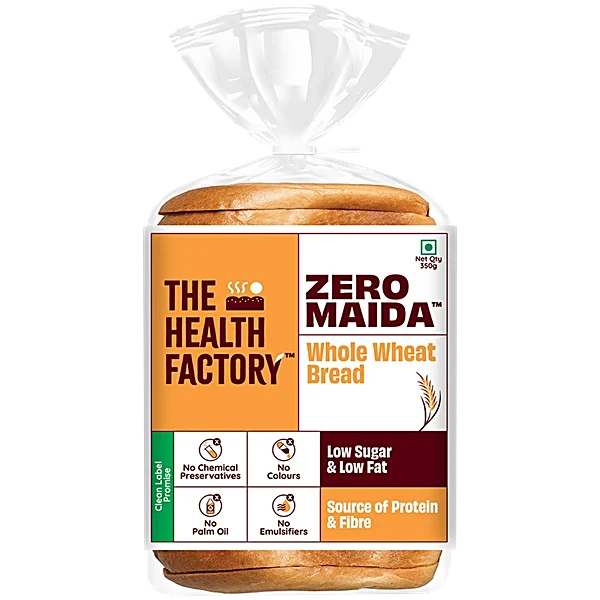
The front of this pack is loud in a way the label section just earned the right to forgive. “Zero Maida”, “100% Whole Wheat”, “Clean Label, Not Brown”, and a row of negative claims covering palm oil, emulsifiers, colours, and malt powder.
Loud marketing usually widens the gap between the promise and the formulation, so the question is how much of this survives contact with the ingredient list. Most of it does. The “no palm oil, no emulsifiers, no added colour” claims are simply true, verifiable by their absence from a list this short, and in a category where palm oil and DATEM are near-default, that absence is a real and uncommon merit. The “100% whole wheat, zero maida” claim is the genuine article rather than the usual sleight of hand, because chakki atta is the only grain flour present.
The one place the marketing outruns the formulation is the broader health halo, the implication a shopper is meant to absorb that a loaf this clean is something you can stop thinking about. That is where it is worth being precise, because the gap is small but real.
Partly true
“Clean Label, Not Brown”: a health-first loaf you no longer need to ration.
The ingredient quality is real, and the score reflects it. But cleaner ingredients change what the calories are made of, not how many there are. This loaf carries about 241 kcal and 44g of carbohydrate per 100g, the same broad range as a white loaf, and its sodium at roughly 347mg per 100g is standard bread, not reduced. “Clean” is true at the level of what goes in. It does not convert bread into a food without a portion size, and the front of pack lets that distinction blur. Treat it as the best version of an everyday staple, not as a license to eat more of it.
One honest technicality sits underneath the headline claim, worth a sentence because it is the kind of thing a careful reader notices. “100% whole wheat” describes the flour, and on the flour it is accurate. The added wheat gluten is a wheat extract rather than a whole grain, so the loaf as a whole is 100% whole wheat in its grain base, not in every ingredient. This is not a deception, since gluten is openly declared and the protein it adds is a benefit, but it is the reason the phrase is precise rather than absolute.
Clearing up the myths
Bread is one of the most myth-heavy aisles in the Indian supermarket, and this loaf sits exactly where several of those myths collide. Clearing them is half the value of reading a label well.
- “Brown bread is whole wheat bread.” Colour proves nothing, and is often engineered. Many brown loaves get their shade from caramelised sugar or added colour over a mostly maida base. The only reliable test is the ingredient list, where the first flour should be whole wheat, ideally with a declared percentage. This is the myth the entire product is built to break.
- “Bread without preservatives spoils dangerously fast.” It goes stale or mouldy sooner, which is an inconvenience, not a danger. A short shelf life is the honest signature of a preservative-free loaf, not a defect. Refrigerating it after a couple of days largely solves the problem, and a visibly mouldy slice is doing exactly what it should: telling you plainly, instead of being chemically prevented from showing its age.
- “Whole wheat bread is a weight-loss food.” Whole wheat and white bread carry similar calories, around 240 to 260 per 100g. The advantage of whole wheat is fibre, intact minerals, and a slower, steadier rise in blood sugar, not a lighter calorie bill. The benefit is in the quality of the carbohydrate, not the quantity, and portion still decides the outcome.
- “Zero maida means safe for a diabetic in any amount.” This loaf still delivers about 44g of carbohydrate per 100g. Its 6.31g of fibre genuinely blunts the blood sugar response compared with a maida loaf, which is a real advantage, but the carbohydrate load does not vanish. The slice count still matters, and pairing still matters more.
How to eat this well
A clean loaf is a strong foundation, not a finished meal. Bread eaten alone is mostly carbohydrate, even good bread, so the single highest-value habit with this one is to never let it travel alone. The protein and fibre it already carries are a head start, and what you put on top decides whether the meal builds on that or wastes it. How much room you have also depends on who is eating.
Go ahead
Healthy adults and children
A solid everyday bread and a clear upgrade over typical brown bread. The fibre and protein per slice are among the best in the packaged category, which makes it a sound base for school and work breakfasts.
Go easy
People watching blood pressure
At roughly 347mg of sodium per 100g, a few slices add up on a salt-conscious day, especially alongside other packaged food. Count it in your daily total rather than treating it as a free pass because the rest of the loaf is clean.
Be careful
Celiac or gluten-sensitive
This loaf contains wheat and added wheat gluten, which concentrates exactly the protein you must avoid. It is not a borderline case to weigh. Skip it entirely.
Better ways to eat it
Top it with protein, every time
Eggs, paneer bhurji, leftover dal, or peanut butter turn two slices from a carbohydrate snack into a balanced meal and slow the rise in blood sugar. This is the pairing that makes the loaf’s protein head start actually count.
Refrigerate after day two
With no chemical preservative, mould is the natural enemy and the honest cost of the recipe. Keep the loaf sealed and move it to the fridge once opened, then toast slices straight from cold. This single habit prevents the bad first experience that sends people back to preserved bread.
Keep the toppings low-salt
The bread already brings its own sodium, so loading it with processed cheese, ketchup, or salted butter stacks salt on salt. Lean on fresh toppings, a vegetable, an egg, a thin scrape of butter, to keep the meal’s total in check.
Let the slice count do the portioning
Whole wheat does not mean unlimited. Two slices per sitting is a sensible anchor for most adults, the same as any bread, because the calories and carbohydrate are the same range as any bread.
Recipes to try
Masala egg bhurji on toast
A standard Indian breakfast that stacks egg protein on the loaf’s wheat protein. The kind of thing people already make, just on a better base.
You need
- 2 slices, toasted
- 2 eggs
- Half an onion, one small tomato, a green chilli, chopped
- Turmeric, a little oil, coriander
Method
- Soften the onion, chilli, and tomato in a little oil with a pinch of turmeric.
- Pour in the beaten eggs and scramble to just-set. Salt lightly, the toast carries some already.
- Pile onto the toast and finish with coriander.
Peanut butter and banana toast
A no-cook option that adds protein and potassium for a pre-work or post-workout breakfast. Five minutes, no skill required.
You need
- 2 slices, toasted
- 2 tablespoons unsweetened peanut butter
- 1 banana, sliced
- A pinch of cinnamon, optional
Method
- Spread the peanut butter on the warm toast so it loosens.
- Layer the banana on top and dust with cinnamon.
What The Health Factory could do next
This is a strong product, so these are refinements rather than rescues.
- Declare the atta percentage on the front of pack. “Zero maida” is a negative claim, defined by what is absent. A positive “whole wheat flour: 97%” would let a shopper compare this loaf against a blended one at a glance, and would set a standard the rest of the category would have to answer in the same units.
- Publish a micronutrient panel. Whole wheat carries iron, zinc, and magnesium that refined flour loses in milling, and this loaf almost certainly has more of them than its maida-based rivals. Declaring those numbers would claim credit the formulation has already earned, and turn an implied advantage into a stated one.
- Bring the sodium under 300mg per 100g. Sodium is the single number where this loaf still behaves like ordinary bread. A meaningful cut would let it beat the category on the one risk nutrient where it currently only matches it, and would strengthen the score directly.
- Print storage guidance prominently. A preservative-free loaf lives or dies by how it is stored, and a customer who lets it mould on the counter blames the bread, not the kitchen. A clear “refrigerate after opening, best within a week” line on the front would protect both the loaf and the brand’s reputation for it.