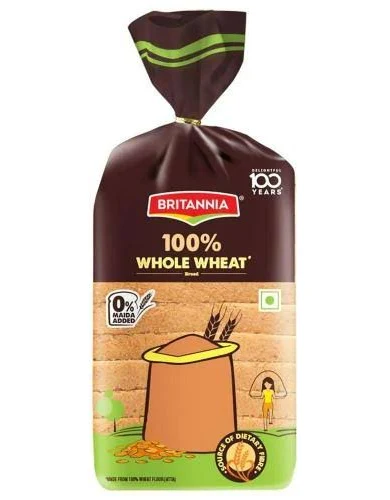
Download: Britannia 100% Whole Wheat Bread Scorecard
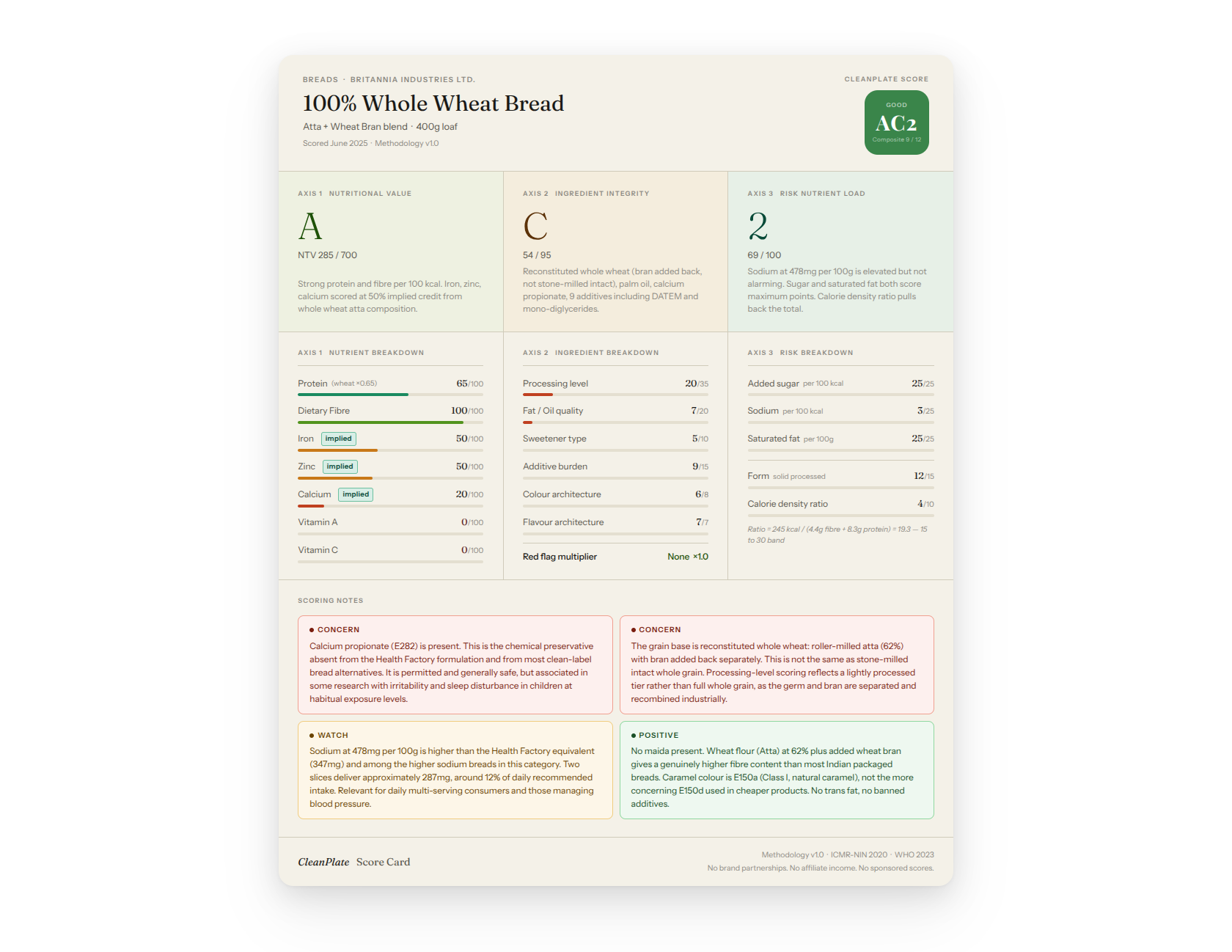
The Category Benchmark, and What It Is Actually Made Of
Britannia has been making bread in India since 1965. Its 100% Whole Wheat Bread is one of the most widely distributed packaged bread products in the country, available in general stores, supermarkets, and quick commerce platforms in virtually every major city. It is also the product most Indian consumers reach for when they decide to switch from white bread. The front of pack says 100% Whole Wheat, No Maida, Good Source of Fibre. These claims are broadly accurate. What the front of pack does not say is where the product sits in its formulation relative to what those words imply, and how it compares to a newer generation of genuinely clean-label whole wheat breads now available in the same category.
A CleanPlate score of A · C · 2 captures this tension precisely. The A reflects the fact that this bread genuinely delivers useful nutrition: meaningful fibre, reasonable protein, and an implied micronutrient profile from the whole wheat atta base. The C tells the more complicated story. The “100% whole wheat” on the pack refers to a reconstituted blend of roller-milled atta and added bran, not stone-milled intact whole grain. And the product carries nine additives, including calcium propionate, palm oil, DATEM, and mono-diglycerides, that are standard for mass-market commercial bread but that a consumer reading “whole wheat” and “clean” would not necessarily expect. The 2 on risk load is a genuine positive: sugar is minimal, saturated fat is low, and the sodium, while higher than cleaner competitors, is not alarming at moderate serving sizes.
This is not a bad product. It is a mainstream product doing what mainstream products do: delivering adequate nutrition at scale and price, using industrial processes and additives to make that possible. The question is whether “adequate” is what you were reaching for when you chose the whole wheat option.
Reading the Pack Honestly
What the label tells you, and what it leaves out
The ingredient list is: Wheat Flour (Atta) (62%), Yeast, Wheat Bran, Sugar, Iodised Salt, Edible Vegetable Oil (Palm), Class II Preservative (282), Improvers (1100(i), 1104, 1102), Emulsifiers (471, 481(i), 472e), Acidity Regulator (260), Flour Treatment Agent (510), and Permitted Natural Food Colour (150a). Thirteen distinct components. For a product marketed on clean, wholesome grain, that is a long list.
The “100% Whole Wheat” claim refers to the grain source, not the milling process. Wheat Flour (Atta) at 62% is roller-milled flour, a high-speed industrial process that separates the bran, germ, and endosperm. The bran is then added back as a separate ingredient. This reconstituted approach is common in commercial bread production because roller-milled atta is cheaper, more consistent, and easier to work with at scale than stone-milled chakki atta. It produces bread that is nutritionally closer to whole grain than white bread, but the process is not the same as using intact whole grain flour, and the bread’s fibre figure of 4.4g per 100g, compared to 6.3g in a stone-milled whole wheat equivalent, reflects this.
The nutrition declaration covers only the five mandatory FSSAI nutrients: energy, protein, carbohydrate, fat, and sodium. Fibre is declared, which is above the minimum. Micronutrients are not declared. Iron and zinc are present in the atta at meaningful levels based on established food composition data, but Britannia does not declare them, so a consumer reading this label cannot see them and most scoring systems, including CleanPlate at full credit, cannot give them full weight.
Ingredients to watch
It is worth being clear about what this product does not contain, because several of the worst additives found in cheaper Indian breads are absent here. There are no azo dyes, no potassium bromate, no partially hydrogenated oils, and no trans fat. The caramel colour is Class I, not the more concerning Class IV used in some competitors. Within the mainstream mass-market bread category, this is a reasonably well-formulated product. The concern is not safety. It is the gap between the clean-grain positioning and the industrial additive load behind it.
Clearing up the myths
- “100% Whole Wheat means it is the same as chakki atta bread.” It does not. The claim is accurate in that no maida is used as a separate ingredient. But the atta here is roller-milled, with bran added back after separation. Stone-milled chakki atta, where the whole grain is ground intact, retains more of the germ’s natural oils and nutrients and has a different fibre matrix. The resulting bread has a higher fibre content, lower glycaemic response, and a nutritionally more complete grain base. Both products are “whole wheat.” They are not the same product.
- “Preservatives in bread are harmless at the quantities used.” For most healthy adults, this is broadly correct. The concern with E282 is not acute toxicity but habitual low-level exposure in children. The paediatric evidence is not conclusive but it is substantial enough that several international markets have seen consumer pressure to remove it from children’s food products. For families with young children eating bread daily, this is a genuine reason to consider an alternative.
- “Britannia whole wheat is healthier than brown bread.” This depends entirely on which brown bread. Britannia’s own brown bread variants use maida as the primary grain, making them nutritionally inferior to this product. But “healthier than brown bread” is not the same as “a clean or nutritionally excellent product.” It is a low-comparison-bar claim that does not address the formulation choices this product actually makes.
- “More additives means it lasts longer, which is just practical.” Shelf stability is a real operational requirement for a brand selling bread at national scale across a hot, humid country. That context is fair. But it is also worth knowing that fermentation-based alternatives using cultured wheat flour and cultured glucose can achieve commercial shelf life without E282 at a comparable price point. The additive load in this product reflects a formulation philosophy, not an unavoidable constraint.
Eating This Bread Sensibly
For most healthy adults eating two to four slices a day as part of a varied diet, this bread is a perfectly serviceable choice. The fibre is real, the sugar is minimal, the saturated fat is low, and the protein contribution is reasonable for a grain product. The additive concerns are proportionate to consumption frequency rather than to any single serving.
The calculus changes for children eating this bread daily. The calcium propionate concern is strongest for habitual daily exposure in young children, not for occasional consumption in adults. If bread is a daily tiffin staple for a child between five and twelve, the E282 question is worth taking seriously, and a propionate-free alternative at a similar price point now exists in most urban markets.
For blood sugar management, this product is better than standard brown bread or white bread but not as well-suited as a stone-milled whole wheat alternative. The reconstituted bran formulation has a slightly higher glycaemic index than intact whole grain bread, and the lower fibre content per 100g (4.4g versus 6.3g in stone-milled equivalents) provides less buffering. The standard advice applies: always pair with protein or fat, never eat bread alone as a meal, and prefer toast to soft bread where blood sugar response is a concern.
Better ways to eat this bread
What Britannia Could Do
- Replace calcium propionate with fermentation-based preservation. Cultured wheat flour and cultured glucose can deliver commercial shelf life in whole wheat bread without E282. Several smaller brands already do this at comparable price points. For a company with Britannia’s R&D infrastructure and sourcing scale, this is not a formulation impossibility. It is a priority call. Removing E282 from the children’s consumption concern is the single most impactful change this product could make.
- Transition the atta base to stone-milled or low-heat chakki processing. The reconstituted whole wheat approach is nutritionally adequate but not optimal. A shift to chakki-milled atta as the primary grain would lift fibre from 4.4g to approximately 6g per 100g, improve the grain’s micronutrient retention, and allow Britannia to make a genuinely differentiated clean-grain claim rather than a technically accurate but practically limited one. The cost premium is real but manageable at Britannia’s volume.
- Rationalise the emulsifier count from three to one. DATEM, sodium stearoyl lactylate, and mono-diglycerides together represent significant formulation engineering for a product sold on a whole-grain promise. A reformulation review to determine whether one emulsifier can replace three without compromising crumb texture or shelf life would reduce the additive burden meaningfully and align the ingredient list more honestly with the product’s market positioning.
- Switch from palm oil to rice bran or expeller-pressed sunflower oil. The palm oil used here contributes only 2g of total fat per 100g, so the saturated fat impact is small. But the switch to a better oil would be low-cost at this fat level, would remove the palm-related environmental and label concerns, and would allow Britannia to make a no-palm-oil claim that is increasingly valued by urban health-conscious consumers who are the primary buyers of whole wheat bread.
- Declare a full micronutrient panel. The whole wheat atta base contains iron, zinc, and B vitamins that are not currently visible on the label. Adding these would cost nothing beyond a one-time lab analysis and label redesign, and the numbers would almost certainly be favourable. A consumer choosing this bread over white bread for its nutritional completeness cannot currently see the most nutritionally relevant part of what they are buying.