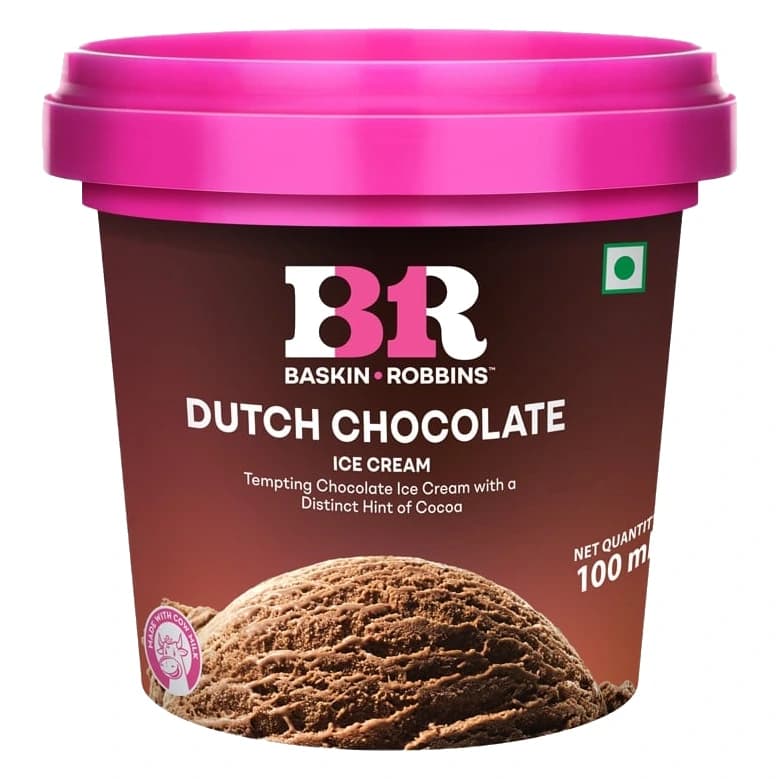
Baskin Robbins Dutch Chocolate Ice Cream Cup
Red flags
No major red flags on the label.
Green flags
- +Green flag: Low sodium
Ingredients, decoded
7 listed- Water
- Milk Solids
- Sugar
- cocoa solids (5.5%)
- Dark Chocolate (0.5%)
- Stabilizers (461,412,407)
- Emulsifier (471)
Our take
CleanPlate reviewDutch chocolate ice cream with no dyes
Baskin Robbins Dutch Chocolate is a 100 ml frozen cup of water, milk solids, sugar and cocoa solids (5.5%) with dark chocolate (0.5%), three stabilisers and an emulsifier. There are no colours or flavourings listed.
CleanPlate scores it EB2. The E for nutrition is low: almost no credited protein, fibre or micronutrients per 100 ml. The B for ingredients reflects mostly refined or industrial ingredients (led by milk solids, sugar and cocoa solids), with additives that cost points: carrageenan, guar gum, methylcellulose and mono- and diglycerides of fatty acids. The 2 for risk is low: sodium, free sugar and saturated fat are all modest (sodium 34 mg, free sugar 9.4 g, saturated fat 3.9 g per 100 ml).
Claims vs reality
What the pack says, checked against the ingredient list and nutrition panel.
- On the packHolds
“Tempting Chocolate Ice Cream with a Distinct Hint of Cocoa”
Cocoa solids are declared at 5.5%.
How EB2 breaks down
Each grade is scored on its own. Here are the label numbers behind each one, per 100 g.
Very low nutrient density
- Protein
- 2.3 g
- Fibre
- 0.4 g
- Vitamins and minerals
- None declared
- Energy
- 129 kcal
Scored on protein, fibre and twelve vitamins and minerals, against the Codex and FSSAI "source" and "high" levels, per 100 g and per 100 kcal.
Good, few concerning additives
- Base
- Water
- Sweeteners
- Sugar
- Additives
- 4
- Flagged
- None
Scored on how processed the ingredients are, which additives are used and why, and whether the label keeps its promises.
Low risk
- Added sugar
- 9.4 g
- Sodium
- 34 mg
- Saturated fat
- 3.9 g
- Trans fat
- 0 g
Scored on free sugar, sodium, saturated fat and trans fat, each weighed by how strong the evidence of harm is.
A closer look
Does the label add up?
Water, milk solids, sugar, cocoa solids (5.5%), dark chocolate (0.5%), stabilizers (461, 412, 407) and emulsifier (471).
Per 100 ml: 129 kcal, 6.8 g fat of which 3.9 g saturated, 12.8 g sugar of which 9.4 g added, 0.4 g fibre, 2.3 g protein, 34 mg sodium. No veg mark could be read on the pack images. Trans fat is printed as 0 g.
Ingredients to watch
- Carrageenan and methylcelluloseWorth watching
Stabilisers cost 10 points on ingredients.
- Added sugarWorth watching
9.4 g per 100 ml.
- No colours or flavouringsFine
Cocoa gives the colour.
- CocoaFine
5.5% cocoa solids.
Common misconceptions
Myth: "Chocolate ice cream always has artificial colour"
This cup lists none.
Myth: "Dark chocolate is the main flavour"
Dark chocolate is only 0.5%; cocoa solids supply most of the taste.
How often, and how
- Healthy adultsOccasionally
- ChildrenRarely
- Diabetes or prediabetesLimit
Smarter ways to eat it
Keep to the cup
A 100 ml cup is 129 kcal.
Add banana slices
Fruit adds fibre and sweetness.
Common questions
Is Baskin Robbins Dutch Chocolate Ice Cream Cup healthy?
Baskin Robbins Dutch Chocolate Ice Cream Cup scores EB2 (Poor) on CleanPlate, which makes it best kept as a rare treat rather than a regular buy. We found no major red flags on its label. On the plus side: Low sodium.
What does the EB2 score mean?
The first letter (E) grades nutritional value: very low nutrient density. The second letter (B) grades ingredient and label integrity: good, few concerning additives. The number (2) grades risk nutrients (sugar, sodium, saturated fat): low risk.
Last reviewed October 19, 2026. Scored with the CleanPlate method from the published label.
Better Frozen Desserts
All 100 →- Go Zero Chocolate Ice Cream Pastry
- −Red flag: Refined flour (maida) base
- +Green flag: High protein (13.2g per 100g)
- Minus Thirty Vanilla Mini Ice Cream Stick (Vegan & Sugar Free)
- +Green flag: No added sugar
- Frozen Fun Sicilian Pistachio Gelato
- −Red flag: High added sugar (10.6g per 100g)
- +Green flag: Low sodium
- Minus Thirty Mini Hazelnut Ice Cream Stick (Vegan & Sugar Free)
- +Green flag: No added sugar