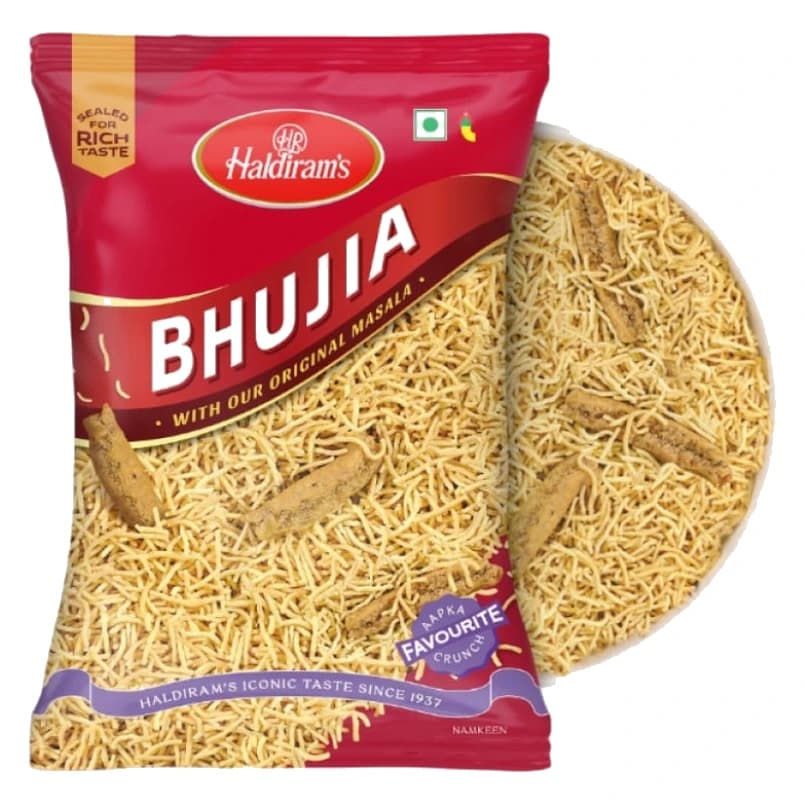
Haldiram's Bhujia
Published
Haldiram's Bhujia is a legume-flour namkeen sold as an everyday tea-time crunch. It scores DA4: nutrition is low because the energy and fat outweigh the protein, ingredients are plain with a short list and no additives, and risk is high on saturated fat, sodium and energy. A snack to keep to small handfuls now and then, not a daily nibble.
Ingredients, decoded
5 listed- Tepary Beans Flour
- Edible Vegetable Oil
- Cotton Seed
- Corn
- Palmolein
- Ground Nut
- Rice Bran
- Gram Pulse Flour
- Iodised Salt
- *Spices & Condiments
- Red Chilli Powder
- Black Pepper Powder
- Ginger Powder
- Clove Powder
- Mace Powder
- Nutmeg Powder
- Cardamom Powder
½ teaspoon of sugar in every 100 g · 3.1 g total sugar, 5 g a teaspoon
| Energy | 579.6 kcal |
|---|---|
| Protein | 14.1 g |
| Carbohydrates | 39 g |
| Total sugars | 3.1 g |
| Added sugars | 0 g |
| Dietary fibre | 4.7 g |
| Total fat | 40.8 g |
| Saturated fat | 6.7 g |
| Sodium | 754 mg |
Think this score is wrong?
What to know about Haldiram's Bhujia
Plain ingredient list, heavy on fat and salt
A thin, crisp namkeen made from tepary (moth) bean flour, gram flour and vegetable oil, seasoned with salt and a blend of whole spices. It is a classic tea-time snack, bought for the crunch and the masala rather than for nutrition.
Per 100 g it gives 579.6 kcal, 14.1 g protein and 4.7 g fibre, with 40.8 g fat of which 6.7 g is saturated. Sodium is 754 mg. One 20 g serve is about 116 kcal, so the calories add up quickly if you eat it from the pack.
The pack makes no health promises, and the ingredient list is short with no additives. The weak points are the oil and salt that come with the crunch. CleanPlate scores it DA4.
Why Haldiram's Bhujia scores DA4
Nutrition is a D because 579.6 kcal and 40.8 g fat outweigh the protein. Ingredients are an A with no additives, and risk is a 4 on sodium and saturated fat.
Low nutrient density
- Protein
- 14.1 g
- Fibre
- 4.7 g
- Vitamins and minerals
- None declared
- Energy
- 580 kcal
01 Nutrition density: why D
Protein is 14.1 g per 100 g and fibre 4.7 g, mostly from the bean and gram flours. In a 20 g serve that is 2.8 g protein and 0.9 g fibre.
Against that, 579.6 kcal and 40.8 g fat per 100 g outweigh the protein, and no vitamins or minerals are declared, so there is nothing else to lift the grade.
Scored on protein, fibre and twelve vitamins and minerals, against the Codex and FSSAI "source" and "high" levels, per 100 g and per 100 kcal. Protein also has to supply at least 12.5% of the calories to count, and 25% for full credit.
Clean, minimally processed
- Base
- Tepary Beans Flour
- Main fat
- Edible Vegetable Oil
- Sweeteners
- None added
- Additives
- 0
- Flagged
- Palmolein
02 Ingredient integrity: why A
Five items make up the list: tepary bean flour, a blend of vegetable oils, gram flour, iodised salt and whole spices. There are no additives, colours or flavourings, and no hydrogenated fat.
The tepary bean flour leads but carries no percentage, so the exact mix of flour and oil is not stated.
Scored on how processed the ingredients are, which additives are used and why, and whether the label keeps its promises.
High risk
- Added sugar
- 0 g
- Sodium
- 754 mg
- Saturated fat
- 6.7 g
03 Load risk: why 4
Sodium is the largest driver at 754 mg per 100 g, with 151 mg in a 20 g serve. Saturated fat is 6.7 g per 100 g, above the 5 g high line.
Energy at 579.6 kcal per 100 g adds to it. Added sugar is 0 g and trans fat is printed as under 0.1 g, so neither plays a part.
Scored on free sugar, sodium, saturated fat and trans fat, each weighed by how strong the evidence of harm is.
Red flags
- −Red flag: High sodium (754mg per 100g)
- −Red flag: High saturated fat (6.7g)
- −Red flag: Palm oil listed
Green flags
- +Green flag: Source of fibre
- +Green flag: No added sugar
Does Haldiram's Bhujia live up to its claims?
The masala claim holds. The moth dal story is framed around a bean flour with no percentage, and the retailer ad card lists a different set of ingredients from the pack.
- On the packBe careful
“Moth dal Bhujia”
The back story calls it moth dal bhujia, but the ingredient list leads with tepary bean flour and prints no percentage for it.
- On the packHolds
“Original masala”
The seasoning is salt plus real spices: red chilli, black pepper, ginger, clove, mace, nutmeg and cardamom. No flavouring is added.
- Retail listingBe careful
“Ad card ingredient list”
The retailer ad card lists besan, cardamom, seeds and cinnamon, which does not match the pack list. The pack list shows tepary bean flour, oil, gram flour, salt and spices.
What's in Haldiram's Bhujia?
Tepary bean flour, vegetable oil and gram flour lead a list of five, with salt and whole spices. Sodium and saturated fat are what to watch.
The ingredient list, read for you
Tepary bean flour comes first, then a blend of cotton seed, corn, palmolein, groundnut and rice bran oils, then gram flour. Iodised salt and a set of whole spices finish the list. The flours give the protein, the oil gives the crunch and the fat.
Ingredients to watch
- SodiumConcern
754 mg per 100 g, 151 mg in a 20 g serve.
- Saturated fatConcern
6.7 g per 100 g, above the 5 g high line, 1.3 g in a 20 g serve.
- EnergyWorth watching
579.6 kcal per 100 g, about 116 kcal in a 20 g serve.
- Protein and fibreFine
14.1 g protein and 4.7 g fibre per 100 g from bean and gram flours.
What it doesn’t have
- No vitamins or minerals are declared on the panel.
Who should eat Haldiram's Bhujia?
An occasional snack for most adults and children, and a rare one for anyone watching blood pressure, since 20 g already brings 151 mg sodium.
- Most adultsOccasionally
Risk is high on saturated fat, sodium and energy.
- ChildrenOccasionally
No dye or sweetener, but 151 mg sodium in a small serve.
- High blood pressureRarely
754 mg sodium per 100 g adds up fast.
- Weight managementOccasionally
About 116 kcal in a 20 g serve, easy to overshoot.
Haldiram's Bhujia: common questions
What is the CleanPlate score of Haldiram's Bhujia?
Haldiram's Bhujia is a legume-flour namkeen sold as an everyday tea-time crunch. It scores DA4: nutrition is low because the energy and fat outweigh the protein, ingredients are plain with a short list and no additives, and risk is high on saturated fat, sodium and energy. A snack to keep to small handfuls now and then, not a daily nibble. Nutrition D, ingredients A, load risk 4; nutrition and ingredients run A to E, risk runs 1 to 5, and A and 1 are best.
How many calories and how much protein are in Haldiram's Bhujia?
Per 100 g, Haldiram's Bhujia has 580 kcal, 14.1 g protein, 39 g carbohydrate, 40.8 g fat and 6.7 g saturated fat. One serve (20 g, a small handful (10 servings per pack)) has 116 kcal and 2.8 g protein.
What are the ingredients in Haldiram's Bhujia?
5 ingredients, in label order: Tepary Beans Flour, Edible Vegetable Oil (Cotton Seed, Corn, Palmolein, Ground Nut, Rice Bran), Gram Pulse Flour, Iodised Salt, *Spices & Condiments (Red Chilli Powder, Black Pepper Powder, Ginger Powder, Clove Powder, Mace Powder, Nutmeg Powder, Cardamom Powder). Flagged: Palmolein (low concern).
Does Haldiram's Bhujia live up to its claims?
3 claims checked: 1 holds, 2 need care. "Moth dal Bhujia" needs care: The back story calls it moth dal bhujia, but the ingredient list leads with tepary bean flour and prints no percentage for it. "Ad card ingredient list" needs care: The retailer ad card lists besan, cardamom, seeds and cinnamon, which does not match the pack list. The pack list shows tepary bean flour, oil, gram flour, salt and spices.
Who should limit Haldiram's Bhujia?
Most adults: occasionally. Risk is high on saturated fat, sodium and energy. Children: occasionally. No dye or sweetener, but 151 mg sodium in a small serve. High blood pressure: rarely. 754 mg sodium per 100 g adds up fast.
How much sugar, salt and saturated fat does Haldiram's Bhujia have?
Per 100 g, Haldiram's Bhujia has 0 g added sugar, 754 mg sodium (about 1.9 g salt) and 6.7 g saturated fat. The FSSAI and UK FSA "high" lines are 10 g added sugar, 600 mg sodium and 5 g saturated fat per 100 g. It is high in salt and saturated fat.
Last reviewed October 27, 2026. Scored with the CleanPlate method from the published label. Spotted a mistake? .