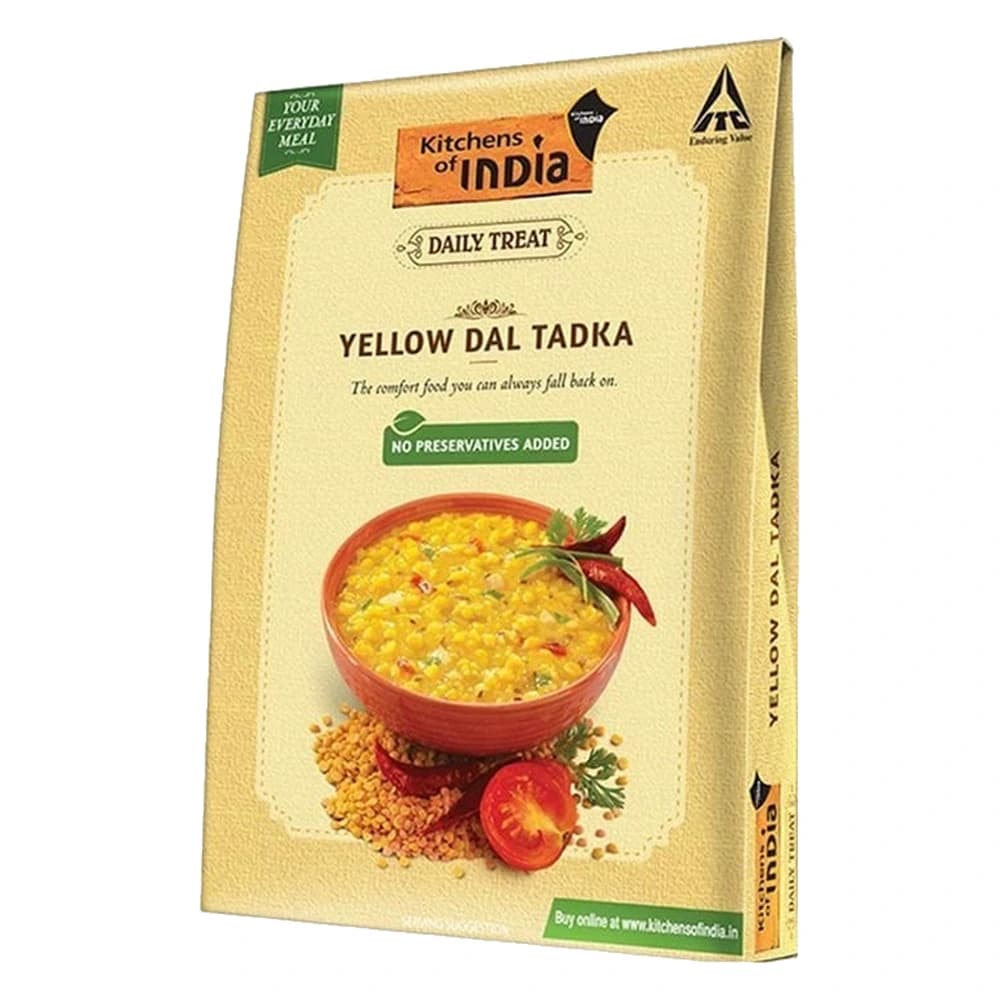
Kitchens of India Yellow Dal Tadka
Red flags
No major red flags on the label.
Green flags
- +Green flag: No additives
Ingredients, decoded
11 listed- Water
- Arhar Dal (8.8%)
- Tomato (8.8%)
- Onion (8.8%)
- Masur Dal
- Refined Sunflower Oil
- Coriander Leaves (1.9%)
- Garlic (0.9%)
- Iodized Salt
- Spices and Condiments (0.5%)
- Ginger and Cumin (0.2%)
Our take
CleanPlate reviewReady dal with no additives and no sodium line
Kitchens of India Yellow Dal Tadka is a ready-to-eat curry in a pouch: water, arhar dal (8.8%), tomato (8.8%), onion (8.8%), masur dal, sunflower oil, coriander, garlic, salt and spices. The pack is 285 g and the panel is printed per 100 g.
CleanPlate scores it EA2. The E for nutrition is low: almost no credited protein, fibre or micronutrients per 100 g. The A for ingredients reflects whole or lightly processed ingredients (led by arhar dal, tomato and onion), and almost no additives. The 2 for risk is low: sodium, free sugar and saturated fat are all modest (sodium 305 mg, free sugar 0 g, saturated fat 0.4 g per 100 g).
Claims vs reality
What the pack says, checked against the ingredient list and nutrition panel.
- Product nameHolds
“Yellow Dal Tadka”
Arhar and masur dal lead the list with tomato, onion, garlic and spices.
- On the packHolds
“Just Heat and Eat”
The pouch is thermally processed and ready to eat.
- On the packHolds
“No Added Preservatives”
No preservative is listed.
How EA2 breaks down
Each grade is scored on its own. Here are the label numbers behind each one, per 100 g.
Very low nutrient density
- Protein
- 3.4 g
- Fibre
- Not declared
- Vitamins and minerals
- None declared
- Energy
- 77 kcal
Scored on protein, fibre and twelve vitamins and minerals, against the Codex and FSSAI "source" and "high" levels, per 100 g and per 100 kcal.
Clean, minimally processed
- Base
- Water
- Main fat
- Refined Sunflower Oil
- Sweeteners
- None added
- Additives
- 0
- Flagged
- None
Scored on how processed the ingredients are, which additives are used and why, and whether the label keeps its promises.
Low risk
- Total sugar
- 3.3 g
- Saturated fat
- 0.4 g
- Trans fat
- 0.05 g
Scored on free sugar, sodium, saturated fat and trans fat, each weighed by how strong the evidence of harm is.
A closer look
Does the label add up?
Thermally processed curried vegetables (ready to eat): water, arhar dal (8.8%), tomato (8.8%), onion (8.8%), masur dal, refined sunflower oil, coriander leaves (1.9%), garlic (0.9%), iodized salt, spices and condiments (0.5%), ginger and cumin (0.2%).
Per 100 g: 77 kcal, 3 g fat of which 0.4 g saturated, 3.3 g sugar, 3.4 g protein. The back-of-pack list names onion at 8.8%, which the info card omits; the back print is used. The panel prints no sodium, added sugar, fibre or cholesterol. Sodium is estimated at 305 mg per 100 g from the Blinkit listing, which is not on the pack, so the score is provisional. Energy matches the Atwater sum (77 kcal). Net 285 g.
Ingredients to watch
- Sodium estimatedWorth watching
The pack prints no sodium; the listing's 305 mg per 100 g is used as an estimate.
- ProteinWorth watching
3.4 g per 100 g, too little to earn credit; about 10 g in the whole pouch.
- FibreWorth watching
No fibre is printed, so none is credited.
- Saturated fatFine
0.4 g per 100 g, with 3 g of fat in total.
Common misconceptions
Myth: "Ready-to-eat dal is a high-protein meal"
It has 3.4 g of protein per 100 g, about 10 g in the whole 285 g pouch.
Myth: "Packaged dal must contain preservatives"
No preservative is listed; the pouch is thermally processed.
How often, and how
- Healthy adultsMost days
- ChildrenMost days
- Diabetes or prediabetesFine in moderation, count the carbohydrate
Smarter ways to eat it
Pair it with rice or roti
The dal alone is light; with a cereal it makes a fuller meal.
Add curd or a salad
Plain curd or a salad adds protein and fibre the pack does not print.
Common questions
Is Kitchens of India Yellow Dal Tadka healthy?
Kitchens of India Yellow Dal Tadka scores EA2 (Poor) on CleanPlate, which makes it best kept as a rare treat rather than a regular buy. We found no major red flags on its label. On the plus side: No additives.
What does the EA2 score mean?
The first letter (E) grades nutritional value: very low nutrient density. The second letter (A) grades ingredient and label integrity: clean, minimally processed. The number (2) grades risk nutrients (sugar, sodium, saturated fat): low risk.
Last reviewed October 19, 2026. Scored with the CleanPlate method from the published label.