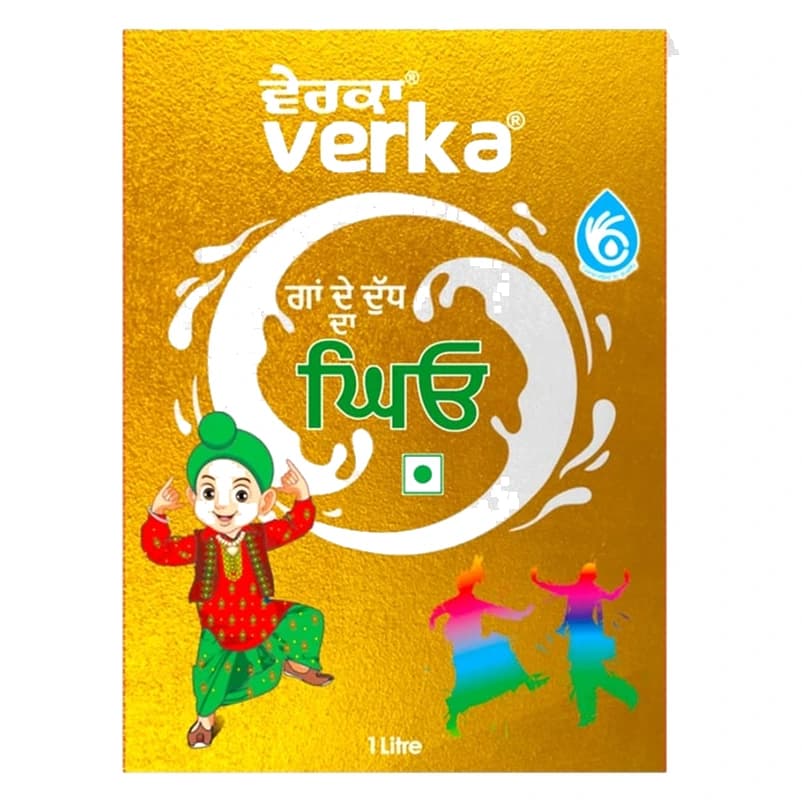
Verka Cow Ghee
Published · Updated
Verka Cow Ghee is ghee made from pure cow milk fat, sold for cooking, frying and sweets. It scores CB4: middling on nutrition because it is all fat with only a little vitamin A, clean on ingredients with one plain item and no additives, and high on risk because of its saturated fat and energy density. Best used by the spoonful.
Ingredients, decoded
1 listed- Cow Milk Fat
0 teaspoon of sugar in every 100 g · 0 g total sugar, 5 g a teaspoon
| Energy | 897 kcal |
|---|---|
| Protein | 0 g |
| Carbohydrates | 0 g |
| Total sugars | 0 g |
| Added sugars | 0 g |
| Total fat | 99.7 g |
| Saturated fat | 64.8 g |
| Trans fat | 0 g |
| Cholesterol | 239.2 mg |
| Sodium | 0 mg |
| Vitamin A | 450 µg |
Think this score is wrong?
What to know about Verka Cow Ghee
Pure cow milk fat, so every spoon counts
Verka Cow Ghee is a 1 litre pack of ghee with a single ingredient on the label: cow milk fat. It is bought as an everyday cooking fat for frying, tempering and sweets, and for its rich aroma and traditional granular texture.
What you get is pure fat: 99.7 g total fat and 897 kcal per 100 g, with no protein, carbohydrate, sugar or sodium. The panel prints a 10 g serve, which is about 90 kcal and 6.5 g saturated fat, and the pack holds 90 such servings. The only vitamin declared is vitamin A, at 450 mcg per 100 g, about 45 mcg per serve.
The pack makes plain promises, cow ghee made from cow milk, and the ingredient list backs both. There are no additives and no trans fat declared. What costs the grade is not the label but the fat itself: 64.8 g saturated fat per 100 g. CleanPlate scores it CB4.
Why Verka Cow Ghee scores CB4
Nutrition is a C because the ghee is all fat, with only vitamin A to add credit. Ingredients are a B on a single plain ingredient, and risk is a 4 on 64.8 g saturated fat per 100 g.
Adequate nutrient density
- Protein
- 0 g
- Fibre
- Not declared
- Vitamins and minerals
- Vitamin A
- Energy
- 897 kcal
01 Nutrition density: why C
There is no protein, carbohydrate, sugar or fibre to score: the product is 99.7 g fat per 100 g. The only credit comes from vitamin A, declared at 450 mcg per 100 g, which lifts the grade to a C.
In one 10 g spoon that is about 45 mcg vitamin A and about 90 kcal, so the credit is real but small.
Scored on protein, fibre and twelve vitamins and minerals, against the Codex and FSSAI "source" and "high" levels, per 100 g and per 100 kcal. Protein also has to supply at least 12.5% of the calories to count, and 25% for full credit.
Good, few concerning additives
- Base
- Cow Milk Fat
- Main fat
- Cow Milk Fat
- Sweeteners
- None added
- Additives
- 0
- Flagged
- None
02 Ingredient integrity: why B
The list is one ingredient, cow milk fat. No additive, sweetener, colour or preservative is listed, and no hydrogenated fat, so the declared trans fat of 0 g is accepted.
Nothing on the pack is a hollow promise, so there is no label-integrity cost. The grade stops at B, since ghee is a rendered, concentrated fat rather than a whole food.
Scored on how processed the ingredients are, which additives are used and why, and whether the label keeps its promises.
High risk
- Added sugar
- 0 g
- Sodium
- 0 mg
- Saturated fat
- 64.8 g
- Trans fat
- 0 g
03 Load risk: why 4
Saturated fat is the main driver: 64.8 g per 100 g, almost 13 times the 5 g high line. One 10 g spoon has about 6.5 g.
Energy adds to it at 897 kcal per 100 g. Sodium, sugar and trans fat are all 0 g, so they play no part, and the risk number lands on a 4.
Scored on free sugar, sodium, saturated fat and trans fat, each weighed by how strong the evidence of harm is.
Red flags
- −Red flag: High saturated fat (64.8g)
Green flags
- +Green flag: No added sugar
- +Green flag: Low sodium
- +Green flag: No additives
Does Verka Cow Ghee live up to its claims?
The cow milk and cow ghee claims hold, since the only ingredient is cow milk fat. The pack gives 1 litre while the retailer page gives a weight, so the net quantity needs care.
- Product nameHolds
“Cow Ghee”
The only ingredient is cow milk fat, 99.7 g fat per 100 g.
- On the packHolds
“Made from cow milk”
The ingredient list reads cow milk fat, with nothing added.
- Retail listingHolds
“Ideal for cooking, frying, and sweets”
As a pure fat with no water, sugar or protein declared, it suits tempering, frying and sweets. A 10 g spoon is about 90 kcal.
- Retail listingBe careful
“Net quantity”
The retailer page shows a net weight of 900 g, the pack shows 1 litre. The panel's 90 servings of 10 g agree with the weight.
What's in Verka Cow Ghee?
One ingredient, cow milk fat, and nothing else. There are no additives to watch, only the saturated fat and the calories.
The ingredient list, read for you
The label lists one ingredient, cow milk fat. That is the whole product: no oil blend, no flavour, no antioxidant and no colour is declared, so the aroma and taste come from the fat itself.
Ingredients to watch
- Saturated fatConcern
64.8 g per 100 g, almost 13 times the 5 g high line. One 10 g spoon has about 6.5 g.
- Energy densityWorth watching
897 kcal per 100 g, about 90 kcal in a 10 g spoon, all from fat.
- CholesterolWorth watching
239.2 mg per 100 g, about 24 mg in a 10 g spoon.
- Single ingredient, no additivesFine
Cow milk fat only, with trans fat declared as 0 g and no hydrogenated fat listed.
- Vitamin AFine
450 mcg per 100 g, about 45 mcg in a spoon.
What it doesn’t have
- No protein, fibre or minerals are declared, and vitamin A is the only vitamin shown.
Who should eat Verka Cow Ghee?
An occasional fat for most adults and children, to be measured by the spoon. Anyone watching heart health should go lighter still, at 64.8 g saturated fat per 100 g.
- Most adultsOccasionally
A 10 g spoon has about 6.5 g saturated fat, around a third of a day's limit.
- ChildrenOccasionally
64.8 g saturated fat per 100 g, so keep to a small spoon.
- Heart healthRarely
64.8 g saturated fat and 239 mg cholesterol per 100 g.
- Lactose intoleranceOccasionally
No carbohydrate is declared, but the saturated fat of 64.8 g per 100 g still limits use.
Recipes with Verka Cow Ghee
Ghee suits tempering, roti and sweets, where a 10 g spoon is about 90 kcal. Measure it rather than pour.
Dal tadka
Temper with one 10 g spoon of ghee for the whole pot, about 90 kcal, rather than pouring freely.
Ghee roti
Brush a thin layer on each roti and measure it, since each 10 g adds about 6.5 g saturated fat.
Suji halwa
Ghee is the main calorie source here at 897 kcal per 100 g, so cut the spoonfuls rather than the flavour.
Verka Cow Ghee: common questions
What is the CleanPlate score of Verka Cow Ghee?
Verka Cow Ghee is ghee made from pure cow milk fat, sold for cooking, frying and sweets. It scores CB4: middling on nutrition because it is all fat with only a little vitamin A, clean on ingredients with one plain item and no additives, and high on risk because of its saturated fat and energy density. Best used by the spoonful. Nutrition C, ingredients B, load risk 4; nutrition and ingredients run A to E, risk runs 1 to 5, and A and 1 are best.
How many calories and how much protein are in Verka Cow Ghee?
Per 100 g, Verka Cow Ghee has 897 kcal, 0 g protein, 0 g carbohydrate, 99.7 g fat and 64.8 g saturated fat. One serve (1 spoon, 10 g) has 90 kcal and 0 g protein.
What are the ingredients in Verka Cow Ghee?
1 ingredient, in label order: Cow Milk Fat.
Does Verka Cow Ghee live up to its claims?
4 claims checked: 3 hold, 1 needs care. "Net quantity" needs care: The retailer page shows a net weight of 900 g, the pack shows 1 litre. The panel's 90 servings of 10 g agree with the weight.
Who should limit Verka Cow Ghee?
Most adults: occasionally. A 10 g spoon has about 6.5 g saturated fat, around a third of a day's limit. Children: occasionally. 64.8 g saturated fat per 100 g, so keep to a small spoon. Heart health: rarely. 64.8 g saturated fat and 239 mg cholesterol per 100 g.
How much sugar, salt and saturated fat does Verka Cow Ghee have?
Per 100 g, Verka Cow Ghee has 0 g added sugar, 0 mg sodium (about 0 g salt) and 64.8 g saturated fat. The FSSAI and UK FSA "high" lines are 10 g added sugar, 600 mg sodium and 5 g saturated fat per 100 g. It is high in saturated fat.
Last reviewed October 21, 2026. Scored with the CleanPlate method from the published label. Spotted a mistake? .