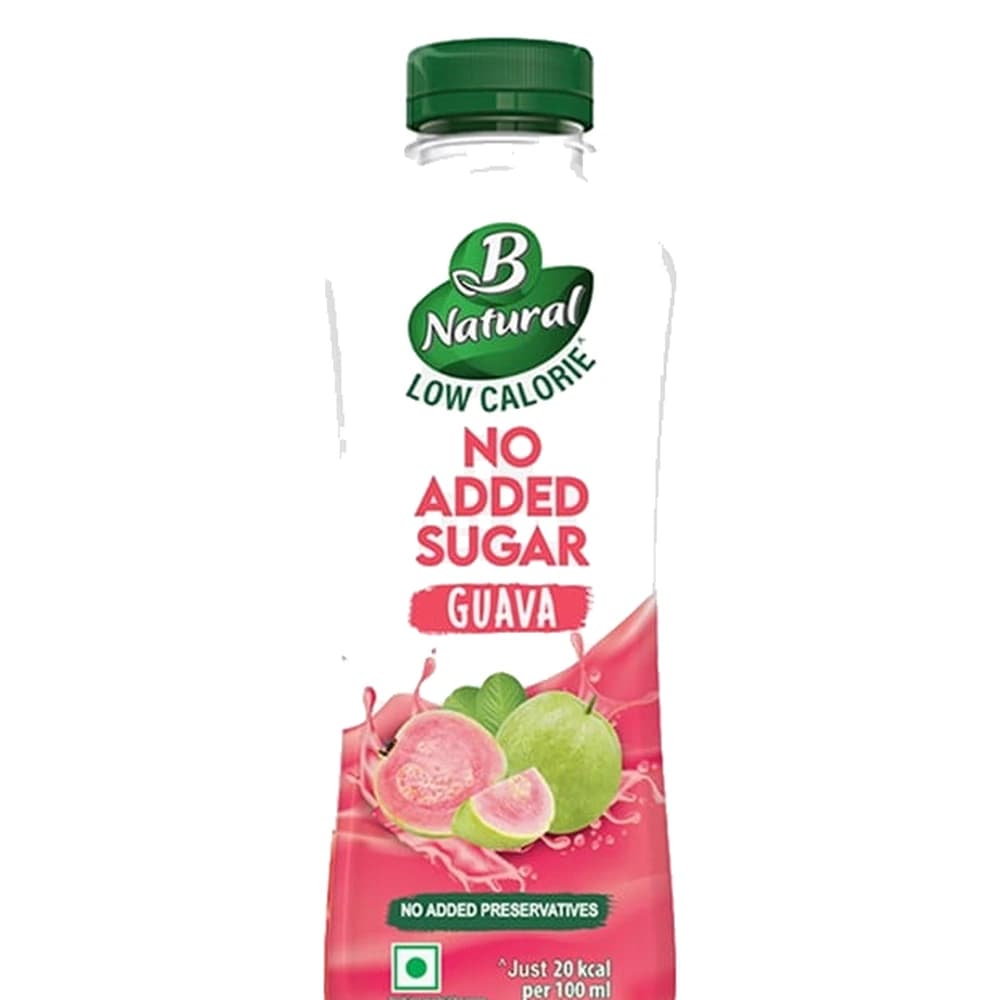
B Natural Guava Fruit Juice (No Added Sugar)
Red flags
No major red flags on the label.
Green flags
- +Green flag: No added sugar
- +Green flag: Low sodium
Ingredients, decoded
10 listed- Water
- Guava Pulp (20.3%)
- Apple Juice Concentrate (4.16%)
- Natural Flavours and Natural Flavouring Substances
- Acidity Regulators [330, 331(iii)]
- Stabilizers [466, 415]
- Vitamin
- Sweeteners [960, 955]
- Colours [150d, 124]
- Iodized Salt
Our take
CleanPlate reviewGuava drink: no added sugar, yet dyes and sweeteners
B Natural Guava Fruit Juice (No Added Sugar) is a ready-to-serve drink of water, guava pulp (20.3%) and apple juice concentrate (4.16%), with flavours, acidity regulators, stabilisers (466, 415), vitamin C, two sweeteners (960, 955), two colours (150d, 124) and salt. The 750 ml pack's panel is printed per 100 ml with a 150 ml serve.
CleanPlate scores it [F][R][L]CC2. The C for nutrition is middling: modest protein, fibre and micronutrients per 100 ml. The [F] marks that added vitamin C lifts the grade; without it it would be E. The C for ingredients reflects a mix of whole and refined ingredients (led by guava pulp and apple juice concentrate), with additives that cost points: carboxymethyl cellulose, caramel colour, sucralose and Ponceau 4R. A red flag (Southampton Six x1) cuts the score by 20%. The [L] marks a hollow label promise: the claim "No Added Sugar" does not hold: a free-sugar ingredient is listed: juice concentrate. The 2 for risk is low: sodium, free sugar and saturated fat are all modest (sodium 8 mg, free sugar 4.7 g, saturated fat 0 g per 100 ml).
Claims vs reality
What the pack says, checked against the ingredient list and nutrition panel.
- On the packMisleading
“No Added Sugar”
Apple juice concentrate (4.16%) is a sugar source, and two sweeteners are added on top.
- On the packHolds
“Low Calorie”
20 kcal per 100 ml is under the 40 kcal low-calorie line.
- On the packHolds
“No Added Preservatives”
No preservative is listed; citric acid (330) and sodium citrate (331(iii)) are acidity regulators.
- Product nameHolds
“Guava”
Guava pulp is 20.3%, the largest food ingredient after water.
How CC2 breaks down
Each grade is scored on its own. Here are the label numbers behind each one, per 100 ml.
Adequate nutrient density
- Protein
- 0.1 g
- Fibre
- 0.3 g
- Vitamins and minerals
- Vitamin C
- Energy
- 20 kcal
Scored on protein, fibre and twelve vitamins and minerals, against the Codex and FSSAI "source" and "high" levels, per 100 g and per 100 kcal.
Mixed processing and additives
- Base
- Water
- Sweeteners
- None added
- Additives
- 5
- Flagged
- None
Scored on how processed the ingredients are, which additives are used and why, and whether the label keeps its promises.
Low risk
- Added sugar
- 0 g
- Sodium
- 8 mg
Scored on free sugar, sodium, saturated fat and trans fat, each weighed by how strong the evidence of harm is.
[F] Added vitamins or minerals meaningfully lift this product's nutrition grade. Without them it would score lower.
[R] Contains an ingredient on our red-flag list (such as a partially hydrogenated oil or a flagged synthetic dye), which cuts the ingredient grade.
[L] The name or pack claims promise more than the ingredient list delivers. See Claims vs reality.
A closer look
Does the label add up?
Water, guava pulp (20.3%), apple juice concentrate (4.16%, equivalent to 28.70% reconstituted apple juice), natural flavours and natural flavouring substances, acidity regulators [330, 331(iii)], stabilizers [466, 415], vitamin, sweeteners [960, 955], colours [150d, 124] and iodized salt.
Per 100 ml: 20 kcal, 0 g fat, 4.7 g sugar of which 0 g added, 0.3 g fibre, 0.1 g protein, 8 mg sodium. Blinkit shows two label versions; the text cards for ingredients and nutrition, which match the listing (total sugar 4.7 g, fibre 0.3 g), are used, not the back-of-bottle mockup. Added sugar is printed as 0 g, but the concentrate's sugar is counted as free sugar (4.7 g per 100 ml). The vitamin in the list is read as vitamin C (10 mg per 100 ml) and counts as fortified. Net 750 ml.
Ingredients to watch
- Ponceau 4R (124)Concern
A synthetic azo dye on the Southampton list; it cuts the processing grade by 20% and costs 2 points.
- SweetenersWorth watching
Sucralose (955) costs 4 points and steviol glycosides (960) 2 points.
- Caramel colour and gumsWorth watching
Caramel colour 150d costs 4 points, cellulose gum (466) 6 and xanthan gum (415) 2.
- CaloriesFine
20 kcal per 100 ml, about 30 kcal in a 150 ml serve.
Common misconceptions
Myth: "No added sugar means just fruit"
Apple juice concentrate is a sugar source, and sucralose, stevia, two colours and two gums are added.
Myth: "A low-calorie fruit drink is light on additives"
Nine additives are listed, including a dye on the Southampton list.
How often, and how
- Healthy adultsA few times a week
- ChildrenOccasionally
- Diabetes or prediabetesSmall amounts, mind the sweeteners
Smarter ways to eat it
Pick a short list
Whole guava, or a drink with only fruit and water, avoids the sweeteners and colours.
Keep to one serve
A 150 ml serve is about 30 kcal, so the 750 ml bottle is five serves.
Common questions
Is B Natural Guava Fruit Juice (No Added Sugar) healthy?
B Natural Guava Fruit Juice (No Added Sugar) scores CC2 (Good) on CleanPlate, which makes it a reasonable choice with a trade-off or two worth knowing about. We found no major red flags on its label. On the plus side: No added sugar; Low sodium.
What does the CC2 score mean?
The first letter (C) grades nutritional value: adequate nutrient density. The second letter (C) grades ingredient and label integrity: mixed processing and additives. The number (2) grades risk nutrients (sugar, sodium, saturated fat): low risk. The [F] means added vitamins or minerals meaningfully lift the nutrition grade.
Last reviewed October 19, 2026. Scored with the CleanPlate method from the published label.