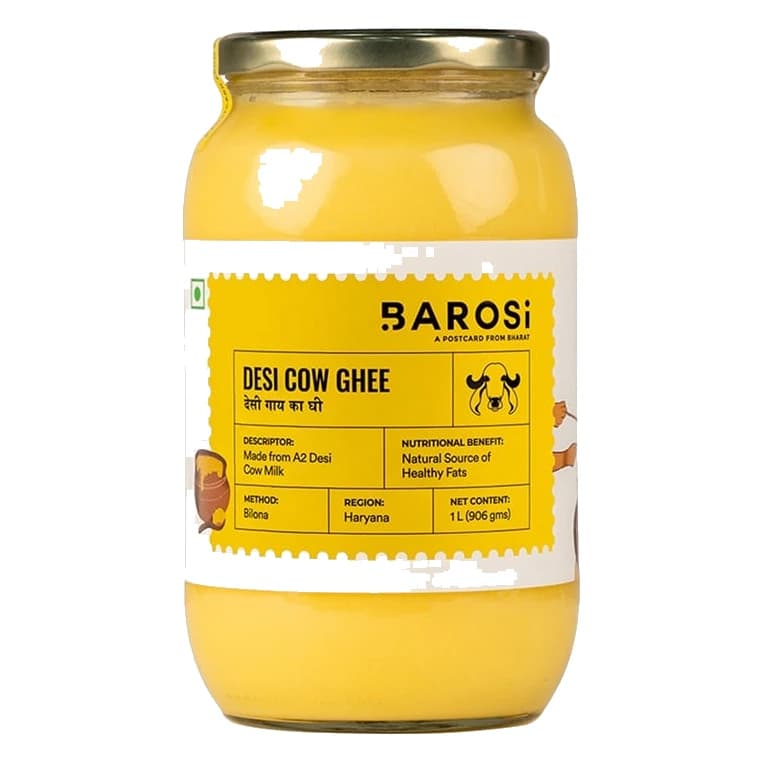
Barosi Desi Cow A2 Ghee
Red flags
- −Red flag: High saturated fat (73.8g)
Green flags
- +Green flag: No added sugar
- +Green flag: Low sodium
- +Green flag: No additives
Ingredients, decoded
1 listed- A2 Desi Cow Milk Fat
Our take
CleanPlate reviewPure milk fat, three-quarters of it saturated
Barosi Desi Cow A2 Ghee lists one ingredient, A2 desi cow milk fat. The jar is 1 L (906 g) and the panel is printed per 100 g, with a 15 g serve column.
CleanPlate scores it CB5. The C for nutrition is middling: some vitamin A per 100 g. The B for ingredients reflects mostly refined or industrial ingredients (led by A2 desi cow milk fat), and almost no additives. The 5 for risk comes mainly from saturated fat (73.8 g per 100 g) and calories (900 kcal per 100 g).
Claims vs reality
What the pack says, checked against the ingredient list and nutrition panel.
- On the packBe careful
“Made from A2 Desi Cow Milk”
A2 describes a milk protein variant, and the panel shows 0 g of protein, so the A2 point has little to act on in a pure fat.
- On the packPartly true
“Natural Source of Healthy Fats”
Monounsaturated fat is 24.6 g and polyunsaturated 1.6 g per 100 g, against 73.8 g of saturated fat.
- On the packBe careful
“Reduces LDL & Increases HDL”
The pack gives no study. Saturated fat, 73.8 g per 100 g here, is the kind that raises LDL.
- On the packPartly true
“Source of Omega 3, 6, 9 fatty acids”
Omega-9 (monounsaturated) is 24.6 g per 100 g, but the panel prints no omega-3 value and only 1.6 g of polyunsaturated fat in all.
How CB5 breaks down
Each grade is scored on its own. Here are the label numbers behind each one, per 100 g.
Adequate nutrient density
- Protein
- 0 g
- Fibre
- Not declared
- Vitamins and minerals
- Vitamin A
- Energy
- 900 kcal
Scored on protein, fibre and twelve vitamins and minerals, against the Codex and FSSAI "source" and "high" levels, per 100 g and per 100 kcal.
Good, few concerning additives
- Base
- A2 Desi Cow Milk Fat
- Main fat
- A2 Desi Cow Milk Fat
- Sweeteners
- None added
- Additives
- 0
- Flagged
- None
Scored on how processed the ingredients are, which additives are used and why, and whether the label keeps its promises.
Very high risk
- Added sugar
- 0 g
- Sodium
- 0 mg
- Saturated fat
- 73.8 g
Scored on free sugar, sodium, saturated fat and trans fat, each weighed by how strong the evidence of harm is.
A closer look
Does the label add up?
A2 desi cow milk fat, a single ingredient.
Per 100 g: 900 kcal, 99.9 g fat of which 73.8 g saturated, 0 g sugar of which 0 g added, 0 g protein, 0 mg sodium. The listing showed different values (energy 897 kcal, saturated fat 66.71 g); the pack panel is used. Trans fat is printed as less than 0.01 g and is scored as zero.
Ingredients to watch
- Saturated fatConcern
73.8 g per 100 g, almost 15 times the 5 g high line; a teaspoon (5 g) carries about 3.7 g.
- CaloriesConcern
900 kcal per 100 g, about 45 kcal in a teaspoon.
- Vitamin AFine
1,021 mcg per 100 g is the only micronutrient printed, and it earns the nutrition grade its credit.
- IngredientsFine
One ingredient, no additives, nothing to flag in the list.
Common misconceptions
Myth: "Ghee is pure, so it can be eaten freely"
Pure only means nothing else is added. Saturated fat is 73.8 g per 100 g, so it works as a measured cooking fat, not a free food.
Myth: "Bilona ghee has less saturated fat"
The method changes flavour, not the fat count: the panel prints 73.8 g of saturated fat per 100 g.
How often, and how
- Healthy adultsA teaspoon or two a day
- ChildrenA teaspoon a day
- Diabetes or prediabetesSmall amounts, watch the portion
Smarter ways to eat it
Measure it
Use a teaspoon (5 g) rather than pouring: that is about 45 kcal and 3.7 g of saturated fat.
Mix your fats
Cook with a little ghee for flavour and use a plain vegetable oil for the rest.
Common questions
Is Barosi Desi Cow A2 Ghee healthy?
Barosi Desi Cow A2 Ghee scores CB5 (Poor) on CleanPlate, which makes it best kept as a rare treat rather than a regular buy. The main concerns are: High saturated fat (73.8g). On the plus side: No added sugar; Low sodium; No additives.
What does the CB5 score mean?
The first letter (C) grades nutritional value: adequate nutrient density. The second letter (B) grades ingredient and label integrity: good, few concerning additives. The number (5) grades risk nutrients (sugar, sodium, saturated fat): very high risk.
Last reviewed October 15, 2026. Scored with the CleanPlate method from the published label.
More Butter & Dairy Spreads
All 7 →- Mother Dairy Cow Ghee
- +Green flag: No additives
- Paras Desi Ghee
- −Red flag: High saturated fat (66g)
- +Green flag: No added sugar
- Amul Salted Butter
- −Red flag: High sodium (836mg per 100g)
- −Red flag: High saturated fat (61g)
- Gowardhan Cow Ghee
- −Red flag: High saturated fat (64g)
- −Red flag: Contains trans fat (4g)