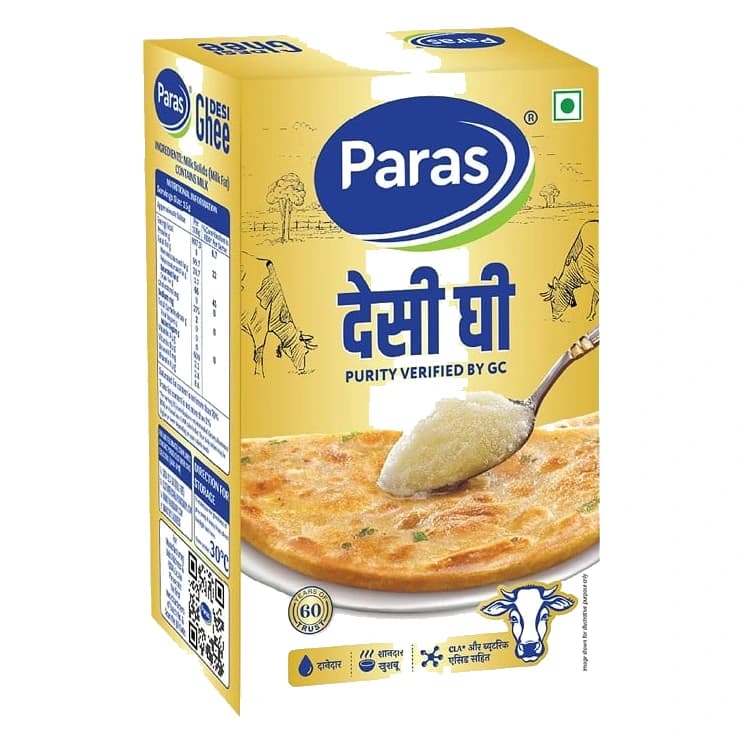
Paras Desi Ghee
Red flags
- −Red flag: High saturated fat (66g)
Green flags
- +Green flag: No added sugar
- +Green flag: Low sodium
- +Green flag: No additives
Ingredients, decoded
1 listed- Milk Solids (Milk Fat)
Our take
CleanPlate reviewGhee with four vitamins declared and 66 g saturated fat
Paras Desi Ghee lists one ingredient, milk solids (milk fat), in a 450 ml pack (405 g). The panel is printed per 100 g.
CleanPlate scores it CB5. The C for nutrition is middling: some vitamin A and vitamin D per 100 g. The B for ingredients reflects mostly refined or industrial ingredients (led by milk fat), and almost no additives. The 5 for risk comes mainly from saturated fat (66 g per 100 g) and calories (897 kcal per 100 g).
Claims vs reality
What the pack says, checked against the ingredient list and nutrition panel.
- On the packPartly true
“Purity verified by GC”
Gas chromatography is a lab test for fat purity, but the pack prints no result.
- On the packPartly true
“CLA* and stearic acid included”
Both are real components of milk fat, but the panel gives no amount of either.
- On the packHolds
“Saturated Fat content is not more than 70%”
Saturated fat is 66 g in 99.7 g of fat, about 66% of the fat.
- On the packHolds
“Trans Fat content is not more than 2%”
The panel prints trans fat as 0 g per 100 g.
How CB5 breaks down
Each grade is scored on its own. Here are the label numbers behind each one, per 100 g.
Adequate nutrient density
- Protein
- 0 g
- Fibre
- Not declared
- Vitamins and minerals
- 4 declared
- Energy
- 897 kcal
Scored on protein, fibre and twelve vitamins and minerals, against the Codex and FSSAI "source" and "high" levels, per 100 g and per 100 kcal.
Good, few concerning additives
- Base
- Milk Solids
- Main fat
- Milk Solids
- Sweeteners
- None added
- Additives
- 0
- Flagged
- None
Scored on how processed the ingredients are, which additives are used and why, and whether the label keeps its promises.
Very high risk
- Added sugar
- 0 g
- Sodium
- 2 mg
- Saturated fat
- 66 g
- Trans fat
- 0 g
Scored on free sugar, sodium, saturated fat and trans fat, each weighed by how strong the evidence of harm is.
A closer look
Does the label add up?
Milk solids (milk fat), a single ingredient.
Per 100 g: 897 kcal, 99.7 g fat of which 66 g saturated, 0 g sugar of which 0 g added, 0 g protein, 2 mg sodium. Only one panel is printed and its digits are small, so nutrition confidence is medium. The listing differs (saturated fat 58 g, trans fat 3 g, vitamin D 1.8 mcg); the pack panel is used. The pack's milk solids are the milk fat itself, so it is scored as milk fat like other ghee.
Ingredients to watch
- Saturated fatConcern
66 g per 100 g, over 13 times the 5 g high line.
- CaloriesConcern
897 kcal per 100 g, about 45 kcal in a teaspoon.
- VitaminsFine
Vitamins A, D, E and K are all declared and earn the full micronutrient credit.
- IngredientsFine
One ingredient and no additives.
Common misconceptions
Myth: "Ghee has no cholesterol"
The panel prints 275 mg of cholesterol per 100 g.
Myth: "A teaspoon of ghee makes no difference"
A teaspoon (5 g) carries about 3.3 g of saturated fat and 45 kcal, and the amount adds up with each use.
How often, and how
- Healthy adultsA teaspoon or two a day
- ChildrenA teaspoon a day
- Diabetes or prediabetesSmall amounts, watch the portion
Smarter ways to eat it
Use a teaspoon
One teaspoon is about 45 kcal.
Mix with oil
Cook with a small spoon of ghee and keep the rest of the fat to a plain oil.
Common questions
Is Paras Desi Ghee healthy?
Paras Desi Ghee scores CB5 (Poor) on CleanPlate, which makes it best kept as a rare treat rather than a regular buy. The main concerns are: High saturated fat (66g). On the plus side: No added sugar; Low sodium; No additives.
What does the CB5 score mean?
The first letter (C) grades nutritional value: adequate nutrient density. The second letter (B) grades ingredient and label integrity: good, few concerning additives. The number (5) grades risk nutrients (sugar, sodium, saturated fat): very high risk.
Last reviewed October 15, 2026. Scored with the CleanPlate method from the published label.
More Butter & Dairy Spreads
All 7 →- Barosi Desi Cow A2 Ghee
- −Red flag: High saturated fat (73.8g)
- +Green flag: No added sugar
- Mother Dairy Cow Ghee
- +Green flag: No additives
- Amul Salted Butter
- −Red flag: High sodium (836mg per 100g)
- −Red flag: High saturated fat (61g)
- Gowardhan Cow Ghee
- −Red flag: High saturated fat (64g)
- −Red flag: Contains trans fat (4g)