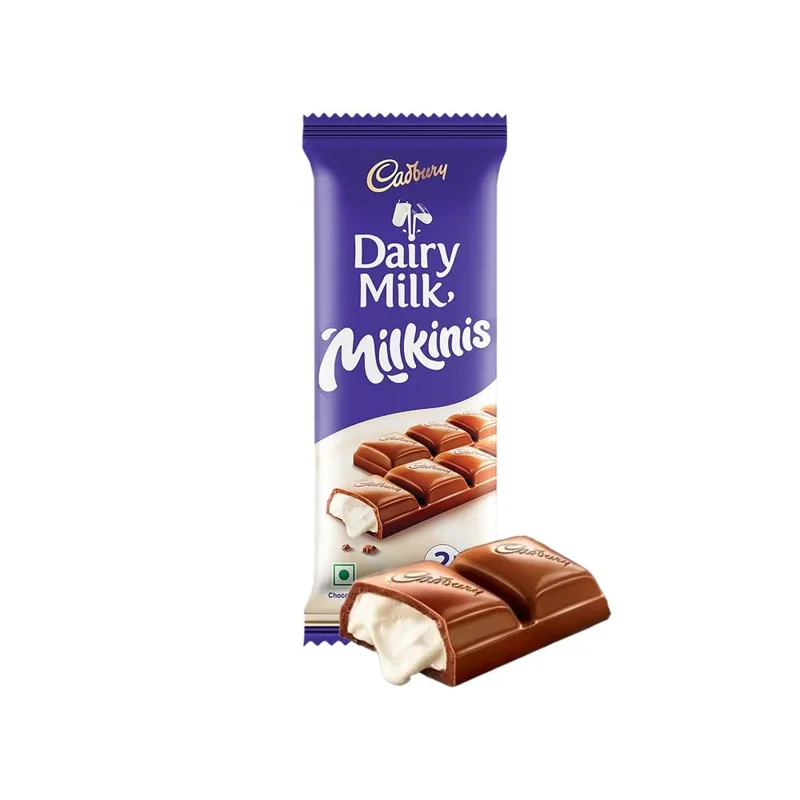
Cadbury Dairy Milk Milkinis Milk Chocolate Bar
Red flags
- −Red flag: High added sugar (42.8g per 100g)
- −Red flag: High saturated fat (17.5g)
Green flags
- +Green flag: Source of protein (8.7g)
Ingredients, decoded
2 listed- Milk Chocolate (60%) (Sugar, Milk Solids (11%), Cocoa Butter, Cocoa Solids, Fractionated Fat, Emulsifiers (442,476), Flavours (Natural, Nature Identical and Artificial (Caramel and Vanilla) Flavouring Substances))
- Centre Filling (40%) (Milk Solids (16%), Sugar, Fractionated fat, Palm Superolein, Emulsifiers (442,476), Flavours (Nature Identical Flavouring Substance))
EB5
Our take
CleanPlate reviewTwo layers of milk chocolate, mostly sugar and fat
Cadbury Dairy Milk Milkinis is a filled chocolate: a milk chocolate shell (60%) and a centre filling (40%), both built on sugar, milk solids, cocoa butter and fractionated fat, with emulsifiers (442, 476), caramel and vanilla flavouring and cocoa butter equivalent. The pack is 34 g and the panel is printed per 100 g.
CleanPlate scores it EB5. The E for nutrition is low: almost no credited protein, fibre or micronutrients per 100 g; its 8.7 g of protein earns no credit because it is under 2.75 g per 100 kcal. The B for ingredients reflects mostly refined or industrial ingredients (led by sugar, milk solids and cocoa butter), with additives that cost points: flavouring, ammonium phosphatides and PGPR. The 5 for risk comes mainly from saturated fat (17.5 g per 100 g) and free sugar (42.8 g per 100 g).
Claims vs reality
What the pack says, checked against the ingredient list and nutrition panel.
- On the packHolds
“Filled Chocolate”
The list shows a milk chocolate shell (60%) around a centre filling (40%).
How EB5 breaks down
Each grade is scored on its own. Here are the label numbers behind each one, per 100 g.
Very low nutrient density
- Protein
- 8.7 g
- Fibre
- Not declared
- Vitamins and minerals
- None declared
- Energy
- 540 kcal
Scored on protein, fibre and twelve vitamins and minerals, against the Codex and FSSAI "source" and "high" levels, per 100 g and per 100 kcal.
Good, few concerning additives
- Base
- Milk Chocolate, Cocoa Butter,...
- Main fat
- Milk Chocolate, Cocoa B...
- Sweeteners
- Milk Chocolate, C..., Centre Filling, S...
- Additives
- 2
- Flagged
- None
- Artificial flavour or colour
- Yes
Scored on how processed the ingredients are, which additives are used and why, and whether the label keeps its promises.
Very high risk
- Added sugar
- 42.8 g
- Sodium
- 124.2 mg
- Saturated fat
- 17.5 g
- Trans fat
- 0.2 g
Scored on free sugar, sodium, saturated fat and trans fat, each weighed by how strong the evidence of harm is.
A closer look
Does the label add up?
Milk chocolate (60%): sugar, milk solids (11%), cocoa butter, cocoa solids, fractionated fat, emulsifiers (442, 476) and flavours; centre filling (40%): milk solids (16%), sugar, fractionated fat, palm superolein, emulsifiers and flavouring; contains cocoa butter equivalent in addition to cocoa butter.
Per 100 g: 540 kcal, 31 g fat of which 17.5 g saturated, 54.7 g sugar of which 42.8 g added, 8.7 g protein, 124 mg sodium. The pack panel is used. The Blinkit listing disagrees (547 kcal, total sugar 52.7 g, protein 9.7 g, saturated fat 20 g, sodium 170 mg); the pack printed 540 kcal, 54.7 g, 8.7 g, 17.5 g and 124.2 mg.
Ingredients to watch
- Free sugarConcern
42.8 g of added sugar per 100 g.
- Saturated fatConcern
17.5 g per 100 g, from cocoa butter, fractionated fat and palm superolein.
- Emulsifiers and flavouringWorth watching
Ammonium phosphatides (442), PGPR (476) and flavouring cost points.
- Real milk solidsFine
Milk solids are 11% of the shell and 16% of the filling.
Common misconceptions
Myth: "Milk chocolate is mostly milk"
Sugar leads the shell, and milk solids are only 11% of the shell and 16% of the filling.
Myth: "A small bar is harmless"
At 34 g the pack is about 184 kcal, with about 14.6 g of added sugar in one bar.
How often, and how
- Healthy adultsOccasionally
- ChildrenRarely
- Diabetes or prediabetesLimit
Smarter ways to eat it
Share the bar
Eat one of the two bars and keep the other for tomorrow.
Try dark chocolate
A 70% dark bar has far less sugar per square.
Common questions
Is Cadbury Dairy Milk Milkinis Milk Chocolate Bar healthy?
Cadbury Dairy Milk Milkinis Milk Chocolate Bar scores EB5 (Poor) on CleanPlate, which makes it best kept as a rare treat rather than a regular buy. The main concerns are: High added sugar (42.8g per 100g); High saturated fat (17.5g). On the plus side: Source of protein (8.7g).
What does the EB5 score mean?
The first letter (E) grades nutritional value: very low nutrient density. The second letter (B) grades ingredient and label integrity: good, few concerning additives. The number (5) grades risk nutrients (sugar, sodium, saturated fat): very high risk.
Last reviewed October 11, 2026. Scored with the CleanPlate method from the published label.
Better Chocolates
All 17 →- CA5The Whole Truth Rich 71% Cocoa Bar
- −Red flag: High added sugar (19.2g per 100g)
- −Red flag: High saturated fat (31.2g)
Poor - EB4Amul Almondbar Milk Chocolate Bar
- −Red flag: High added sugar (39.4g per 100g)
- −Red flag: High saturated fat (7.4g)
Poor - EB4Amul Sugar Free Dark Chocolate Bar
- −Red flag: High saturated fat (20.7g)
- +Green flag: Source of protein (6g)
Poor