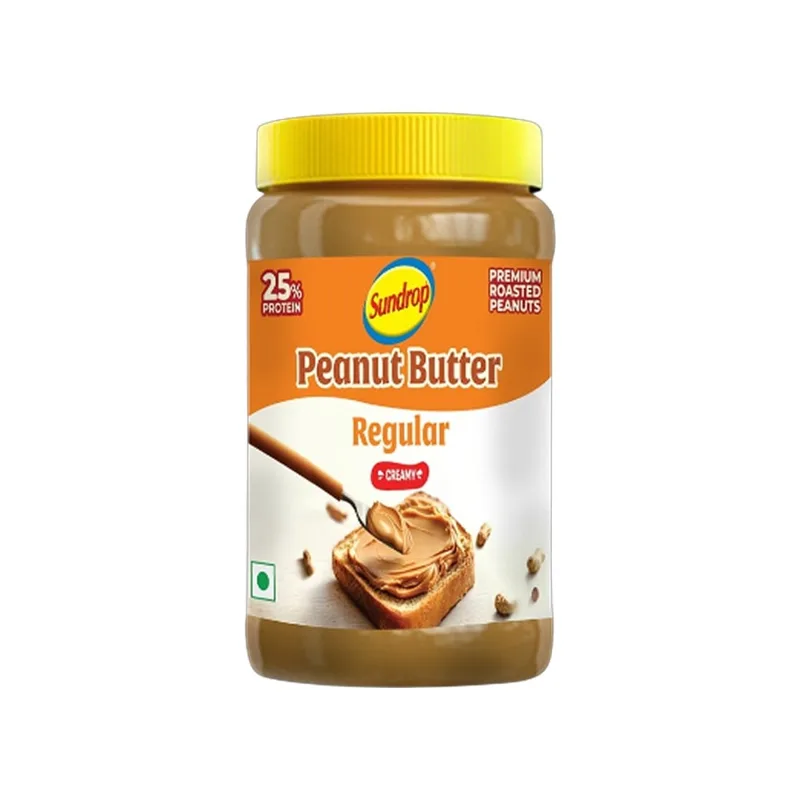
Sundrop Creamy Peanut Butter
Red flags
- −Red flag: Contains Hydrogenated Vegetable Oil
- −Red flag: High saturated fat (8.2g)
Green flags
- +Green flag: High protein (25g per 100g)
- +Green flag: Source of fibre
Ingredients, decoded
5 listed- Roasted Peanuts (90.8%)
- Sugar
- Hydrogenated Vegetable Oil
- Refined Edible Groundnut Oil
- Iodized Salt
CC3
Our take
CleanPlate review90% peanuts, but with hydrogenated oil added
Sundrop Creamy Peanut Butter is made of roasted peanuts (90.8%), sugar, hydrogenated vegetable oil, refined groundnut oil and iodised salt. The pack is 924 g and the panel is printed per 100 g with a 30 g serving.
CleanPlate scores it [R]CC3. The C for nutrition is middling: 25 g protein and 5 g fibre per 100 g. The C for ingredients reflects whole or lightly processed ingredients (led by roasted peanuts, sugar and hydrogenated vegetable oil), and almost no additives. A red flag (hydrogenated fat / vanaspati (unqualified)) cuts the score by 40%. The 3 for risk comes mainly from saturated fat (8.2 g per 100 g) and sodium (310 mg per 100 g).
Claims vs reality
What the pack says, checked against the ingredient list and nutrition panel.
- On the packHolds
“25% Protein”
The panel declares 25 g of protein per 100 g, above the 11 g line for a high-protein claim.
- On the packHolds
“Source of Dietary Fibre”
The panel declares 5 g of fibre per 100 g, above the 3 g line.
- On the packHolds
“Good Fats*”
Monounsaturated and polyunsaturated fat total 44.2 g of the 52.4 g of fat; the star says high in unsaturated fats.
- On the packBe careful
“Trans Fatty Acid 0.0”
The list shows hydrogenated vegetable oil with no qualifier, so a 0.0 g figure cannot be taken at face value.
How CC3 breaks down
Each grade is scored on its own. Here are the label numbers behind each one, per 100 g.
Adequate nutrient density
- Protein
- 25 g
- Fibre
- 5 g
- Vitamins and minerals
- None declared
- Energy
- 637 kcal
Scored on protein, fibre and twelve vitamins and minerals, against the Codex and FSSAI "source" and "high" levels, per 100 g and per 100 kcal.
Mixed processing and additives
- Base
- Roasted Peanuts
- Main fat
- Hydrogenated Vegetable...
- Sweeteners
- Sugar
- Additives
- 0
- Flagged
- Hydrogenated Vegetable Oil
Scored on how processed the ingredients are, which additives are used and why, and whether the label keeps its promises.
Moderate risk
- Added sugar
- 6.7 g
- Sodium
- 310 mg
- Saturated fat
- 8.2 g
- Trans fat
- 0 g
Scored on free sugar, sodium, saturated fat and trans fat, each weighed by how strong the evidence of harm is.
[R] Contains an ingredient on our red-flag list (such as a partially hydrogenated oil or a flagged synthetic dye), which cuts the ingredient grade.
A closer look
Does the label add up?
Roasted peanuts (90.8%), sugar, hydrogenated vegetable oil, refined edible groundnut oil and iodised salt.
Per 100 g: 637 kcal, 52.4 g fat of which 8.2 g saturated, 8.9 g sugar of which 6.7 g added, 5 g fibre, 25 g protein, 310 mg sodium. The unqualified hydrogenated oil means the declared 0 g trans fat is not accepted, and the score is provisional until the maker confirms. Added sugar is 6.7 g per 100 g.
Ingredients to watch
- Hydrogenated oilConcern
Listed with no qualifier; scored as partially hydrogenated, which cuts the Ingredients score by 40%.
- Added sugarWorth watching
6.7 g per 100 g.
- CaloriesWorth watching
637 kcal per 100 g, about 191 kcal in a 30 g serving.
- Peanuts firstFine
Peanuts are 90.8%, with 25 g of protein and 5 g of fibre per 100 g.
Common misconceptions
Myth: "Zero trans fat on the label means no hydrogenated oil"
The list shows hydrogenated vegetable oil; the declared figure is a rounded panel value.
Myth: "Peanut butter is a protein food, so any amount is fine"
A 30 g serve is 191 kcal; protein is 7.5 g.
How often, and how
- Healthy adultsA few times a week
- ChildrenOccasionally
- Diabetes or prediabetesOccasionally, watch the sugar
Smarter ways to eat it
Choose a peanuts-only jar
Look for a list of peanuts and salt, with no hydrogenated oil.
Spread thin
Keep to a 30 g serve on toast or fruit.
Common questions
Is Sundrop Creamy Peanut Butter healthy?
Sundrop Creamy Peanut Butter scores CC3 (Fair) on CleanPlate, which makes it an occasional-use product, where the concerns start to outweigh the positives. The main concerns are: Contains Hydrogenated Vegetable Oil; High saturated fat (8.2g). On the plus side: High protein (25g per 100g); Source of fibre.
What does the CC3 score mean?
The first letter (C) grades nutritional value: adequate nutrient density. The second letter (C) grades ingredient and label integrity: mixed processing and additives. The number (3) grades risk nutrients (sugar, sodium, saturated fat): moderate risk.
Which ingredients in Sundrop Creamy Peanut Butter should I watch?
Hydrogenated Vegetable Oil (Hydrogenated Vegetable Oil).
Last reviewed October 11, 2026. Scored with the CleanPlate method from the published label.
Better Nut Butters
All 5 →- CA2Pintola All Natural Creamy Peanut Butter (Unsweetened)
- −Red flag: High saturated fat (7g)
- +Green flag: High protein (30g per 100g)
Good - CA2Pintola All Natural Crunchy Peanut Butter
- −Red flag: High saturated fat (7g)
- +Green flag: High protein (30g per 100g)
Good - CA3MyFitness High Protein Chocolate Crunchy Peanut Butter Spread
- −Red flag: High saturated fat (14.3g)
- +Green flag: High protein (26.8g per 100g)
Good