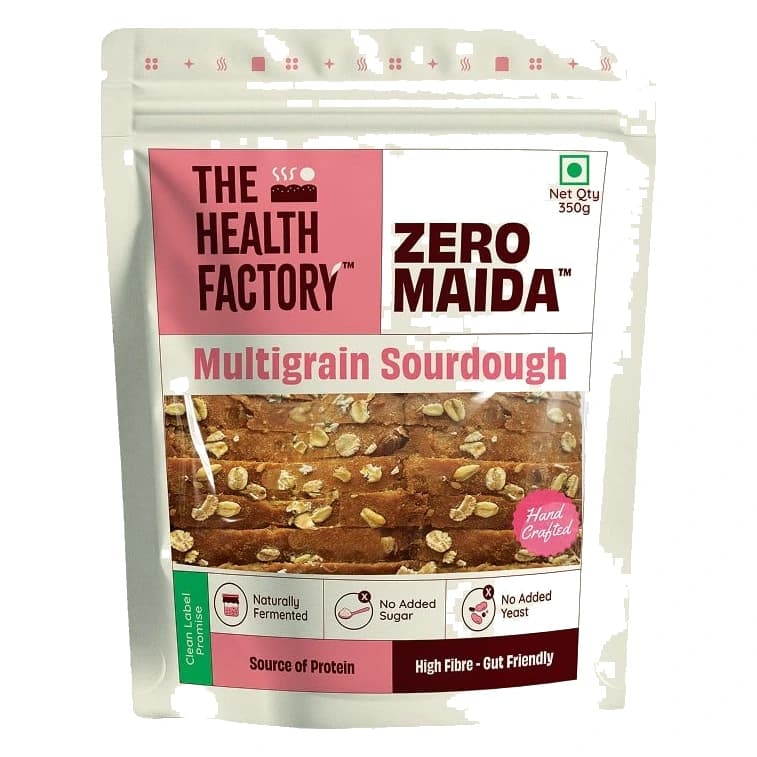
The Health Factory Zero Maida Multigrain Sourdough
Red flags
No major red flags on the label.
Green flags
- +Green flag: High protein (12.2g per 100g)
- +Green flag: High fibre (10.1g)
- +Green flag: No added sugar
Ingredients, decoded
5 listed- Chakki Fresh Atta
- Multigrain Seed Mix (Rolled Oats, Barley Flakes, Flax Seeds, Sunflower Seeds, White Sesame Seeds, Soya Bean Seed Grits, Watermelon Seeds)
- Wheat Gluten
- Olive Oil (Edible Vegetable Oil)
- Iodised Salt
Our take
CleanPlate reviewMultigrain sourdough: five ingredients, 10 g fibre
The Health Factory Zero Maida Multigrain Sourdough is a 350 g loaf made from chakki atta, a multigrain seed mix (oats, barley, flax, sunflower, sesame, soya, watermelon seeds), wheat gluten, olive oil and iodised salt. The panel is printed per 100 g with a 64 g serve (two slices).
CleanPlate scores it CA2. The C for nutrition is middling: 12.2 g protein and 10.1 g fibre per 100 g. The A for ingredients reflects whole or lightly processed ingredients (led by chakki fresh atta, rolled oats and barley flakes), and almost no additives. The 2 for risk is low: sodium, free sugar and saturated fat are all modest (sodium 417 mg, free sugar 0 g, saturated fat 0.71 g per 100 g).
Claims vs reality
What the pack says, checked against the ingredient list and nutrition panel.
- On the packHolds
“Zero Maida”
The flour is chakki atta and no refined flour is listed.
- On the packHolds
“No Added Sugar”
No sugar is listed and the panel prints 0 g added sugar.
- On the packHolds
“No Added Yeast”
No yeast is listed.
- On the packPartly true
“Naturally Fermented”
The list names no starter or culture, so the fermentation is not itemised.
How CA2 breaks down
Each grade is scored on its own. Here are the label numbers behind each one, per 100 g.
Adequate nutrient density
- Protein
- 12.2 g
- Fibre
- 10.1 g
- Vitamins and minerals
- None declared
- Energy
- 269 kcal
Scored on protein, fibre and twelve vitamins and minerals, against the Codex and FSSAI "source" and "high" levels, per 100 g and per 100 kcal.
Clean, minimally processed
- Base
- Chakki Fresh Atta
- Main fat
- Olive Oil
- Sweeteners
- None added
- Additives
- 0
- Flagged
- None
Scored on how processed the ingredients are, which additives are used and why, and whether the label keeps its promises.
Low risk
- Added sugar
- 0 g
- Sodium
- 417 mg
- Saturated fat
- 0.71 g
- Trans fat
- 0 g
Scored on free sugar, sodium, saturated fat and trans fat, each weighed by how strong the evidence of harm is.
A closer look
Does the label add up?
Chakki fresh atta, multigrain seed mix (rolled oats, barley flakes, flax seeds, sunflower seeds, white sesame seeds, soya bean seed grits, watermelon seeds), wheat gluten, olive oil and iodised salt.
Per 100 g: 269 kcal, 4.46 g fat of which 0.71 g saturated, 2.36 g sugar of which 0 g added, 10.1 g fibre, 12.2 g protein, 417 mg sodium. The back and the flat render of the panel match exactly. The listing says Chakki Atta and a 250 g net weight; the pack says Chakki Fresh Atta and 350 g, and the pack is used. The seed-mix shares are not printed.
Ingredients to watch
- SodiumWorth watching
417 mg per 100 g.
- Fibre and proteinFine
10.1 g fibre and 12.2 g protein per 100 g.
- IngredientsFine
Five ingredient groups with no additive or added sugar.
Common misconceptions
Myth: "Sourdough has no yeast"
True here: no yeast is listed, though the starter is not itemised.
Myth: "Sourdough is gluten free"
Wheat gluten is listed.
How often, and how
- Healthy adultsMost days
- ChildrenMost days
- Diabetes or prediabetesFine in moderation
Smarter ways to eat it
Toast it
Good with eggs or hung curd.
Slice and freeze
Keeps without a preservative.
Common questions
Is The Health Factory Zero Maida Multigrain Sourdough healthy?
The Health Factory Zero Maida Multigrain Sourdough scores CA2 (Good) on CleanPlate, which makes it a reasonable choice with a trade-off or two worth knowing about. We found no major red flags on its label. On the plus side: High protein (12.2g per 100g); High fibre (10.1g); No added sugar.
What does the CA2 score mean?
The first letter (C) grades nutritional value: adequate nutrient density. The second letter (A) grades ingredient and label integrity: clean, minimally processed. The number (2) grades risk nutrients (sugar, sodium, saturated fat): low risk.
Last reviewed October 19, 2026. Scored with the CleanPlate method from the published label.