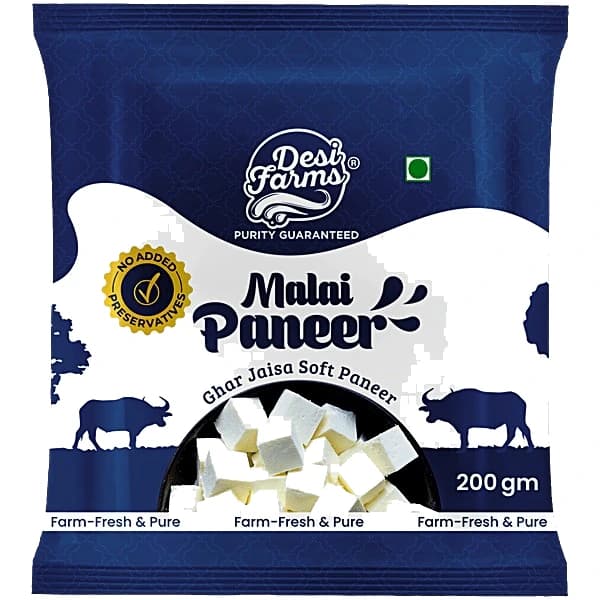
Desi Farms Malai Paneer
Published
Desi Farms Malai Paneer is a rich paneer made from just milk and citric acid. It scores [L]BA3: nutrition is solid on protein and calcium, ingredients are as short and clean as they come, but a low-fat mention on the back costs label points, and risk is moderate because of the saturated fat. Fine a few times a week in modest portions.
Ingredients, decoded
2 listed- Milk & Milk Solids
- Citric Acid
1 teaspoon of sugar in every 100 g · 4.5 g total sugar, 5 g a teaspoon
| Energy | 314 kcal |
|---|---|
| Protein | 20 g |
| Carbohydrates | 4.5 g |
| Total sugars | 4.5 g |
| Added sugars | 0 g |
| Total fat | 25 g |
| Saturated fat | 15 g |
| Trans fat | 0 g |
| Cholesterol | 65 mg |
| Sodium | 22 mg |
| Calcium | 480 mg |
Think this score is wrong?
What to know about Desi Farms Malai Paneer
Two-ingredient paneer, 20 g protein, 15 g saturated fat
Desi Farms Malai Paneer is a 200 g block of fresh paneer made from milk and milk solids, set with citric acid. It is bought by home cooks who want a soft, ready-to-cut paneer for curries, bhurji and grills, and it is sold chilled with a 0 to 4 degree storage instruction.
A 50 g serve, the size printed on the pack, gives about 157 kcal, 10 g protein, 12.5 g fat and 240 mg calcium. Per 100 g that is 314 kcal, 20 g protein, 25 g fat, 15 g saturated fat and only 22 mg sodium, with no added sugar.
The pack promises purity and no preservatives, and the short list backs that up. The back panel also pushes a Low Fat Paneer range, while this block has 25 g fat per 100 g, and that wording is what sets the [L] flag. CleanPlate scores it [L]BA3.
Does Desi Farms Malai Paneer live up to its claims?
The no-preservatives, calcium and protein claims hold. The back-panel Low Fat Paneer wording does not suit a block with 25 g fat per 100 g, and that sets the [L].
- On the packMisleading
“Try our Low Fat Paneer”
The back panel talks up a Low Fat Paneer range, but this block has 25 g fat per 100 g, over the low-fat line, so the wording loses label points.
- On the packHolds
“No Preservatives Added”
Only citric acid is listed besides the milk, and it is used as an acidifier. No preservative is named.
- On the packBe careful
“Farm-Fresh & Pure”
The list is short, just milk and citric acid. Purity and freshness are not something the label numbers can show.
- On the packHolds
“Calcium 24% RDA per 100 g”
The panel shows 480 mg calcium per 100 g, so about 240 mg in a 50 g serve.
- On the packHolds
“Protein 20% RDA per 100 g”
The panel shows 20 g protein per 100 g, so 10 g in a 50 g serve.
Why Desi Farms Malai Paneer scores [L]BA3
Nutrition is a B on 20 g protein and 480 mg calcium per 100 g. Ingredients are an A on a milk-and-citric-acid list, held back by the low-fat wording. Risk is a 3 on 15 g saturated fat.
Good nutrient density
- Protein
- 20 g
- Fibre
- Not declared
- Vitamins and minerals
- Calcium
- Energy
- 314 kcal
01 Nutrition density: why B
Protein is 20 g per 100 g, about a quarter of the calories, and the pack lists no other protein source than the milk itself. A 50 g serve gives 10 g protein.
Calcium is declared at 480 mg per 100 g, which earns the micronutrient credit and lifts the grade. No other vitamins or minerals are declared.
Scored on protein, fibre and twelve vitamins and minerals, against the Codex and FSSAI "source" and "high" levels, per 100 g and per 100 kcal. Protein also has to supply at least 12.5% of the calories to count, and 25% for full credit.
Clean, minimally processed
- Base
- Milk & Milk Solids
- Sweeteners
- None added
- Additives
- 1
- Flagged
- None
02 Ingredient integrity: why A
The list is two items: milk and milk solids, then citric acid. Citric acid is the only additive and it costs no ingredient points, so the base score is near the top.
The back panel points shoppers to a Low Fat Paneer range, while this block has 25 g fat per 100 g, well over the low-fat line. That costs label points and sets the [L] flag, but the ingredients stay in the A band.
Scored on how processed the ingredients are, which additives are used and why, and whether the label keeps its promises.
Moderate risk
- Added sugar
- 0 g
- Sodium
- 22 mg
- Saturated fat
- 15 g
- Trans fat
- 0 g
03 Load risk: why 3
Saturated fat drives the risk number: 15 g per 100 g, three times the 5 g high line. One 50 g serve has about 7.5 g.
Energy at 314 kcal per 100 g adds a little. Sodium is only 22 mg per 100 g, added sugar is 0 g and trans fat is 0 g, so none of those add to the risk.
Scored on free sugar, sodium, saturated fat and trans fat, each weighed by how strong the evidence of harm is.
[L] The name or pack claims promise more than the ingredient list delivers. See Claims vs reality.
Red flags
- −Red flag: High saturated fat (15g)
Green flags
- +Green flag: High protein (20g per 100g)
- +Green flag: No added sugar
- +Green flag: Low sodium
What's in Desi Farms Malai Paneer?
Milk and milk solids come first, followed by citric acid, a common acidifier used to set paneer. The saturated fat from the milk is what to watch.
The ingredient list, read for you
Milk and milk solids lead the list and make up the whole block, with citric acid added to set the curd. No percentages are declared, and no cream is named despite malai in the name.
Ingredients to watch
- Low-fat wording on the backConcern
The pack mentions a Low Fat Paneer range, but this block has 25 g fat per 100 g. That costs label points.
- Saturated fatConcern
15 g per 100 g, about 7.5 g in a 50 g serve, with 65 mg cholesterol per 100 g.
- EnergyWorth watching
314 kcal per 100 g, about 157 kcal in a 50 g serve, most of it from fat.
- Citric acidFine
The only additive, used to set the paneer, and it costs no ingredient points.
- Protein and calciumFine
20 g protein and 480 mg calcium per 100 g, with only 22 mg sodium.
What it doesn’t have
- The list gives no percentages and names no cream, so the malai in the name is not explained.
Who should eat Desi Farms Malai Paneer?
A few times a week for most adults and children, occasionally for heart health, and a check with a doctor for lactose intolerance.
- Most adultsA few times a week
A 50 g serve has about 7.5 g saturated fat, a third of a day's limit.
- ChildrenA few times a week
10 g protein and 240 mg calcium per 50 g, with 7.5 g saturated fat.
- Heart healthOccasionally
15 g saturated fat and 65 mg cholesterol per 100 g.
- Lactose intoleranceCheck with your doctor
Milk is the whole base and total sugar is 4.5 g per 100 g.
Myths about Desi Farms Malai Paneer
Paneer is a protein food, but not a lean one. This block has 25 g fat per 100 g, and fat gives most of its calories.
Myth: Is paneer a lean protein?
No. This block has 20 g protein but 25 g fat per 100 g, and fat supplies most of the calories. It is a good protein and calcium food, but not a low-fat one.
Recipes with Desi Farms Malai Paneer
Paneer cooks well in bhurji, tikka and spinach gravy. Each 50 g adds 10 g protein, so keep added oil low to hold the saturated fat down.
Paneer bhurji
Crumble 50 g per person for 10 g protein, and cook with a little oil, since the paneer already has 12.5 g fat per 50 g.
Palak paneer
Cubes in a spinach gravy make a meal around 10 g protein per 50 g, and the gravy needs little added cream.
Paneer tikka
Marinate in spices and grill on a tawa or in an oven. It needs very little salt, as the paneer has just 22 mg sodium per 100 g.
Desi Farms Malai Paneer: common questions
What is the CleanPlate score of Desi Farms Malai Paneer?
Desi Farms Malai Paneer is a rich paneer made from just milk and citric acid. It scores [L]BA3: nutrition is solid on protein and calcium, ingredients are as short and clean as they come, but a low-fat mention on the back costs label points, and risk is moderate because of the saturated fat. Fine a few times a week in modest portions. Nutrition B, ingredients A, load risk 3; nutrition and ingredients run A to E, risk runs 1 to 5, and A and 1 are best.
How many calories and how much protein are in Desi Farms Malai Paneer?
Per 100 g, Desi Farms Malai Paneer has 314 kcal, 20 g protein, 4.5 g carbohydrate, 25 g fat and 15 g saturated fat. One serve (50 g serve, as printed on the pack) has 157 kcal and 10 g protein.
What are the ingredients in Desi Farms Malai Paneer?
2 ingredients, in label order: Milk & Milk Solids, Citric Acid.
Does Desi Farms Malai Paneer live up to its claims?
5 claims checked: 3 hold, 1 needs care, 1 is misleading. "Try our Low Fat Paneer" is misleading: The back panel talks up a Low Fat Paneer range, but this block has 25 g fat per 100 g, over the low-fat line, so the wording loses label points. "Farm-Fresh & Pure" needs care: The list is short, just milk and citric acid. Purity and freshness are not something the label numbers can show.
Who should limit Desi Farms Malai Paneer?
Most adults: a few times a week. A 50 g serve has about 7.5 g saturated fat, a third of a day's limit. Children: a few times a week. 10 g protein and 240 mg calcium per 50 g, with 7.5 g saturated fat. Heart health: occasionally. 15 g saturated fat and 65 mg cholesterol per 100 g.
How much sugar, salt and saturated fat does Desi Farms Malai Paneer have?
Per 100 g, Desi Farms Malai Paneer has 0 g added sugar, 22 mg sodium (about 0.1 g salt) and 15 g saturated fat. The FSSAI and UK FSA "high" lines are 10 g added sugar, 600 mg sodium and 5 g saturated fat per 100 g. It is high in saturated fat.
Last reviewed October 28, 2026. Scored with the CleanPlate method from the published label. Spotted a mistake? .
Better Cheese & Paneer
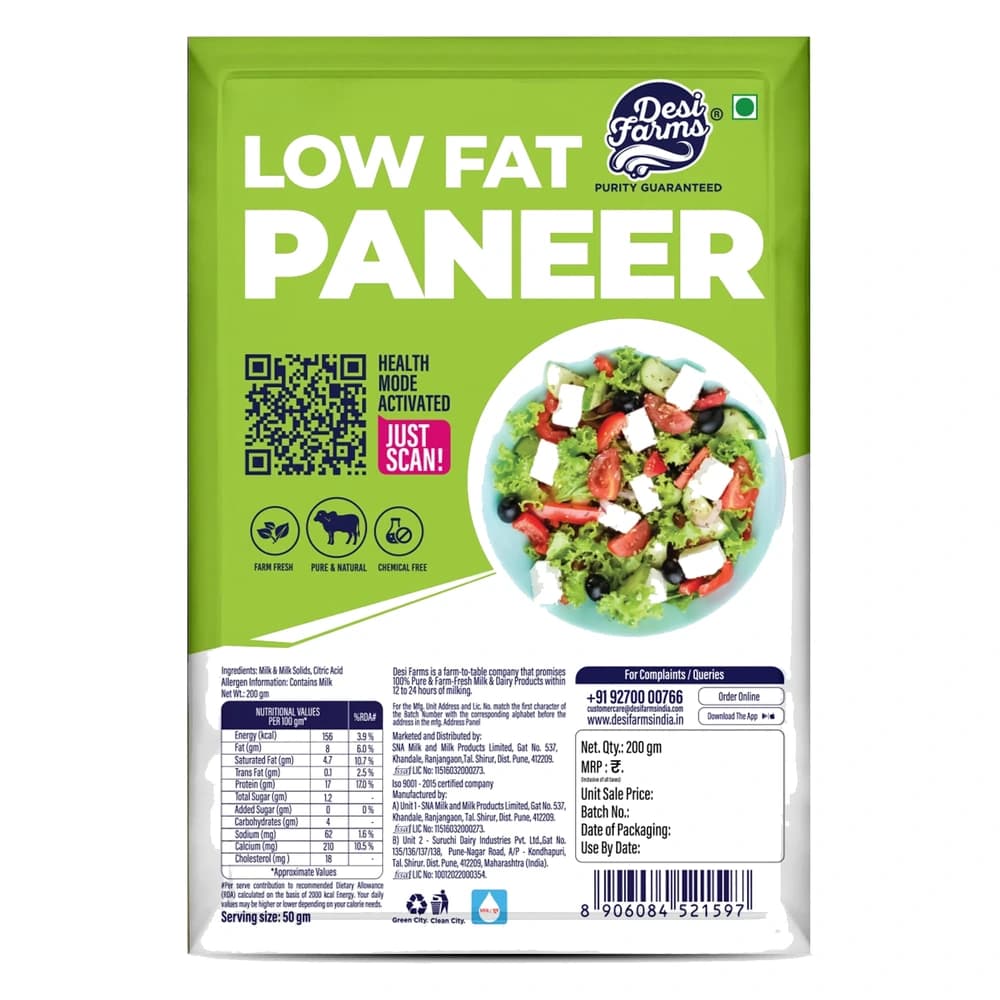
All Cheese & Paneer →- Desi Farms Low Fat Paneer
- +Green flag: High protein (17g per 100g)
- +Green flag: No added sugar
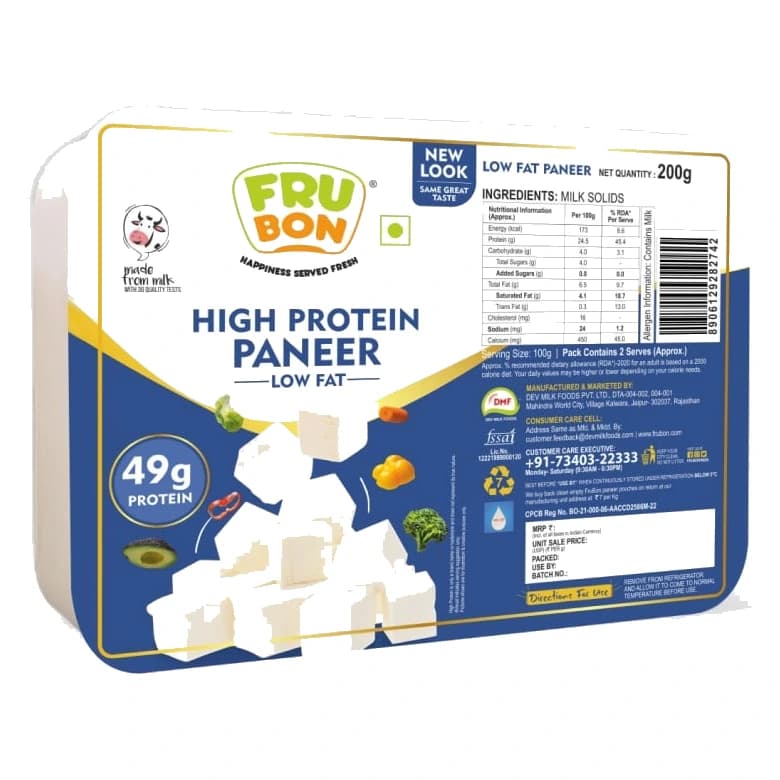
- FruBon Low Fat High Protein Paneer
- −Red flag: Contains trans fat (0.3g)
- +Green flag: High protein (24.5g per 100g)
- Morinaga Silken Extra Firm Tofu
- +Green flag: Source of protein (8.2g)
- +Green flag: No added sugar
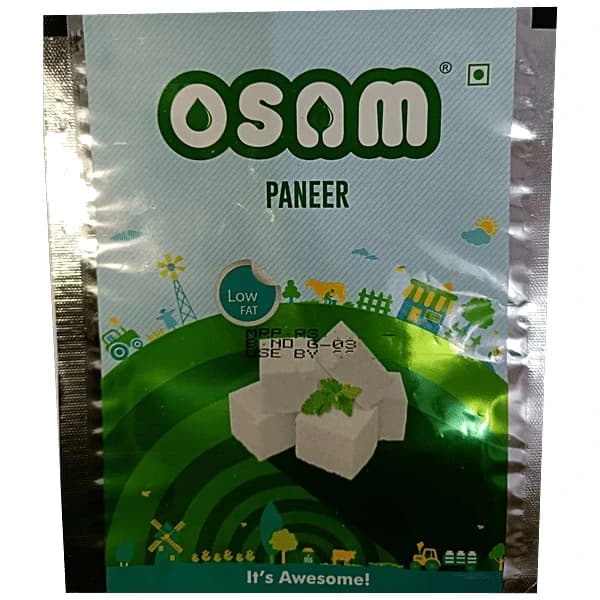
- OSAM Low Fat Paneer
- +Green flag: High protein (31g per 100g)
- +Green flag: No added sugar