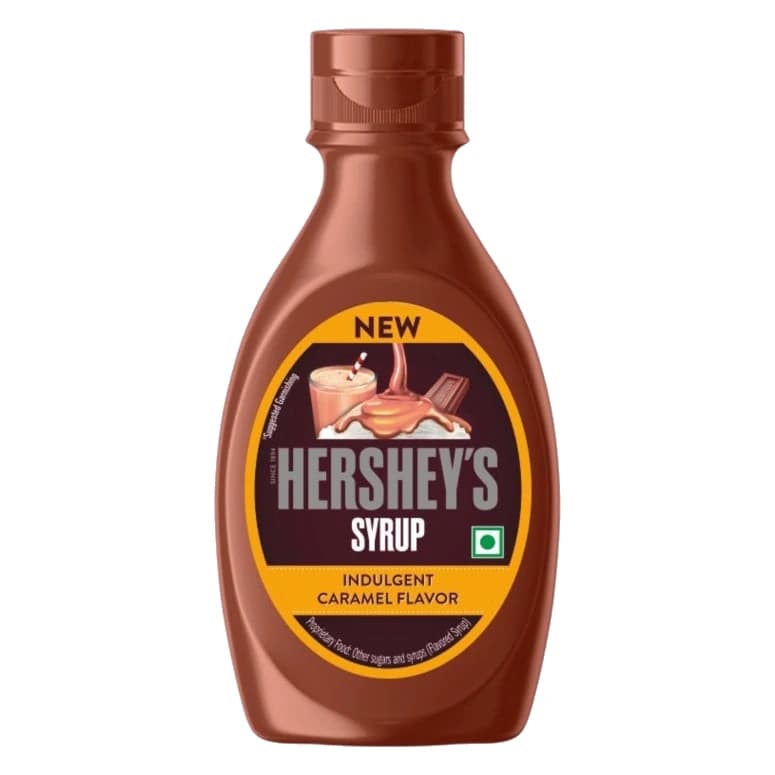
Hershey's Caramel Syrup
Published · Updated
Hershey's Caramel Syrup is a sweet dessert topping made from sugar, glucose and invert sugar, with a little milk solids and artificial caramel flavour. It scores EC4: very low on nutrition because it offers almost nothing besides sugar, middling on ingredients because of colours and other additives, and high on risk from added sugar. Best as a small drizzle now and then.
Ingredients, decoded
11 listed- Sugar
- Water
- Liquid Glucose
- Invert Sugar
- Milk Solids
- Sequestrants
- 339(ii)
- 331(iii)
- Iodised Salt
- Flavour (Artificial Flavouring Substance- Caramel)
- Thickener (415)
- Preservative(202)
- Natural and Synthetic Food Colours (150c and 124)
13 teaspoons of sugar in every 100 g · 66 g total sugar, 5 g a teaspoon
| Energy | 259 kcal |
|---|---|
| Protein | 1.7 g |
| Carbohydrates | 66 g |
| Total sugars | 66 g |
| Added sugars | 63 g |
| Total fat | 0 g |
| Sodium | 416.5 mg |
Think this score is wrong?
What to know about Hershey's Caramel Syrup
A caramel topping that is two-thirds sugar
Hershey's Caramel Syrup is a pourable dessert topping in a 180 g pack. It is built from sugar, water, liquid glucose and invert sugar, with milk solids, salt, artificial caramel flavouring, a thickener, a preservative and two colours. It is bought to go over ice cream, desserts, shakes and coffee. No percentages are declared.
A 30 g serve of 2 tablespoons gives about 78 kcal, 0.5 g protein and 18.9 g added sugar, and the pack holds six serves. Per 100 g it is 259 kcal, 66 g total sugar, 63 g of it added, and 416.5 mg sodium. There is no fat and no fibre, and no vitamins or minerals are declared.
The name and front say caramel, and the list shows that the caramel taste comes from an artificial flavouring substance, with caramel colour for the brown. The pack calls it a flavour, which is honest, but it gives no share for any caramel or milk ingredient. CleanPlate scores it EC4.
Why Hershey's Caramel Syrup scores EC4
Nutrition is an E because there is almost no protein, no fibre and no fat, only sugar. Ingredients are a C on colours and additives, and risk is a 4 on 63 g added sugar per 100 g.
Very low nutrient density
- Protein
- 1.7 g
- Fibre
- Not declared
- Vitamins and minerals
- None declared
- Energy
- 259 kcal
01 Nutrition density: why E
Protein is 1.7 g per 100 g, mostly from milk solids, and there is no fat and no fibre. A 30 g serve gives about 0.5 g protein, too little to earn credit.
No vitamins or minerals are declared, so nothing lifts the grade. The calories are almost entirely sugar, which is why nutrition sits at the bottom.
Scored on protein, fibre and twelve vitamins and minerals, against the Codex and FSSAI "source" and "high" levels, per 100 g and per 100 kcal. Protein also has to supply at least 12.5% of the calories to count, and 25% for full credit.
Mixed processing and additives
- Base
- Sugar
- Sweeteners
- 3 types
- Additives
- 4
- Flagged
- None
- Artificial flavour or colour
- Yes
02 Ingredient integrity: why C
Sugar, water, liquid glucose and invert sugar lead the list, so the base is sweetener and water. Milk solids come after them, with no percentage declared.
Several additives cost ingredient points: Ponceau 4R (124), caramel III (150c), sodium phosphates (339), xanthan gum (415) and the artificial caramel flavouring. Potassium sorbate (202) and sodium citrates (331) cost nothing. No hollow label promise is found, so the grade stays at a C.
Scored on how processed the ingredients are, which additives are used and why, and whether the label keeps its promises.
High risk
- Added sugar
- 63 g
- Sodium
- 416.5 mg
03 Load risk: why 4
Added sugar is the main driver: 63 g per 100 g, about 19 g in a 30 g serve. It accounts for most of the risk number.
Sodium adds a smaller share at 416.5 mg per 100 g, about 125 mg per serve. Energy is 259 kcal per 100 g, and saturated fat and trans fat are 0 g.
Scored on free sugar, sodium, saturated fat and trans fat, each weighed by how strong the evidence of harm is.
Red flags
- −Red flag: High added sugar (63g per 100g)
Green flags
Nothing stands out in its favour.
Does Hershey's Caramel Syrup live up to its claims?
The caramel flavour is honestly named, but the taste is artificial and no caramel or milk share is declared. The name promises more than the list backs up.
- Product namePartly true
“Caramel Syrup”
The caramel taste comes from an artificial flavouring substance, and caramel colour (150c) gives the brown. No caramel share is declared.
- On the packHolds
“Indulgent Caramel Flavor”
The pack calls it a flavour, and the list confirms it: the caramel comes from an artificial flavouring substance, not a declared caramel ingredient.
What's in Hershey's Caramel Syrup?
Sugar, water, liquid glucose and invert sugar lead the list. Watch the sugar first, then the two colours, Ponceau 4R and caramel III.
The ingredient list, read for you
Sugar, water, liquid glucose and invert sugar come first, so this is a sweetener syrup. Milk solids add a dairy note, with no percentage given. Iodised salt, artificial caramel flavouring and xanthan gum (415) shape the taste and thickness.
Potassium sorbate (202) preserves it, and sodium citrates (331) and sodium phosphates (339) are sequestrants. The colour comes from caramel III (150c) and Ponceau 4R (124), labelled as natural and synthetic colours.
Ingredients to watch
- Added sugarConcern
63 g per 100 g, about 19 g in a 30 g serve. This drives the risk number.
- Colours 124 and 150cConcern
Ponceau 4R is a synthetic dye and 150c is ammonia caramel. Both cost ingredient points.
- Sodium phosphates (339)Worth watching
A sequestrant that costs ingredient points, together with xanthan gum and the artificial flavouring.
- SodiumWorth watching
416.5 mg per 100 g, about 125 mg in a serve. Modest per serve but worth knowing.
- No fatFine
0 g fat per 100 g, so no saturated or trans fat, and no hydrogenated fat in the list.
What it doesn’t have
- No percentage is given for the milk solids or any caramel.
- No fibre, vitamins or minerals are declared.
Who should eat Hershey's Caramel Syrup?
An occasional topping for most adults, and rarely for children or anyone watching blood sugar, since a 30 g serve has about 19 g added sugar.
- Most adultsOccasionally
About 19 g added sugar in a 30 g serve, and risk is a 4.
- ChildrenRarely
High added sugar plus a synthetic dye, Ponceau 4R.
- Diabetes or prediabetesRarely
63 g added sugar per 100 g, with almost no protein or fibre to slow it.
- Weight managementOccasionally
78 kcal per serve, almost all from sugar, and easy to over-pour.
Recipes with Hershey's Caramel Syrup
Use it as a measured drizzle on ice cream, pancakes or coffee, since two tablespoons already bring about 19 g added sugar.
Caramel drizzle on ice cream
Measure one 30 g serve over a scoop, since two tablespoons already bring about 19 g added sugar.
Caramel coffee
Stir in one tablespoon, about 15 g, for roughly 9 g added sugar, and skip other sweetener.
Pancakes with a light caramel finish
Use it as a topping rather than a soak, so the serve stays near 78 kcal.
Hershey's Caramel Syrup: common questions
What is the CleanPlate score of Hershey's Caramel Syrup?
Hershey's Caramel Syrup is a sweet dessert topping made from sugar, glucose and invert sugar, with a little milk solids and artificial caramel flavour. It scores EC4: very low on nutrition because it offers almost nothing besides sugar, middling on ingredients because of colours and other additives, and high on risk from added sugar. Best as a small drizzle now and then. Nutrition E, ingredients C, load risk 4; nutrition and ingredients run A to E, risk runs 1 to 5, and A and 1 are best.
How many calories and how much protein are in Hershey's Caramel Syrup?
Per 100 g, Hershey's Caramel Syrup has 259 kcal, 1.7 g protein, 66 g carbohydrate, 0 g fat and 63 g added sugar. One serve (2 tbsp, 30 g) has 78 kcal and 0.5 g protein.
What are the ingredients in Hershey's Caramel Syrup?
11 ingredients, in label order: Sugar, Water, Liquid Glucose, Invert Sugar, Milk Solids, Sequestrants (339(ii),331(iii)), Iodised Salt, Flavour (Artificial Flavouring Substance- Caramel), Thickener (415), Preservative(202), Natural and Synthetic Food Colours (150c and 124).
Does Hershey's Caramel Syrup live up to its claims?
2 claims checked: 1 holds, 1 is partly true. "Caramel Syrup" is partly true: The caramel taste comes from an artificial flavouring substance, and caramel colour (150c) gives the brown. No caramel share is declared.
Who should limit Hershey's Caramel Syrup?
Most adults: occasionally. About 19 g added sugar in a 30 g serve, and risk is a 4. Children: rarely. High added sugar plus a synthetic dye, Ponceau 4R. Diabetes or prediabetes: rarely. 63 g added sugar per 100 g, with almost no protein or fibre to slow it.
How much sugar, salt and saturated fat does Hershey's Caramel Syrup have?
Per 100 g, Hershey's Caramel Syrup has 63 g added sugar and 417 mg sodium (about 1 g salt). The FSSAI and UK FSA "high" lines are 10 g added sugar, 600 mg sodium and 5 g saturated fat per 100 g. It is high in sugar.
Last reviewed October 23, 2026. Scored with the CleanPlate method from the published label. Spotted a mistake? .