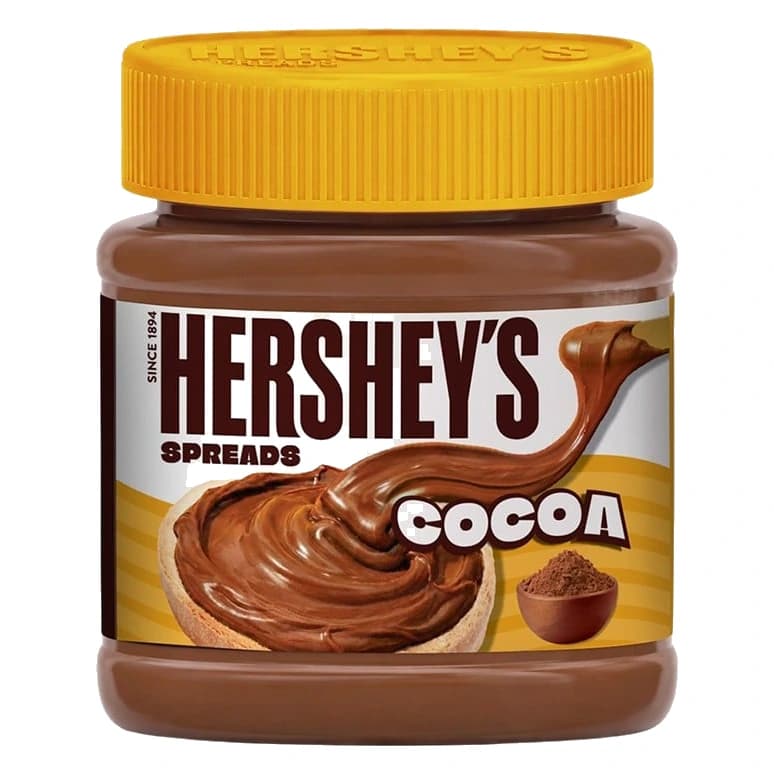
Hershey's Cocoa Chocolate Spread
Published
Hershey's Cocoa Chocolate Spread is a sweet jar spread for bread, roti and snacks, made mostly of sugar and palm oil with little cocoa. It scores EB5: nutrition is low with almost no protein, ingredients do better on a short list despite hydrogenated fat, and risk is high because of sugar and saturated fat. Best as a thin scrape now and then.
Ingredients, decoded
8 listed- Sugar
- Edible Vegetable Oil (Palm Superolein)
- Milk Solids
- Cocoa Solids (#5%)
- Emulsifier (322(i))
- Hydrogenated Vegetable Fat (Palm Oil & Sesame Oil)
- Iodized Salt
- Flavour (Artificial Flavouring Substances - Vanilla)
13 teaspoons of sugar in every 100 g · 64 g total sugar, 5 g a teaspoon
| Energy | 530 kcal |
|---|---|
| Protein | 2.3 g |
| Carbohydrates | 67 g |
| Total sugars | 64 g |
| Added sugars | 55 g |
| Total fat | 28 g |
| Saturated fat | 11 g |
| Trans fat | 0.3 g |
| Cholesterol | 10 mg |
| Sodium | 140 mg |
Think this score is wrong?
What to know about Hershey's Cocoa Chocolate Spread
A cocoa spread that is mostly sugar and palm oil
A cocoa-flavoured spread sold in a 150 g jar, built from sugar, palm superolein, milk solids and cocoa solids (5%), with an emulsifier, hydrogenated vegetable fat (palm and sesame oil), iodized salt and artificial vanilla flavouring. It is bought as a quick topping for bread, roti, paratha, dosa, waffles and fruit, mostly for the chocolate taste.
A 15 g serve gives about 80 kcal, 8.3 g added sugar and 1.7 g saturated fat, with under 0.4 g protein. Per 100 g the spread has 530 kcal, 55 g added sugar and 11 g saturated fat. The pack declares 0.3 g trans fat per 100 g, but the hydrogenated fat carries no partly or fully qualifier, so it is scored as partially hydrogenated.
The name and front say cocoa, and cocoa is in the list, but at 5% it sits behind sugar, palm oil and milk solids. The claim is not false, it is just a small share of the jar. CleanPlate scores it EB5.
Why Hershey's Cocoa Chocolate Spread scores EB5
Nutrition is an E: 2.3 g protein per 100 g and no credit from fibre or minerals. Ingredients are a B on a short list. Risk is a 5 on 55 g added sugar and 11 g saturated fat.
Very low nutrient density
- Protein
- 2.3 g
- Fibre
- Not declared
- Vitamins and minerals
- None declared
- Energy
- 530 kcal
01 Nutrition density: why E
Protein is 2.3 g per 100 g, and the largest contributor is milk solids. That is under 0.4 g in a 15 g serve, which is too little to earn credit.
No vitamins, minerals or fibre add to the grade. The energy comes from sugar and fat, so there is nothing to lift the nutrition axis.
Scored on protein, fibre and twelve vitamins and minerals, against the Codex and FSSAI "source" and "high" levels, per 100 g and per 100 kcal. Protein also has to supply at least 12.5% of the calories to count, and 25% for full credit.
Good, few concerning additives
- Base
- Sugar
- Main fat
- Edible Vegetable Oil
- Sweeteners
- Sugar
- Additives
- 1
- Flagged
- Palm oil
- Artificial flavour or colour
- Yes
02 Ingredient integrity: why B
The list is short and has no dye or sweetener. Sugar, palm superolein and milk solids lead, with cocoa solids at 5%, so the list does reasonably well on label points.
Hydrogenated vegetable fat with no partly or fully qualifier is scored as a partially hydrogenated oil, which costs ingredient points. Artificial vanilla flavouring and the lecithin emulsifier (322(i)) cost a few more. No claim on the pack is hollow, so nothing was lost for label integrity.
Scored on how processed the ingredients are, which additives are used and why, and whether the label keeps its promises.
Very high risk
- Added sugar
- 55 g
- Sodium
- 140 mg
- Saturated fat
- 11 g
- Trans fat
- 0.3 g
03 Load risk: why 5
Added sugar is the biggest driver: 55 g per 100 g, more than half the weight of the jar. Saturated fat is 11 g per 100 g, over twice the 5 g high line, and energy is 530 kcal per 100 g.
Sodium at 140 mg per 100 g adds little. The declared trans fat of 0.3 g is not accepted until the maker confirms the type of hydrogenation, so it is counted with the unqualified hydrogenated fat.
Scored on free sugar, sodium, saturated fat and trans fat, each weighed by how strong the evidence of harm is.
Red flags
- −Red flag: High added sugar (55g per 100g)
- −Red flag: High saturated fat (11g)
- −Red flag: Contains trans fat (0.3g)
- −Red flag: Palm oil listed
Green flags
Nothing stands out in its favour.
Does Hershey's Cocoa Chocolate Spread live up to its claims?
The cocoa is real but only 5% of the jar, and the energy-boost line is framed generously. The retailer page shows different fat figures from the pack.
- On the packPartly true
“Cocoa”
Cocoa solids are listed at 5%, behind sugar, palm superolein and milk solids. The flavour is real but a small share of the spread.
- Retail listingBe careful
“High-quality cocoa: premium cocoa solids”
Cocoa solids are in the list, but at 5% of a spread that is 55 g added sugar per 100 g. Nothing on the pack backs up the quality wording.
- Retail listingBe careful
“Anytime energy boost”
True in calories: 530 kcal per 100 g, about 80 kcal per 15 g serve. That energy is mostly added sugar and fat.
- Retail listingBe careful
“Fat 30 g, saturated 12 g per 100 g”
The retailer page shows 30 g fat and 12 g saturated fat per 100 g, the pack shows 28 g and 11 g. The pack figures are used.
What's in Hershey's Cocoa Chocolate Spread?
Sugar, palm superolein and milk solids lead the list, with cocoa solids at 5%. Watch the sugar, the saturated fat and the hydrogenated fat of unstated type.
The ingredient list, read for you
Sugar comes first, then palm superolein, so the jar is mostly sugar and oil. Milk solids add creaminess and most of the little protein, and cocoa solids are declared at 5%. The emulsifier (322(i)) is lecithin, which keeps the oil and sugar blended. Hydrogenated vegetable fat (palm and sesame oil) firms the texture, with iodized salt and artificial vanilla flavouring to finish.
Ingredients to watch
- Hydrogenated vegetable fat (type not stated)Concern
No partly or fully qualifier is given, so it is scored as a partially hydrogenated oil and costs ingredient points. Trans fat is declared at 0.3 g per 100 g.
- Added sugarConcern
55 g per 100 g, the first ingredient and the biggest part of the risk grade. A 15 g serve has about 8.3 g.
- Saturated fatConcern
11 g per 100 g, from palm oil and the hydrogenated fat. A 15 g serve has about 1.7 g.
- Artificial flavouring and lecithinWorth watching
Artificial vanilla flavouring and the emulsifier 322(i) each cost a small number of ingredient points.
- SodiumFine
140 mg per 100 g, about 21 mg in a 15 g serve.
What it doesn’t have
- No vitamins or minerals are declared on the panel.
- Very little protein for a spread made with milk solids: 2.3 g per 100 g.
Who should eat Hershey's Cocoa Chocolate Spread?
Rarely for most adults, and best avoided for children. Anyone managing diabetes should check with their doctor, as a 15 g serve carries about 8.3 g added sugar.
- Most adultsRarely
55 g added sugar and 11 g saturated fat per 100 g.
- ChildrenAvoid
Hydrogenated fat and 8.3 g added sugar in a 15 g serve.
- Diabetes or prediabetesCheck with your doctor
64 g total sugar per 100 g, almost all of it added.
- Weight managementRarely
530 kcal per 100 g, mostly from sugar and fat.
Recipes with Hershey's Cocoa Chocolate Spread
Use a thin layer on roti, fruit or dosa. At 80 kcal per 15 g serve, the spoon size is what changes the numbers.
Thin spread on roti
Spread a 15 g layer on a warm roti for about 80 kcal of topping, and keep to one serve.
Sliced fruit with a thin scrape
Use the spread as a light dip for banana or apple slices, and measure out 15 g so the added sugar stays near 8 g.
Dosa or waffle topping
Use 15 g to finish a dosa or waffle, rather than a thick coat that would double the 11 g saturated fat per 100 g into the serve.
Hershey's Cocoa Chocolate Spread: common questions
What is the CleanPlate score of Hershey's Cocoa Chocolate Spread?
Hershey's Cocoa Chocolate Spread is a sweet jar spread for bread, roti and snacks, made mostly of sugar and palm oil with little cocoa. It scores EB5: nutrition is low with almost no protein, ingredients do better on a short list despite hydrogenated fat, and risk is high because of sugar and saturated fat. Best as a thin scrape now and then. Nutrition E, ingredients B, load risk 5; nutrition and ingredients run A to E, risk runs 1 to 5, and A and 1 are best.
How many calories and how much protein are in Hershey's Cocoa Chocolate Spread?
Per 100 g, Hershey's Cocoa Chocolate Spread has 530 kcal, 2.3 g protein, 67 g carbohydrate, 28 g fat and 11 g saturated fat. One serve (15 g serve, as printed) has 80 kcal and 0.3 g protein.
What are the ingredients in Hershey's Cocoa Chocolate Spread?
8 ingredients, in label order: Sugar, Edible Vegetable Oil (Palm Superolein), Milk Solids, Cocoa Solids (#5%), Emulsifier (322(i)), Hydrogenated Vegetable Fat (Palm Oil & Sesame Oil), Iodized Salt, Flavour (Artificial Flavouring Substances - Vanilla). Flagged: Palm oil (low concern).
Does Hershey's Cocoa Chocolate Spread live up to its claims?
4 claims checked: 1 is partly true, 3 need care. "Cocoa" is partly true: Cocoa solids are listed at 5%, behind sugar, palm superolein and milk solids. The flavour is real but a small share of the spread. "High-quality cocoa: premium cocoa solids" needs care: Cocoa solids are in the list, but at 5% of a spread that is 55 g added sugar per 100 g. Nothing on the pack backs up the quality wording.
Who should limit Hershey's Cocoa Chocolate Spread?
Most adults: rarely. 55 g added sugar and 11 g saturated fat per 100 g. Children: avoid. Hydrogenated fat and 8.3 g added sugar in a 15 g serve. Diabetes or prediabetes: check with your doctor. 64 g total sugar per 100 g, almost all of it added.
How much sugar, salt and saturated fat does Hershey's Cocoa Chocolate Spread have?
Per 100 g, Hershey's Cocoa Chocolate Spread has 55 g added sugar, 140 mg sodium (about 0.3 g salt) and 11 g saturated fat. The FSSAI and UK FSA "high" lines are 10 g added sugar, 600 mg sodium and 5 g saturated fat per 100 g. It is high in sugar and saturated fat.
Last reviewed October 20, 2026. Scored with the CleanPlate method from the published label. Spotted a mistake? .