Kellogg's Muesli Fruit, Nut & Seeds
Published · Updated
Kellogg's Muesli Fruit, Nut & Seeds is a multigrain muesli with candied and dried fruit, nuts and seeds, sold as a ready breakfast. It scores [F]BB5: nutrition is helped by fibre, protein and added vitamins, ingredients are mostly grains with a few additives, but risk is at its worst level because of sugar and energy density. Best kept for small, occasional bowls.
Ingredients, decoded
13 listed- Multigrain Mix
- Corn Grits (18.3%)
- Wheat (16.6%)
- Rice (9.7%)
- Rolled Barley (8%)
- Rolled Oats (8%)
- Ragi Millet Flour (3.5%)
- Rice Flour
- Corn Meal
- Wheat Flour (Atta)
- Candied & Dry Fruits, Nuts & Seeds
- Candied Papaya (5%)
- Raisins (4.5%)
- Almonds (3.5%)
- Pumpkin Seeds (3.5%)
- Candied Cranberry (3%)
- Black Currants (1.5%)
- Sugar
- Cereal Extract
- Oligofructose
- Wheat Bran
- Iodized Salt
- Cocoa Solids
- Vitamins
- Colours (INS 140, INS 150D)
- Flavours {Nature Identical & Artificial (Coconut)}
- Antioxidant (INS 307B)
- And Mineral

11 teaspoons of sugar in every 100 g · 54.5 g total sugar, 5 g a teaspoon
| Energy | 965 kcal |
|---|---|
| Protein | 20.3 g |
| Carbohydrates | 200 g |
| Total sugars | 54.5 g |
| Added sugars | 31.3 g |
| Dietary fibre | 16 g |
| Total fat | 12.8 g |
| Saturated fat | 2.3 g |
| Trans fat | 0 g |
| Cholesterol | 0 mg |
| Sodium | 350 mg |
| Iron | 35 mg |
| Vitamin C | 62.5 mg |
| Vitamin B1 | 2 mg |
| Vitamin B2 | 2.3 mg |
| Vitamin B3 | 25 mg |
| Vitamin B6 | 3.3 mg |
| Folic acid | 165 µg |
| Vitamin B12 | 0.5 µg |
Think this score is wrong?
What to know about Kellogg's Muesli Fruit, Nut & Seeds
High fibre, but over 50 g sugar per 100 g
A multigrain muesli built on corn grits (18.3%), wheat (16.6%), rice (9.7%), rolled barley (8%) and rolled oats (8%), with candied and dried fruit, nuts and seeds making up 21% of the mix. It is sold as a pour-and-eat breakfast to have with milk or yogurt, and the pack calls it a 12 in 1 power breakfast.
What you get is real fibre and protein: 16 g fibre and 20.25 g protein per 100 g, so about 6.4 g fibre and 8.1 g protein in a 40 g serve, plus added iron and vitamins. What it costs is sugar: free sugar is 53.9 g per 100 g, about 21.5 g per serve, much of it from sugar, candied papaya and candied cranberry.
The name promises fruit, nuts and seeds, and they are in the list, but the named pieces are small: candied papaya 5%, raisins 4.5%, almonds 3.5% and pumpkin seeds 3.5%. The name stresses them with no percentage beside it, which costs label points. CleanPlate scores it [F]BB5.
Why Kellogg's Muesli Fruit, Nut & Seeds scores [F]BB5
Nutrition is a B on 16 g fibre and 20.25 g protein per 100 g, helped by added vitamins and iron. Ingredients are a B, and risk is a 5 because of 53.9 g free sugar and a high energy density.
Good nutrient density
- Protein
- 20.3 g
- Fibre
- 16 g
- Vitamins and minerals
- 8 declared
- Energy
- 965 kcal
01 Nutrition density: why B
Protein is 20.25 g per 100 g and fibre is 16 g, which is 8.1 g protein and 6.4 g fibre in a 40 g serve. Most of the protein comes from wheat and other grains, with almonds and pumpkin seeds adding a little.
Added iron and vitamins C, B1, B2, B3, B6, B12 and folate lift the grade from a C to a B. Without that fortification the grade would be a C, so part of the credit comes from what is added rather than from the grains.
Scored on protein, fibre and twelve vitamins and minerals, against the Codex and FSSAI "source" and "high" levels, per 100 g and per 100 kcal. Protein also has to supply at least 12.5% of the calories to count, and 25% for full credit.
Good, few concerning additives
- Base
- Multigrain Mix, Wheat, Rice,...
- Sweeteners
- Sugar, Oligofructose
- Additives
- 2
- Flagged
- Caramel Colour (Class IV)
- Artificial flavour or colour
- Yes
02 Ingredient integrity: why B
Whole and rolled grains lead the list: corn grits, wheat, rice, rolled barley, rolled oats and ragi. Sugar, cereal extract and oligofructose follow the fruit, nuts and seeds. No hydrogenated fat or palm oil is listed.
Sulphite ammonia caramel (150d) costs the most ingredient points, and the nature-identical and artificial coconut flavouring and chlorophyll (140) cost a few more. The tocopherol antioxidant (307b) costs none.
The name stresses fruit, nuts and seeds without a percentage beside each, which costs label points. The ingredient list does give the pieces: candied papaya 5%, raisins 4.5%, almonds 3.5%.
Scored on how processed the ingredients are, which additives are used and why, and whether the label keeps its promises.
Very high risk
- Added sugar
- 31.3 g
- Sodium
- 350 mg
- Saturated fat
- 2.3 g
- Trans fat
- 0 g
03 Load risk: why 5
Sugar and energy drive the risk grade. Free sugar is 53.9 g per 100 g, because the candied fruit's sugar is counted along with the added sugar, and energy is 965 kcal per 100 g. Together they make up most of the risk load.
Sodium is 350 mg per 100 g, 140 mg per serve, and saturated fat is 2.25 g per 100 g. Trans fat is 0 g. These add little next to the sugar and energy.
Scored on free sugar, sodium, saturated fat and trans fat, each weighed by how strong the evidence of harm is.
[F] Added vitamins or minerals meaningfully lift this product's nutrition grade. Without them it would score lower.
Red flags
- −Red flag: High added sugar (31.3g per 100g)
- −Red flag: Contains Caramel Colour (Class IV)
Green flags
- +Green flag: High fibre (16g)
Does Kellogg's Muesli Fruit, Nut & Seeds live up to its claims?
The fibre, no-preservative and no-trans-fat claims hold. The iron and vitamin claims come from fortification, and the front energy figure does not match the nutrition table.
- Product namePartly true
“Muesli Fruit, Nut & Seeds”
The fruit, nuts and seeds are real and make up 21% of the mix, but the named pieces are small, such as almonds at 3.5%. The grain mix is 66%.
- On the packHolds
“High in Fibre”
Fibre is 16 g per 100 g, about 6.4 g in a 40 g serve, from whole grains, wheat bran and oligofructose.
- On the packBe careful
“High in Iron”
True, at 35 mg per 100 g, but the iron and the vitamins are added. Without that fortification the nutrition grade would be a C.
- On the packHolds
“No Added Preservatives”
No preservative is listed. The antioxidant 307b is a tocopherol, and the caramel colour and flavouring are additives of another kind.
- On the packBe careful
“Energy 154 kcal per serve”
The front panel prints 154 kcal for a 40 g serve, which does not match the 965 kcal per 100 g in the nutrition table. Sugar, protein and fibre per serve match the back panel.
What's in Kellogg's Muesli Fruit, Nut & Seeds?
Grains lead the list, then candied fruit, nuts and seeds, then sugar. The sugar, the caramel colour and the flavouring are what to watch.
The ingredient list, read for you
Corn grits, wheat, rice, rolled barley and rolled oats lead the multigrain mix, which is 66% of the pack, with ragi, rice flour, corn meal and atta after them. Candied papaya, raisins, almonds, pumpkin seeds, candied cranberry and black currants make up 21%.
Sugar, cereal extract and oligofructose sweeten it, wheat bran adds fibre, and cocoa solids add colour and taste. Vitamins and a mineral are added, colours 140 and 150d and coconut flavouring finish the list, and 307b protects the fats.
Ingredients to watch
- Free sugarConcern
53.9 g per 100 g, about 21.5 g in a 40 g serve, from sugar and the candied papaya and cranberry as well as raisins.
- Caramel colour 150d and flavouringWorth watching
Sulphite ammonia caramel costs the most ingredient points, and the nature-identical and artificial coconut flavouring costs more. Chlorophyll (140) costs a little.
- Added vitamins and ironWorth watching
Iron is 35 mg per 100 g and eight nutrients are added, which lifts the nutrition grade from a C to a B. The credit comes from fortification.
- Fibre and proteinFine
16 g fibre and 20.25 g protein per 100 g, so 6.4 g and 8.1 g in a 40 g serve, with no trans fat and no cholesterol.
Who should eat Kellogg's Muesli Fruit, Nut & Seeds?
Rarely for most adults and for anyone watching sugar, since a 40 g serve carries about 21.5 g free sugar. Children should have it rarely too.
- Most adultsRarely
A 40 g serve has about 21.5 g free sugar, and risk is at the highest level.
- ChildrenRarely
53.9 g free sugar per 100 g and a caramel colour.
- Diabetes or prediabetesRarely
53.9 g free sugar per 100 g, only partly offset by 16 g fibre.
- Active peopleRarely
Fibre and iron are real, but about 21.5 g sugar per serve is high.
Recipes with Kellogg's Muesli Fruit, Nut & Seeds
Keep to a 40 g serve over plain curd or unsweetened milk, so the 6.4 g fibre per serve is not paired with extra sugar.
Muesli over plain curd
Spoon a 40 g serve over plain curd, as the pack suggests, to add protein without adding more sugar to the 21.5 g in the muesli.
Measured bowl with milk
Weigh 40 g, pour on unsweetened milk and add fresh fruit if you want more, rather than using sweetened milk.
Muesli topping, not the base
Use a spoonful as a crunchy topping on a bowl of curd and fruit, so the muesli contributes fibre without making up the whole serve.
Kellogg's Muesli Fruit, Nut & Seeds: common questions
What is the CleanPlate score of Kellogg's Muesli Fruit, Nut & Seeds?
Kellogg's Muesli Fruit, Nut & Seeds is a multigrain muesli with candied and dried fruit, nuts and seeds, sold as a ready breakfast. It scores [F]BB5: nutrition is helped by fibre, protein and added vitamins, ingredients are mostly grains with a few additives, but risk is at its worst level because of sugar and energy density. Best kept for small, occasional bowls. Nutrition B, ingredients B, load risk 5; nutrition and ingredients run A to E, risk runs 1 to 5, and A and 1 are best.
How many calories and how much protein are in Kellogg's Muesli Fruit, Nut & Seeds?
Per 100 g, Kellogg's Muesli Fruit, Nut & Seeds has 965 kcal, 20.3 g protein, 200 g carbohydrate, 12.8 g fat and 2.3 g saturated fat. One serve (40 g serve) has 386 kcal and 8.1 g protein.
What are the ingredients in Kellogg's Muesli Fruit, Nut & Seeds?
13 ingredients, in label order: Multigrain Mix (Corn Grits (18.3%), Wheat (16.6%), Rice (9.7%), Rolled Barley (8%), Rolled Oats (8%), Ragi Millet Flour (3.5%), Rice Flour, Corn Meal, Wheat Flour (Atta)), Candied & Dry Fruits, Nuts & Seeds (Candied Papaya (5%), Raisins (4.5%), Almonds (3.5%), Pumpkin Seeds (3.5%), Candied Cranberry (3%), Black Currants (1.5%)), Sugar, Cereal Extract, Oligofructose, Wheat Bran, Iodized Salt, Cocoa Solids, Vitamins.... Flagged: Caramel Colour (Class IV) (low concern).
Does Kellogg's Muesli Fruit, Nut & Seeds live up to its claims?
5 claims checked: 2 hold, 1 is partly true, 2 need care. "Muesli Fruit, Nut & Seeds" is partly true: The fruit, nuts and seeds are real and make up 21% of the mix, but the named pieces are small, such as almonds at 3.5%. The grain mix is 66%. "High in Iron" needs care: True, at 35 mg per 100 g, but the iron and the vitamins are added. Without that fortification the nutrition grade would be a C.
Who should limit Kellogg's Muesli Fruit, Nut & Seeds?
Most adults: rarely. A 40 g serve has about 21.5 g free sugar, and risk is at the highest level. Children: rarely. 53.9 g free sugar per 100 g and a caramel colour. Diabetes or prediabetes: rarely. 53.9 g free sugar per 100 g, only partly offset by 16 g fibre.
How much sugar, salt and saturated fat does Kellogg's Muesli Fruit, Nut & Seeds have?
Per 100 g, Kellogg's Muesli Fruit, Nut & Seeds has 31.3 g added sugar, 350 mg sodium (about 0.9 g salt) and 2.3 g saturated fat. The FSSAI and UK FSA "high" lines are 10 g added sugar, 600 mg sodium and 5 g saturated fat per 100 g. It is high in sugar.
Last reviewed October 29, 2026. Scored with the CleanPlate method from the published label. Spotted a mistake? .
Better Breakfast Cereals
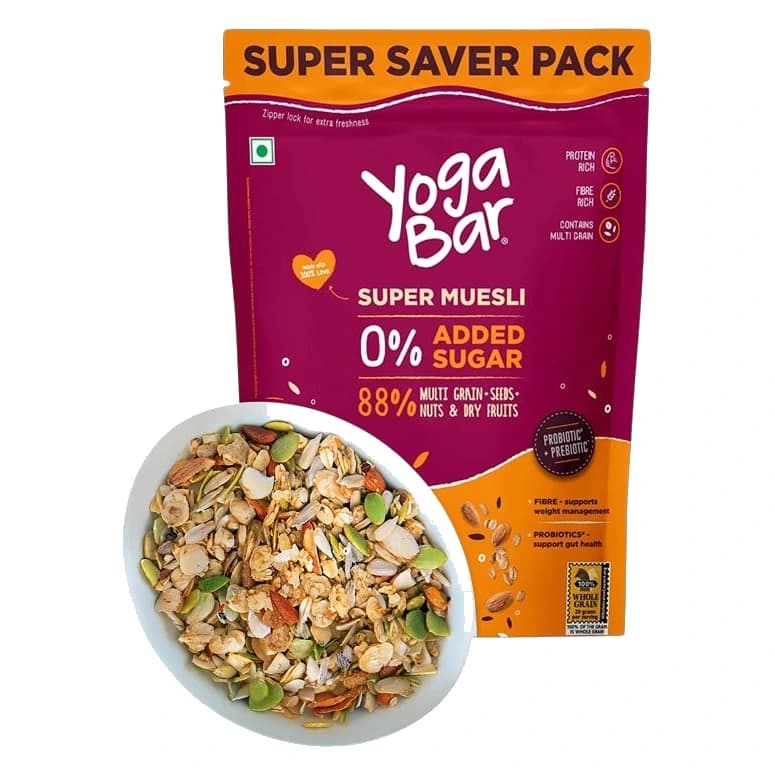
All Breakfast Cereals →- Yoga Bar 0% Added Sugar Super Muesli
- +Green flag: Source of protein (15g)
- +Green flag: High fibre (14g)
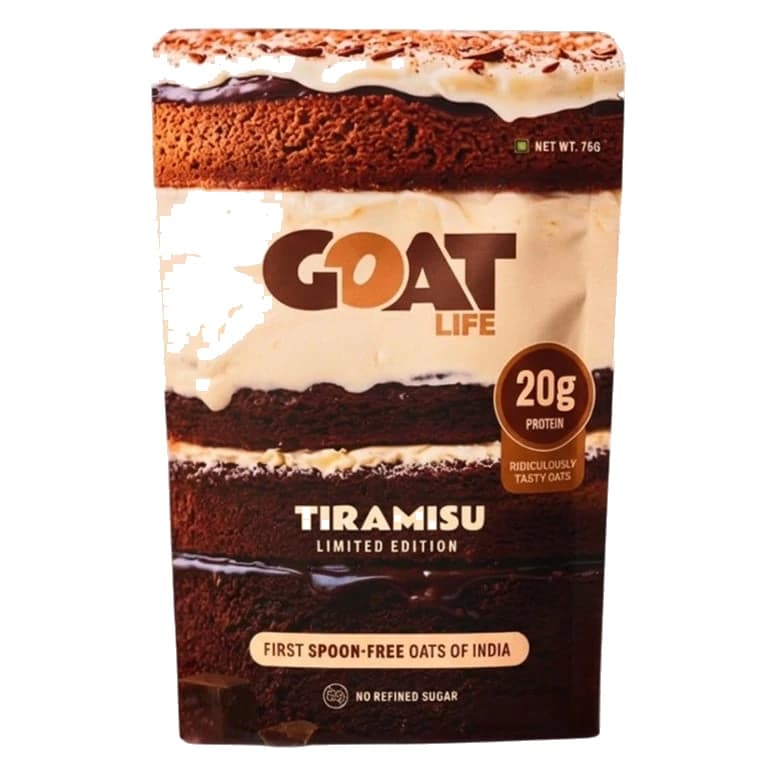
- GOAT Life High Protein Overnight Oats Tiramisu
- +Green flag: High protein (26.7g per 100g)
- +Green flag: High fibre (8g)
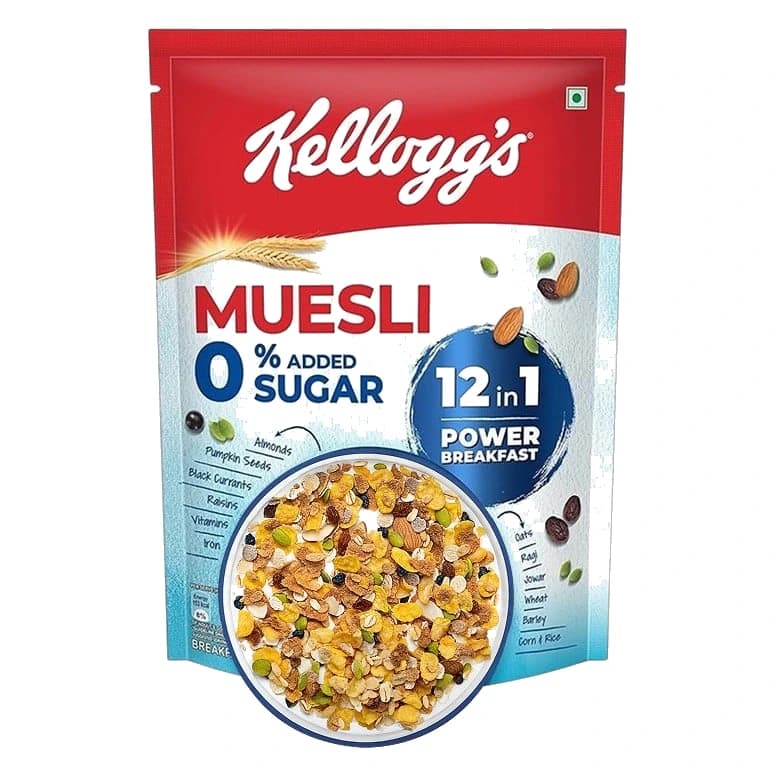
- Kellogg's Muesli 0% Added SugarFortified
- +Green flag: High fibre (6.4g)
- +Green flag: No added sugar
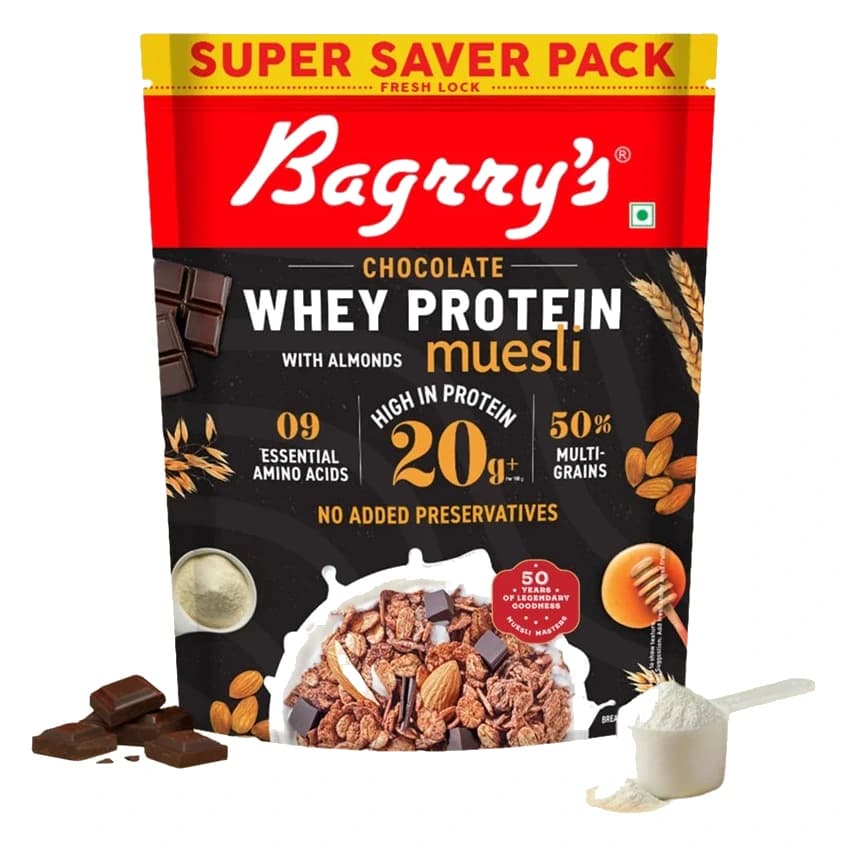
- Bagrry's Chocolate Whey Protein Muesli with Almonds
- −Red flag: High added sugar (11g per 100g)
- +Green flag: Source of protein (20.3g)