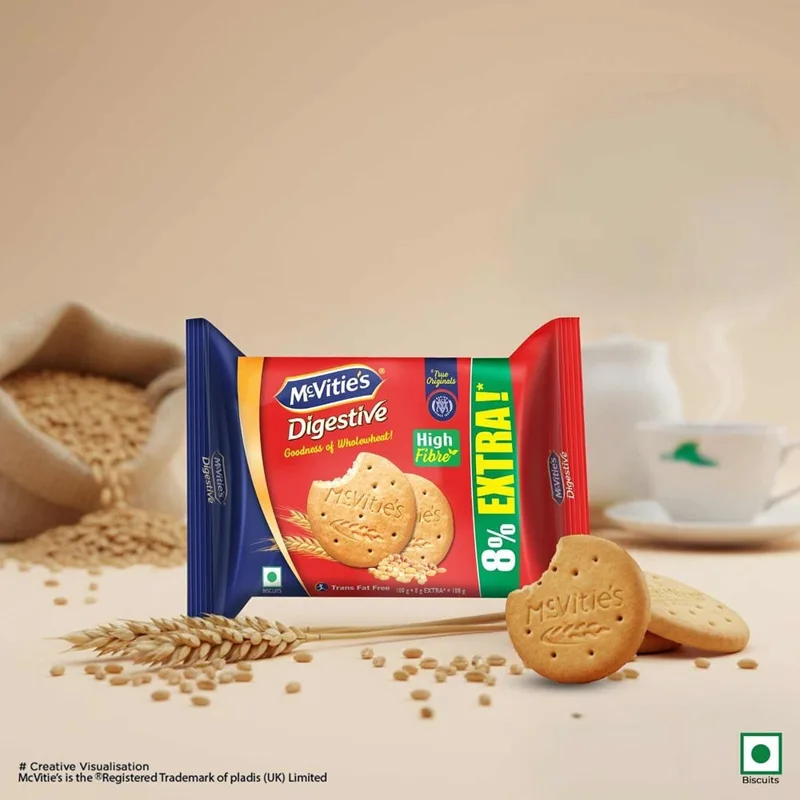
McVitie's Digestive High Fibre Biscuit, Trans Fat Free
Red flags
- −Red flag: High added sugar (16.6g per 100g)
- −Red flag: High saturated fat (8.3g)
- −Red flag: Refined flour (maida) base
- −Red flag: Palm oil listed
Green flags
- +Green flag: Source of protein (7.9g)
- +Green flag: High fibre (6.5g)
Ingredients, decoded
12 listed- Refined Wheat Flour(Maida) (49.8%)
- Wheat Flour(Atta) (18%)
- Edible Vegetable Oil(Palm Oil)
- Sugar
- Wheat Bran(3.2%)
- Invert Sugar Syrup
- Raising Agents (INS 500(ii), INS 503(ii), INS 450(i))
- Iodised Salt
- Malt Extract
- Emulsifiers(INS 322, INS 472e)
- Acidity Regulator (INS 296)
- Dough Conditioner (INS 223)
CC4
Our take
CleanPlate reviewHigh fibre, but half the flour is maida
McVitie's Digestive High Fibre is a baked digestive biscuit of refined wheat flour (maida, 49.8%), atta (18%), palm oil, sugar, wheat bran (3.2%) and invert syrup, with raising agents, emulsifiers (322, 472e), an acidity regulator and a dough conditioner (INS 223). The pack is 108.4 g.
CleanPlate scores it [L]CC4. The C for nutrition is middling: 6.5 g fibre per 100 g; its 7.9 g of protein earns no credit because it is under 2.75 g per 100 kcal. The C for ingredients reflects mostly refined or industrial ingredients (led by refined wheat flour, wheat flour and edible vegetable oil), with additives that cost points: diphosphates, sodium metabisulphite and DATEM. The [L] marks a hollow label promise: the claim "Goodness of Wholewheat!" does not hold: maida (refined wheat flour) is the first ingredient at 49.8%. The 4 for risk comes mainly from saturated fat (8.3 g per 100 g) and sodium (527 mg per 100 g).
Claims vs reality
What the pack says, checked against the ingredient list and nutrition panel.
- On the packMisleading
“Goodness of Wholewheat!”
Maida is the first ingredient at 49.8%; atta is 18% and wheat bran 3.2%.
- On the packHolds
“High Fibre”
The panel declares 6.5 g of fibre per 100 g, above the 6 g line for a high-fibre claim.
- Product nameHolds
“Trans Fat Free”
The panel declares 0 g trans fat and no hydrogenated fat is listed; the fat is palm oil.
How CC4 breaks down
Each grade is scored on its own. Here are the label numbers behind each one, per 100 g.
Adequate nutrient density
- Protein
- 7.9 g
- Fibre
- 6.5 g
- Vitamins and minerals
- None declared
- Energy
- 470 kcal
Scored on protein, fibre and twelve vitamins and minerals, against the Codex and FSSAI "source" and "high" levels, per 100 g and per 100 kcal.
Mixed processing and additives
- Base
- Refined Wheat Flour
- Main fat
- Edible Vegetable Oil
- Sweeteners
- Sugar, Invert Sugar Syrup
- Additives
- 7
- Flagged
- Maida, Palm oil
Scored on how processed the ingredients are, which additives are used and why, and whether the label keeps its promises.
High risk
- Added sugar
- 16.6 g
- Sodium
- 527 mg
- Saturated fat
- 8.3 g
- Trans fat
- 0 g
Scored on free sugar, sodium, saturated fat and trans fat, each weighed by how strong the evidence of harm is.
[L] The name or pack claims promise more than the ingredient list delivers. See Claims vs reality.
A closer look
Does the label add up?
Refined wheat flour (maida) 49.8%, wheat flour (atta) 18%, palm oil, sugar, wheat bran 3.2%, invert sugar syrup, raising agents (500ii, 503ii, 450i), salt, malt extract, emulsifiers (322, 472e), acidity regulator (296) and dough conditioner (223).
Per 100 g: 470 kcal, 17.3 g fat of which 8.3 g saturated, 18.1 g sugar of which 16.6 g added, 6.5 g fibre, 7.9 g protein, 527 mg sodium. The pack prints milk and nuts as "may contain".
Ingredients to watch
- Refined flour firstConcern
Maida 49.8% leads the list, so the wholewheat line on the front fails the label test.
- Added sugarWorth watching
16.6 g per 100 g, with invert syrup and malt extract on top.
- Saturated fatWorth watching
8.3 g per 100 g, from palm oil.
- Dough conditioner and diphosphatesWorth watching
Sodium metabisulphite (INS 223), DATEM (472e) and diphosphates (450i) each cost points on the additive scale.
Common misconceptions
Myth: "Digestive biscuits are a health food"
This one is 470 kcal per 100 g with 16.6 g of added sugar and 8.3 g of saturated fat.
Myth: "High fibre means whole wheat"
Atta is 18% of the biscuit against 49.8% maida; the bran and atta supply the fibre, but maida is still the main flour.
How often, and how
- Healthy adultsA few times a week
- ChildrenOccasionally
- Diabetes or prediabetesOccasionally, watch the sugar
Smarter ways to eat it
Count them out
Take a few biscuits with tea instead of eating from the pack; 100 g is 470 kcal.
Pick an atta-first biscuit
Read the first ingredient: atta or whole wheat flour first is the better sign than the word wholewheat.
Common questions
Is McVitie's Digestive High Fibre Biscuit, Trans Fat Free healthy?
McVitie's Digestive High Fibre Biscuit, Trans Fat Free scores CC4 (Fair) on CleanPlate, which makes it an occasional-use product, where the concerns start to outweigh the positives. The main concerns are: High added sugar (16.6g per 100g); High saturated fat (8.3g); Refined flour (maida) base; Palm oil listed. On the plus side: Source of protein (7.9g); High fibre (6.5g).
What does the CC4 score mean?
The first letter (C) grades nutritional value: adequate nutrient density. The second letter (C) grades ingredient and label integrity: mixed processing and additives. The number (4) grades risk nutrients (sugar, sodium, saturated fat): high risk.
Which ingredients in McVitie's Digestive High Fibre Biscuit, Trans Fat Free should I watch?
Refined Wheat Flour(Maida) (49.8%) (Maida), Edible Vegetable Oil(Palm Oil) (Palm oil).
Last reviewed October 11, 2026. Scored with the CleanPlate method from the published label.
Better Biscuits & Cookies
All 28 →- CB3Open Secret Healthy Digestive Biscuit High Fibre
- −Red flag: High added sugar (11g per 100g)
- −Red flag: High saturated fat (6g)
Good - CB4Britannia NutriChoice 5 Grain Digestive Biscuit
- −Red flag: High added sugar (17.3g per 100g)
- −Red flag: High saturated fat (9.7g)
Fair - CB4Britannia NutriChoice Digestive High-Fibre Biscuit
- −Red flag: High added sugar (12.1g per 100g)
- −Red flag: High saturated fat (10.3g)
Fair - CB4Britannia NutriChoice Digestive Zero Biscuit
- −Red flag: High saturated fat (10.2g)
- −Red flag: Contains Maltodextrin
Fair