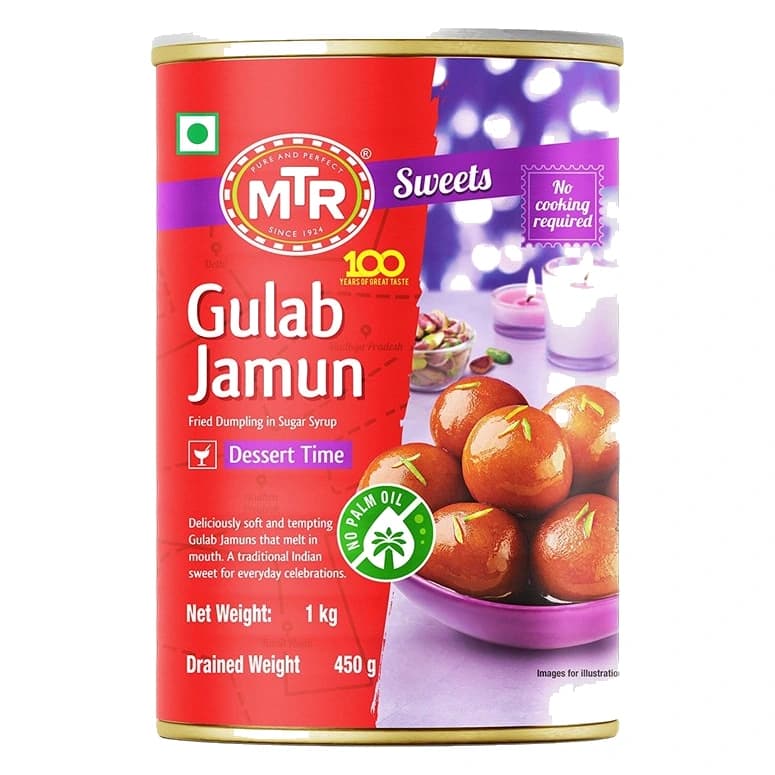
MTR Gulab Jamun
Red flags
- −Red flag: High added sugar (47g per 100g)
- −Red flag: Refined flour (maida) base
Green flags
- +Green flag: Low sodium
Ingredients, decoded
6 listed- Sugar syrup (Sugar, Water)
- Khoa (9.4%)
- Refined wheat flour (Maida)
- Refined rice bran oil
- Raising agent [INS 500(ii)]
- Cardamom powder & its oleoresin
Our take
CleanPlate reviewCanned gulab jamun: 47 g added sugar per 100 g
MTR Gulab Jamun is a 1 kg can of fried dumplings in sugar syrup, made from sugar syrup, khoa (9.4%), refined wheat flour, rice bran oil, a raising agent and cardamom. The panel is printed per 100 g with a 55 g serve.
CleanPlate scores it EB4. The E for nutrition is low: almost no credited protein, fibre or micronutrients per 100 g. The B for ingredients reflects mostly refined or industrial ingredients (led by sugar syrup, khoa and refined wheat flour), and almost no additives. The 4 for risk comes mainly from free sugar (49.6 g per 100 g) and saturated fat (2.3 g per 100 g).
Claims vs reality
What the pack says, checked against the ingredient list and nutrition panel.
- On the packHolds
“No Palm Oil”
The oil is refined rice bran oil.
- On the packHolds
“No cooking required”
It is ready to eat from the can.
- On the packHolds
“Fried Dumpling in Sugar Syrup”
The list is syrup, khoa and flour with fried dumplings.
How EB4 breaks down
Each grade is scored on its own. Here are the label numbers behind each one, per 100 g.
Very low nutrient density
- Protein
- 2 g
- Fibre
- Not declared
- Vitamins and minerals
- None declared
- Energy
- 269 kcal
Scored on protein, fibre and twelve vitamins and minerals, against the Codex and FSSAI "source" and "high" levels, per 100 g and per 100 kcal.
Good, few concerning additives
- Base
- Sugar syrup
- Main fat
- Refined rice bran oil
- Sweeteners
- Sugar syrup
- Additives
- 1
- Flagged
- Maida
Scored on how processed the ingredients are, which additives are used and why, and whether the label keeps its promises.
High risk
- Added sugar
- 47 g
- Sodium
- 15 mg
- Saturated fat
- 2.3 g
Scored on free sugar, sodium, saturated fat and trans fat, each weighed by how strong the evidence of harm is.
A closer look
Does the label add up?
Sugar syrup (sugar and water), khoa (9.4%), refined wheat flour (maida), refined rice bran oil, raising agent (INS 500(ii)) and cardamom powder and its oleoresin.
Per 100 g: 269 kcal, 5 g fat of which 2.3 g saturated, 50 g sugar of which 47 g added, 2 g protein, 15 mg sodium. The listing ingredients (milk solids 18%, edible vegetable fat, acidity regulator) do not match the pack; the pack is used. Trans fat is printed as under 0.1 g and is not stored. Protein is 2 g per 100 g and earns no credit.
Ingredients to watch
- Added sugarConcern
47 g per 100 g; a 55 g serve is 52% of the daily limit.
- EnergyWorth watching
269 kcal per 100 g.
- IngredientsFine
Short list: syrup, khoa, flour, oil, raising agent, cardamom.
- AdditivesFine
No preservative, colour or flavouring.
Common misconceptions
Myth: "Traditional sweets are healthier"
A 55 g serve has about 26 g of added sugar.
Myth: "Khoa makes it a dairy dessert"
Khoa is 9.4% of the can.
How often, and how
- Healthy adultsA piece, occasionally
- ChildrenOccasionally
- Diabetes or prediabetesOccasionally, watch the sugar
Smarter ways to eat it
One piece
Two small jamuns is about 55 g.
Drain the syrup
Most of the sugar is in the syrup.
Common questions
Is MTR Gulab Jamun healthy?
MTR Gulab Jamun scores EB4 (Poor) on CleanPlate, which makes it best kept as a rare treat rather than a regular buy. The main concerns are: High added sugar (47g per 100g); Refined flour (maida) base. On the plus side: Low sodium.
What does the EB4 score mean?
The first letter (E) grades nutritional value: very low nutrient density. The second letter (B) grades ingredient and label integrity: good, few concerning additives. The number (4) grades risk nutrients (sugar, sodium, saturated fat): high risk.
Which ingredients in MTR Gulab Jamun should I watch?
Refined wheat flour (Maida) (Maida).
Last reviewed October 19, 2026. Scored with the CleanPlate method from the published label.
Better Indian Sweets
All 9 →- Sweet Karam Coffee Peanut Chikki
- −Red flag: High added sugar (28.2g per 100g)
- +Green flag: High protein (14.1g per 100g)
- Sweet Karam Coffee Sesame Chikki Bites
- −Red flag: High added sugar (29g per 100g)
- +Green flag: Source of protein (8.7g)
- Chheda's Peanut Chikki
- −Red flag: High sugar (40g per 100g)
- +Green flag: High protein (20g per 100g)
- Haldiram's Nagpur Rasgulla
- −Red flag: High sugar (51.9g per 100g)
- +Green flag: Source of protein (8.5g)