Parle Nutricrunch Digestives
Red flags
- −Red flag: High added sugar (14.4g per 100g)
- −Red flag: High saturated fat (9.2g)
- −Red flag: Refined flour (maida) base
- −Red flag: Palm oil listed
Green flags
- +Green flag: Source of protein (6.7g)
- +Green flag: High fibre (6g)
Ingredients, decoded
14 listed- Refined Wheat Flour (Maida) (40%)
- Refined Palm Oil
- Wheat Flour (Atta) (19%)
- Sugar
- Sorghum Flour (5%)
- Wheat Bran (4.4%)
- Wheat Fibre (1.2%)
- Milk Solids
- Malt Extract
- Raising Agents [503(ii), 500(ii)]
- Iodised Salt
- Invert Sugar Syrup
- Vitamins and Minerals (0.3%)
- Emulsifier of Vegetable Origin (Diacetyltartaric and Fatty Acid Esters of Glycerol)
Our take
CleanPlate reviewDigestive biscuit with jowar, mostly refined flour
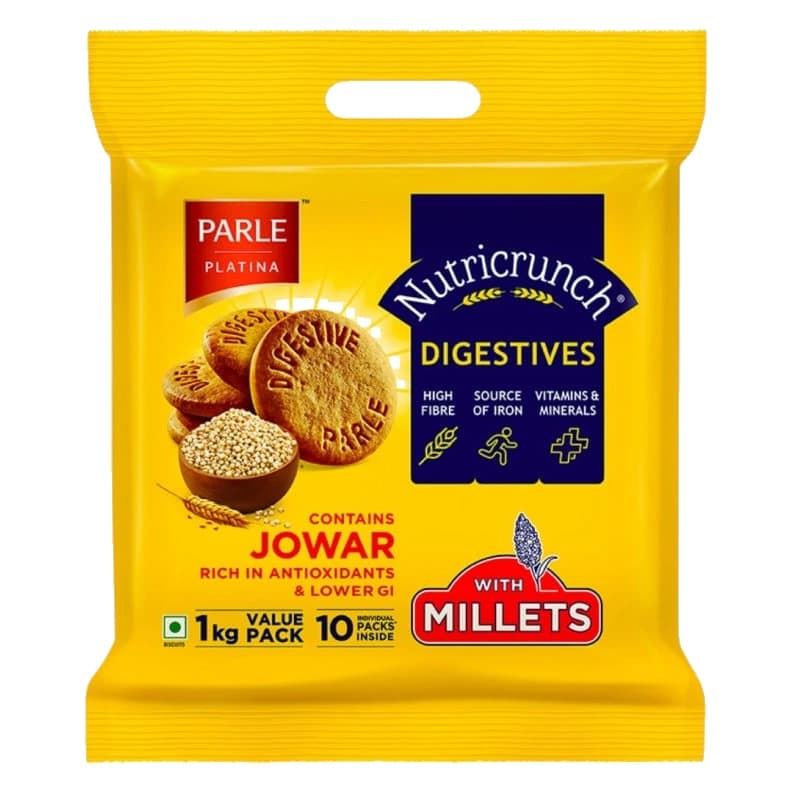
Parle Platina Nutricrunch Digestives with Millets is a wheat biscuit that lists 5% sorghum (jowar) flour, 4.4% wheat bran and 1.2% wheat fibre. It is sold as a 1 kg value pack of 10 individual packs, and refined wheat flour (40%) and refined palm oil lead the list.
CleanPlate scores it CB4. The C for nutrition is middling: 6 g fibre per 100 g; its 6.7 g of protein earns no credit because it is under 2.75 g per 100 kcal. Added vitamins earn no credit in this product type. The B for ingredients reflects mostly refined or industrial ingredients (led by refined wheat flour, refined palm oil and wheat flour), with additives that cost points: glycerol. The 4 for risk comes mainly from saturated fat (9.2 g per 100 g) and calories (489 kcal per 100 g).
Claims vs reality
What the pack says, checked against the ingredient list and nutrition panel.
- On the packHolds
“High Fibre”
The panel prints 6 g of fibre per 100 g, which meets the high-fibre test.
- On the packHolds
“Source of Iron”
The panel prints 3.2 mg of iron per 100 g, enough to meet the source-of-iron test.
- On the packBe careful
“Rich in antioxidants & lower GI”
No antioxidant or glycaemic value is printed; jowar is 5% of the biscuit.
- On the packPartly true
“Contains Jowar / With Millets”
Sorghum flour is listed at 5%; no other millet is listed.
How CB4 breaks down
Each grade is scored on its own. Here are the label numbers behind each one, per 100 g.
Adequate nutrient density
- Protein
- 6.7 g
- Fibre
- 6 g
- Vitamins and minerals
- 9 declared
- Energy
- 489 kcal
Scored on protein, fibre and twelve vitamins and minerals, against the Codex and FSSAI "source" and "high" levels, per 100 g and per 100 kcal.
Good, few concerning additives
- Base
- Refined Wheat Flour
- Main fat
- Refined Palm Oil
- Sweeteners
- Sugar, Invert Sugar Syrup
- Additives
- 3
- Flagged
- Maida, Palm oil
Scored on how processed the ingredients are, which additives are used and why, and whether the label keeps its promises.
High risk
- Added sugar
- 14.4 g
- Sodium
- 251 mg
- Saturated fat
- 9.2 g
- Trans fat
- 0 g
Scored on free sugar, sodium, saturated fat and trans fat, each weighed by how strong the evidence of harm is.
A closer look
Does the label add up?
Refined wheat flour (maida) 40%, refined palm oil, wheat flour (atta) 19%, sugar, sorghum flour 5%, wheat bran 4.4%, wheat fibre 1.2%, milk solids, malt extract, raising agents, iodised salt, invert sugar syrup, vitamins and minerals 0.3% and an emulsifier; the added flavours are artificial (cereal, milk, vanilla).
Per 100 g: 489 kcal, 20 g fat of which 9.2 g saturated, 15.6 g sugar of which 14.4 g added, 6 g fibre, 6.7 g protein, 251 mg sodium. The back panel photo is low resolution and was read from crops, so the score is provisional. Added vitamins and minerals earn no credit in a biscuit. Net 1 kg (10 individual packs).
Ingredients to watch
- Saturated fatConcern
9.2 g per 100 g, mostly from the refined palm oil.
- Added sugarWorth watching
14.4 g per 100 g, with sugar, malt extract and invert sugar syrup all listed.
- FibreFine
6 g per 100 g from atta, wheat bran and wheat fibre.
Common misconceptions
Myth: "Digestive means good for digestion"
It is a biscuit style; the panel gives 6 g of fibre per 100 g, but 40% of the biscuit is refined flour.
Myth: "With millets means a millet biscuit"
Sorghum flour is 5%; wheat flours make up most of the rest.
How often, and how
- Healthy adultsA few times a week
- ChildrenOccasionally
- Diabetes or prediabetesOccasionally, watch the sugar
Smarter ways to eat it
Eat it with milk or curd
A little protein steadies a sweet, refined biscuit.
Keep it to a couple
At 489 kcal per 100 g, two or three biscuits go a long way.
Common questions
Is Parle Nutricrunch Digestives healthy?
Parle Nutricrunch Digestives scores CB4 (Fair) on CleanPlate, which makes it an occasional-use product, where the concerns start to outweigh the positives. The main concerns are: High added sugar (14.4g per 100g); High saturated fat (9.2g); Refined flour (maida) base; Palm oil listed. On the plus side: Source of protein (6.7g); High fibre (6g).
What does the CB4 score mean?
The first letter (C) grades nutritional value: adequate nutrient density. The second letter (B) grades ingredient and label integrity: good, few concerning additives. The number (4) grades risk nutrients (sugar, sodium, saturated fat): high risk.
Which ingredients in Parle Nutricrunch Digestives should I watch?
Refined Wheat Flour (Maida) (40%) (Maida), Refined Palm Oil (Palm oil).
Last reviewed October 19, 2026. Scored with the CleanPlate method from the published label.