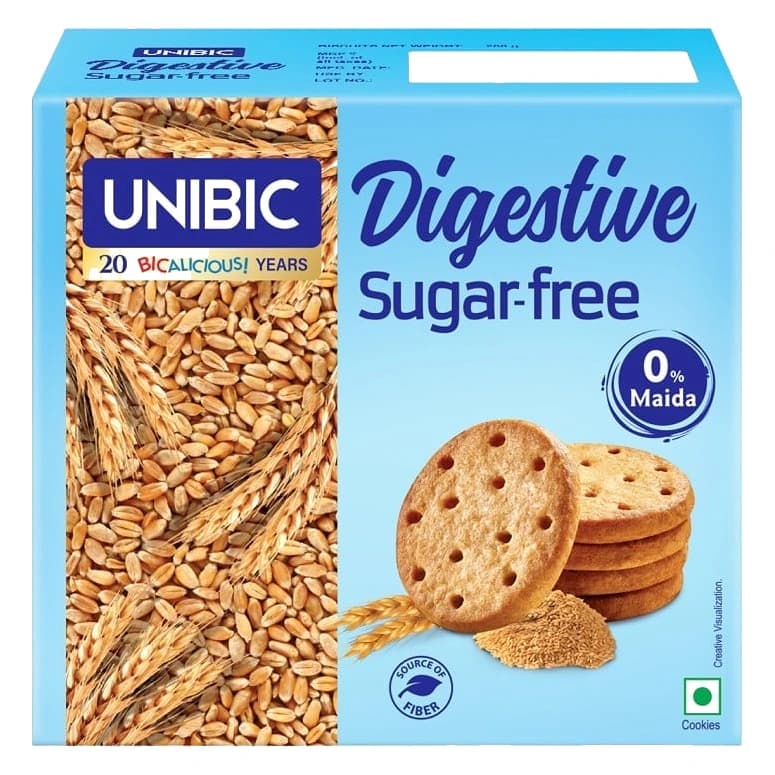
Unibic Sugar-Free Digestive Cookies
Red flags
- −Red flag: High saturated fat (11.5g)
Green flags
- +Green flag: Source of protein (7g)
- +Green flag: Source of fibre
- +Green flag: No added sugar
Ingredients, decoded
9 listed- Whole Wheat Flour (Atta)
- Edible Vegetable Oil (Palm)
- Sweetener (INS 965 - Maltitol)
- Wheat Bran (5 %)
- Fructooligosaccharide (Dietary Fibre)
- Leavening Agents (INS 503 ii, INS 500 ii)
- Iodised Salt
- Emulsifier (INS 322 from Soy)
- Natural Flavouring Substance (Milk)
Our take
CleanPlate reviewSugar-free digestives, but 24 g fat per 100 g
Unibic Sugar-Free Digestive Cookies is whole wheat flour (atta), palm oil, maltitol, wheat bran (5%) and fructooligosaccharide, with raising agents, salt, soy lecithin and a natural milk flavouring. The pack is 200 g and the panel is printed per 100 g.
CleanPlate scores it EB4. The E for nutrition is low: almost no credited protein, fibre or micronutrients per 100 g; its 7 g of protein earns no credit because it is under 2.75 g per 100 kcal. The B for ingredients reflects a mix of whole and refined ingredients (led by whole wheat flour, edible vegetable oil and wheat bran), with additives that cost points: maltitol. The 4 for risk comes mainly from saturated fat (11.5 g per 100 g) and calories (452 kcal per 100 g).
Claims vs reality
What the pack says, checked against the ingredient list and nutrition panel.
- Product nameHolds
“Sugar-Free”
Total sugars are 0.5 g per 100 g and added sugar is 0 g; the sweetness comes from 18 g of polyols (maltitol).
- On the packHolds
“0% Maida”
No refined wheat flour is listed; the flour is whole wheat atta.
- On the packPartly true
“Packed with 100% atta”
Whole wheat flour leads the list but no percentage is declared, and wheat bran, palm oil and maltitol make up the rest.
- On the packPartly true
“Packed with dietary fibre”
Fibre is 3.8 g per 100 g, just above the 3 g source line, and 1.5 g of it is added fructooligosaccharide.
How EB4 breaks down
Each grade is scored on its own. Here are the label numbers behind each one, per 100 g.
Very low nutrient density
- Protein
- 7 g
- Fibre
- 3.8 g
- Vitamins and minerals
- None declared
- Energy
- 452 kcal
Scored on protein, fibre and twelve vitamins and minerals, against the Codex and FSSAI "source" and "high" levels, per 100 g and per 100 kcal.
Good, few concerning additives
- Base
- Whole Wheat Flour
- Main fat
- Edible Vegetable Oil
- Sweeteners
- Sweetener
- Additives
- 3
- Flagged
- None
Scored on how processed the ingredients are, which additives are used and why, and whether the label keeps its promises.
High risk
- Added sugar
- 0 g
- Sodium
- 254 mg
- Saturated fat
- 11.5 g
- Trans fat
- 0 g
Scored on free sugar, sodium, saturated fat and trans fat, each weighed by how strong the evidence of harm is.
A closer look
Does the label add up?
Whole wheat flour (atta), edible vegetable oil (palm), sweetener (INS 965, maltitol), wheat bran (5%), fructooligosaccharide (dietary fibre), leavening agents (503(ii), 500(ii)), iodised salt, emulsifier (INS 322 from soy) and natural flavouring substance (milk).
Per 100 g: 452 kcal, 24 g fat of which 11.5 g saturated, 0.5 g sugar of which 0 g added, 3.8 g fibre, 7 g protein, 254 mg sodium. Energy is declared as 452.4 kcal against an Atwater sum of about 488 kcal, 8% above it, because the 18 g of polyols carry less energy than ordinary carbohydrate. The side panel prints the added fibre (1.5 g per 100 g) and the polyols warning. Net weight 200 g, serve 30 g.
Ingredients to watch
- Saturated fatConcern
11.5 g per 100 g, about 2.3 times the 5 g high line, from palm oil.
- CaloriesWorth watching
452 kcal per 100 g, about 136 kcal in a 30 g serve.
- MaltitolWorth watching
18 g of polyols per 100 g; the pack warns they may have a laxative effect, and maltitol still raises blood sugar.
- ProteinWorth watching
7 g per 100 g, too little per calorie to earn credit.
Common misconceptions
Myth: "Sugar-free means low calorie"
It has 452 kcal per 100 g; the sugar is replaced by 24 g of fat and 18 g of maltitol.
Myth: "Digestive biscuits are high in fibre"
This one has 3.8 g per 100 g, of which 1.5 g is added fructooligosaccharide.
How often, and how
- Healthy adultsOccasionally
- ChildrenRarely
- Diabetes or prediabetesLimit
Smarter ways to eat it
Keep to the 30 g serve
A 30 g serve is about 136 kcal, so a few cookies rather than the 200 g pack.
Pair with plain tea or curd
Eat them with unsweetened tea or plain curd rather than another sweet snack.
Common questions
Is Unibic Sugar-Free Digestive Cookies healthy?
Unibic Sugar-Free Digestive Cookies scores EB4 (Poor) on CleanPlate, which makes it best kept as a rare treat rather than a regular buy. The main concerns are: High saturated fat (11.5g). On the plus side: Source of protein (7g); Source of fibre; No added sugar.
What does the EB4 score mean?
The first letter (E) grades nutritional value: very low nutrient density. The second letter (B) grades ingredient and label integrity: good, few concerning additives. The number (4) grades risk nutrients (sugar, sodium, saturated fat): high risk.
Last reviewed October 19, 2026. Scored with the CleanPlate method from the published label.
Better Biscuits & Cookies
All 33 →- Unibic Oats Digestive Cookies
- −Red flag: High added sugar (16.6g per 100g)
- −Red flag: High sodium (655.7mg per 100g)
- Britannia NutriChoice 5 Grain Digestive Biscuit
- −Red flag: High added sugar (17.3g per 100g)
- −Red flag: High saturated fat (9.7g)
- Britannia NutriChoice Digestive High-Fibre Biscuit
- −Red flag: High added sugar (12.1g per 100g)
- −Red flag: High saturated fat (10.3g)
- Britannia NutriChoice Digestive Zero Biscuit
- −Red flag: High saturated fat (10.2g)
- −Red flag: Contains Maltodextrin