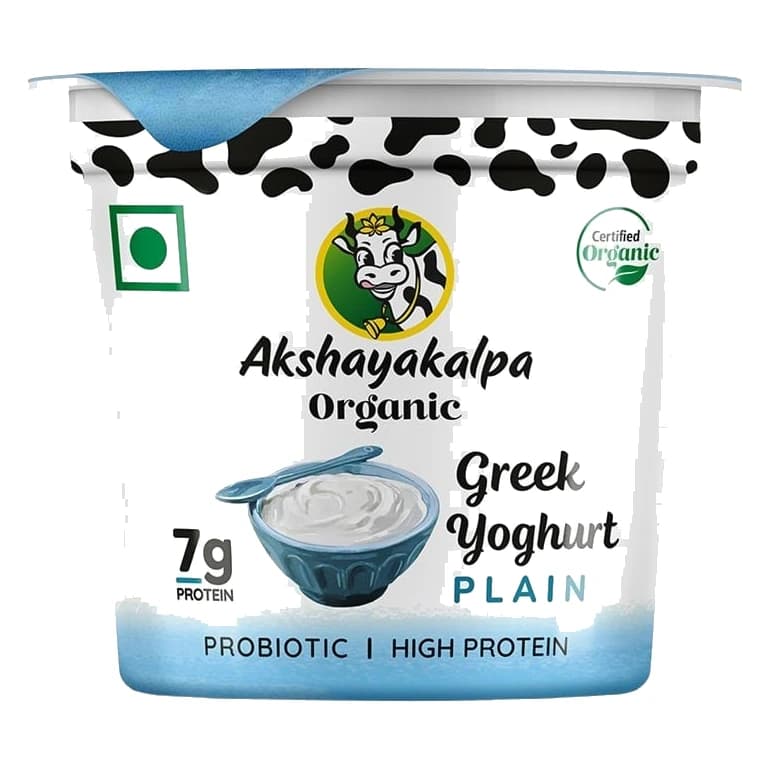
Akshayakalpa Organic Plain Greek Yogurt
Red flags
No major red flags on the label.
Green flags
- +Green flag: Source of protein (7.8g)
- +Green flag: No added sugar
- +Green flag: Low sodium
Ingredients, decoded
2 listed- Organic Milk and Milk Solids
- Active Culture
Our take
CleanPlate reviewOrganic Greek yogurt with 7.8 g protein
Akshayakalpa Organic Plain Greek Yogurt is a 90 g pot made from organic milk and milk solids with an active culture. The panel is printed per 90 g serve and converted here to per 100 g.
CleanPlate scores it CA1. The C for nutrition is middling: 7.8 g protein per 100 g. The A for ingredients reflects whole or lightly processed ingredients (led by organic milk and milk solids), and almost no additives. The 1 for risk is low: sodium, free sugar and saturated fat are all modest (sodium 57.2 mg, free sugar 0 g, saturated fat 2.71 g per 100 g).
Claims vs reality
What the pack says, checked against the ingredient list and nutrition panel.
- On the packHolds
“HIGH PROTEIN”
7.8 g per 100 g is about a third of the energy.
- On the packHolds
“PROBIOTIC”
The pack names Bifidobacterium animalis lactis -12 at 10 to the 8 CFU per serving or more.
- On the packHolds
“Certified Organic”
The back carries NPOP certification by Aditi Organic Certifications.
- On the packPartly true
“Made from organic Milk, and nothing else”
Milk solids and a culture are also listed.
How CA1 breaks down
Each grade is scored on its own. Here are the label numbers behind each one, per 100 g.
Adequate nutrient density
- Protein
- 7.8 g
- Fibre
- Not declared
- Vitamins and minerals
- None declared
- Energy
- 97 kcal
Scored on protein, fibre and twelve vitamins and minerals, against the Codex and FSSAI "source" and "high" levels, per 100 g and per 100 kcal.
Clean, minimally processed
- Base
- Organic Milk and Milk Solids
- Sweeteners
- None added
- Additives
- 0
- Flagged
- None
Scored on how processed the ingredients are, which additives are used and why, and whether the label keeps its promises.
Clean
- Added sugar
- 0 g
- Sodium
- 57.2 mg
- Saturated fat
- 2.7 g
- Trans fat
- 0 g
Scored on free sugar, sodium, saturated fat and trans fat, each weighed by how strong the evidence of harm is.
A closer look
Does the label add up?
Organic milk and milk solids, active culture.
Per 100 g: 96.7 kcal, 3.89 g fat of which 2.71 g saturated, 7.61 g sugar of which 0 g added, 7.8 g protein, 57.2 mg sodium. The pack panel is per 90 g (87 kcal, protein 7.02 g, total fat 3.5 g, sodium 51.5 mg) and is divided by 0.9. No calcium is declared, so none is credited. The 7.6 g of sugar per 100 g is lactose.
Ingredients to watch
- Saturated fatWorth watching
2.7 g per 100 g from whole-milk fat.
- ProteinFine
7.8 g per 100 g.
- SugarFine
7.6 g, all lactose; none added.
Common misconceptions
Myth: "Organic yogurt has more protein"
7.8 g per 100 g is in line with other plain Greek yogurts.
Myth: "Probiotic means more protein"
The culture adds no protein.
How often, and how
- Healthy adultsDaily
- ChildrenDaily
- Diabetes or prediabetesA good choice
Smarter ways to eat it
Add fruit or seeds
Fibre is not on the panel; seeds add it.
Use as a base
Works in raita and dips.
Common questions
Is Akshayakalpa Organic Plain Greek Yogurt healthy?
Akshayakalpa Organic Plain Greek Yogurt scores CA1 (Very Good) on CleanPlate, which makes it a strong choice that holds up on nutrition and ingredients. We found no major red flags on its label. On the plus side: Source of protein (7.8g); No added sugar; Low sodium.
What does the CA1 score mean?
The first letter (C) grades nutritional value: adequate nutrient density. The second letter (A) grades ingredient and label integrity: clean, minimally processed. The number (1) grades risk nutrients (sugar, sodium, saturated fat): clean.
Last reviewed October 19, 2026. Scored with the CleanPlate method from the published label.
Better Curd & Yogurt
All 11 →- Amul Greek Yogurt (Plain)
- +Green flag: Source of protein (8g)
- +Green flag: No added sugar
- Milky Mist Skyr High Protein Plain Yogurt
- +Green flag: High protein (11g per 100g)
- +Green flag: No added sugar
- Epigamia Alphonso Mango Flavoured Greek Yogurt
- +Green flag: Source of protein (6g)
- +Green flag: Low sodium
- Epigamia Mixed Berries Flavoured Greek Yogurt
- +Green flag: Source of protein (6.3g)
- +Green flag: No added sugar