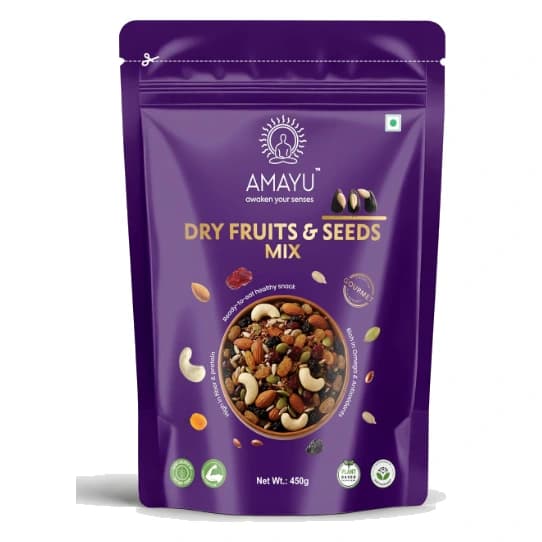
AMAYU Dry Fruits & Seeds Mix
Red flags
- −Red flag: High saturated fat (6.7g)
Green flags
- +Green flag: High protein (29.6g per 100g)
- +Green flag: High fibre (8.9g)
- +Green flag: Low sodium
Ingredients, decoded
8 listed- Almond
- Cashew
- Raisin
- Black Raisin
- Pumpkin Seed
- Sunflower Seed
- Flax Seed
- Cranberry
Our take
CleanPlate reviewNut, seed and raisin mix with doubtful panel values
AMAYU Dry Fruits & Seeds Mix is almond, cashew, raisin, black raisin, pumpkin seed, sunflower seed, flax seed and cranberry, with no percentages declared. The pack is 450 g and the panel is printed per 100 g with a 25 g serve. It is sold on other platforms as a trail mix.
CleanPlate scores it [L]CA3. The C for nutrition is middling: 8.93 g fibre and some iron per 100 g. The declared protein figure is not credited because the ingredients cannot supply it. The A for ingredients reflects whole or lightly processed ingredients (led by almond, cashew and raisin), and almost no additives. The [L] marks a declared value that the ingredients cannot support. The 3 for risk comes mainly from calories (550 kcal per 100 g) and saturated fat (6.73 g per 100 g).
Claims vs reality
What the pack says, checked against the ingredient list and nutrition panel.
- On the packMisleading
“High in fiber & protein”
Fibre, 8.93 g per 100 g, passes. The printed protein of 29.56 g is about 1.5 times what the listed nuts and seeds supply (about 19 g), so the protein half rests on a value the list cannot support.
- On the packBe careful
“Rich in omega & antioxidants”
The panel prints polyunsaturated fat (11 g) but no omega-3 and no antioxidant line, so there is nothing on the pack to test the claim against.
- On the packBe careful
“Ready-to-eat healthy snack”
A general wellness phrase; the mix carries about 550 kcal per 100 g.
How CA3 breaks down
Each grade is scored on its own. Here are the label numbers behind each one, per 100 g.
Adequate nutrient density
- Protein
- 29.6 g
- Fibre
- 8.9 g
- Vitamins and minerals
- Vitamin C, Calcium, Iron
- Energy
- 550 kcal
Scored on protein, fibre and twelve vitamins and minerals, against the Codex and FSSAI "source" and "high" levels, per 100 g and per 100 kcal.
Clean, minimally processed
- Base
- Almond
- Sweeteners
- None added
- Additives
- 0
- Flagged
- None
Scored on how processed the ingredients are, which additives are used and why, and whether the label keeps its promises.
Moderate risk
- Total sugar
- 9 g
- Sodium
- 70.3 mg
- Saturated fat
- 6.7 g
Scored on free sugar, sodium, saturated fat and trans fat, each weighed by how strong the evidence of harm is.
[L] The name or pack claims promise more than the ingredient list delivers. See Claims vs reality.
A closer look
Does the label add up?
Almond, cashew, raisin, black raisin, pumpkin seed, sunflower seed, flax seed, cranberry; no percentages are declared, and seeds are named in the title without a percentage.
Per 100 g: 550 kcal, 40.8 g fat of which 6.73 g saturated, 8.96 g sugar, 8.93 g fibre, 29.6 g protein, 70.3 mg sodium. Sodium is printed as 70.3 gm; 70.3 g per 100 g is impossible, so it is read as 70.3 mg and the score is provisional. Protein (29.56 g) is not credited, and total sugar (8.96 g) is too low for a mix with raisins and cranberries, so the risk grade is held at 3 or worse. The panel header reads per 100 g but the column says per serving; values are taken as per 100 g. The pack photos show 450 g; other listings call the same product a 900 g trail mix.
Ingredients to watch
- CaloriesConcern
549.8 kcal per 100 g, about twice the 275 kcal density line.
- SugarWorth watching
The printed 8.96 g per 100 g is low for a mix with raisins and cranberries, so check the pack.
- FibreFine
8.9 g per 100 g from the nuts, seeds and fruit.
- IngredientsFine
Whole nuts, seeds and dried fruit only, with no additives and no added sugar listed.
Common misconceptions
Myth: "A trail mix is a low-sugar snack"
Raisins and cranberries carry sugar of their own; the printed 8.96 g per 100 g looks low for this list.
Myth: "High in protein means 30 g per 100 g"
The printed protein is about 1.5 times what the listed nuts and seeds supply, so it is not credited.
How often, and how
- Healthy adultsA small handful most days
- ChildrenA small handful most days
- Diabetes or prediabetesA small handful, watch the portion
Smarter ways to eat it
Keep to a small handful
A printed 25 g serve is about 137 kcal.
Add to oats or yogurt
The pack suggests sprinkling it on oatmeal, yogurt or salads.
Common questions
Is AMAYU Dry Fruits & Seeds Mix healthy?
AMAYU Dry Fruits & Seeds Mix scores CA3 (Good) on CleanPlate, which makes it a reasonable choice with a trade-off or two worth knowing about. The main concerns are: High saturated fat (6.7g). On the plus side: High protein (29.6g per 100g); High fibre (8.9g); Low sodium.
What does the CA3 score mean?
The first letter (C) grades nutritional value: adequate nutrient density. The second letter (A) grades ingredient and label integrity: clean, minimally processed. The number (3) grades risk nutrients (sugar, sodium, saturated fat): moderate risk.
Last reviewed October 19, 2026. Scored with the CleanPlate method from the published label.
Better Nuts & Trail Mixes
All 17 →- Tata Sampann Premium Pumpkin Seeds
- −Red flag: High saturated fat (8.8g)
- +Green flag: High protein (33.9g per 100g)
- Bolas Royal Almonds
- +Green flag: High protein (21.4g per 100g)
- +Green flag: High fibre (9.9g)
- Farmley Classic Delight Date Bites
- −Red flag: High sugar (31.3g per 100g)
- +Green flag: High protein (11.6g per 100g)