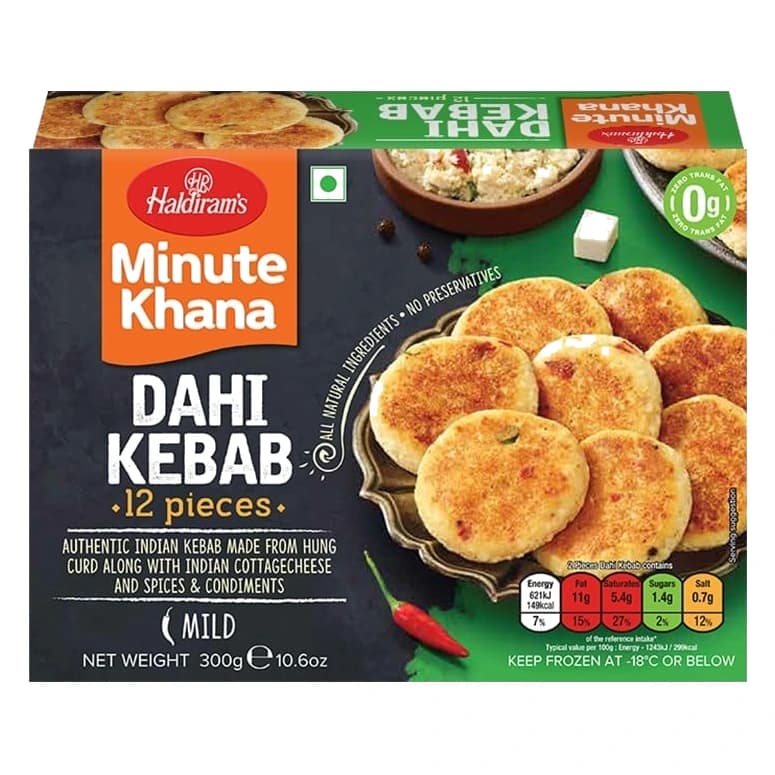
Haldiram's Dahi Veg Kebab (Frozen)
Red flags
- −Red flag: High saturated fat (10g)
Green flags
- +Green flag: Source of protein (10g)
- +Green flag: No added sugar
- +Green flag: No additives
Ingredients, decoded
13 listed- Yoghurt (Milk) 59%
- Indian Cottage Cheese (25%)
- Chickpea Flour
- Refined Sunflower Oil
- Arrowroot Powder
- Green Chilli
- Fresh Garlic
- Salt
- Fresh Ginger
- Wheat Flour
- Spices (Cardamom, Cinnamon, Nutmeg, Mace, Cumin Seeds, Coriander, Cloves, Curry Leaves)
- Red Chilli Powder
- Black Pepper
Our take
CleanPlate reviewFrozen curd and cottage cheese kebab
Haldiram's Dahi Veg Kebab is a 300 g pack of 12 frozen kebabs made from yoghurt (59%) and Indian cottage cheese (25%), bound with chickpea flour, sunflower oil, arrowroot and spices.
CleanPlate scores it DA4. The D for nutrition is low: only 10 g protein per 100 g and little else credited. The A for ingredients reflects whole or lightly processed ingredients (led by yoghurt, indian cottage cheese and chickpea flour), and almost no additives. The 4 for risk comes mainly from saturated fat (10 g per 100 g) and sodium (520 mg per 100 g).
Claims vs reality
What the pack says, checked against the ingredient list and nutrition panel.
- On the packHolds
“Authentic Indian kebab made from hung curd along with Indian cottage cheese and spices & condiments”
Yoghurt and cottage cheese are the first two ingredients, at 59% and 25%.
- On the packHolds
“Suitable for vegetarians”
The list is vegetarian.
- On the packHolds
“No artificial colours”
No colour is listed.
How DA4 breaks down
Each grade is scored on its own. Here are the label numbers behind each one, per 100 g.
Low nutrient density
- Protein
- 10 g
- Fibre
- Not declared
- Vitamins and minerals
- None declared
- Energy
- 300 kcal
Scored on protein, fibre and twelve vitamins and minerals, against the Codex and FSSAI "source" and "high" levels, per 100 g and per 100 kcal.
Clean, minimally processed
- Base
- Yoghurt 59%
- Main fat
- Refined Sunflower Oil
- Sweeteners
- None added
- Additives
- 0
- Flagged
- None
Scored on how processed the ingredients are, which additives are used and why, and whether the label keeps its promises.
High risk
- Added sugar
- 0 g
- Sodium
- 520 mg
- Saturated fat
- 10 g
- Trans fat
- 0 g
Scored on free sugar, sodium, saturated fat and trans fat, each weighed by how strong the evidence of harm is.
A closer look
Does the label add up?
Yoghurt (milk) 59%, Indian cottage cheese (25%), chickpea flour, refined sunflower oil, arrowroot powder, green chilli, fresh garlic, salt, fresh ginger, wheat flour, spices (cardamom, cinnamon, nutmeg, mace, cumin, coriander, cloves, curry leaves), red chilli powder and black pepper.
Per 100 g: 300 kcal, 22 g fat of which 10 g saturated, 2 g sugar of which 0 g added, 10 g protein, 520 mg sodium. The panel is per 2 pieces (50 g); values are doubled to per 100 g (150 kcal becomes 300). Sodium prints as '260g' and is read as 260 mg. Fibre prints as under 1 g and is not stored. Allergens and veg status come from the earlier record. Net 300 g (6 servings of 50 g).
Ingredients to watch
- Saturated fatConcern
10 g per 100 g from the dairy and the oil.
- SodiumWorth watching
520 mg per 100 g.
- CaloriesWorth watching
300 kcal per 100 g.
- IngredientsFine
Yoghurt and cottage cheese are 84% of the list, with no additives.
Common misconceptions
Myth: "A dahi kebab is a light snack"
It is 300 kcal and 10 g of saturated fat per 100 g.
Myth: "Curd-based means low fat"
Fat is 22 g per 100 g, from the dairy and the sunflower oil.
How often, and how
- Healthy adultsA few times a week
- ChildrenOccasionally
- Diabetes or prediabetesOccasionally
Smarter ways to eat it
Bake it rather than fry it
The pack's oven option avoids extra oil.
Serve with chutney and salad
The pack suggests pudina chutney; a salad adds the fibre.
Common questions
Is Haldiram's Dahi Veg Kebab (Frozen) healthy?
Haldiram's Dahi Veg Kebab (Frozen) scores DA4 (Fair) on CleanPlate, which makes it an occasional-use product, where the concerns start to outweigh the positives. The main concerns are: High saturated fat (10g). On the plus side: Source of protein (10g); No added sugar; No additives.
What does the DA4 score mean?
The first letter (D) grades nutritional value: low nutrient density. The second letter (A) grades ingredient and label integrity: clean, minimally processed. The number (4) grades risk nutrients (sugar, sodium, saturated fat): high risk.
Last reviewed October 19, 2026. Scored with the CleanPlate method from the published label.
Better Frozen Ready Meals & Snacks
All 134 →- Delichic Boneless Frozen Chicken Tikka Cubes Cut
- +Green flag: High protein (29.5g per 100g)
- +Green flag: No additives
- Hello Tempayy Achari Tadka Protein Paratha
- +Green flag: High protein (15.8g per 100g)
- +Green flag: High fibre (6.4g)
- Hello Tempayy Punjabi Style Protein Paratha
- +Green flag: High protein (15.9g per 100g)
- +Green flag: High fibre (6.1g)
- Delichic Marinated Tandoori Chicken Tikka
- +Green flag: High protein (22g per 100g)
- +Green flag: No additives