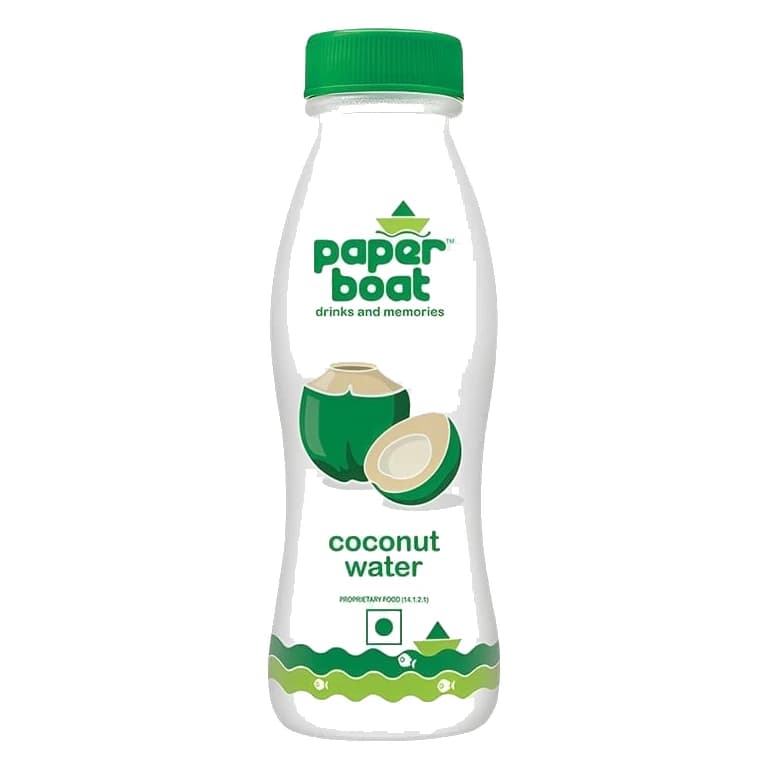
Paper Boat Coconut Water
Published · Updated
Paper Boat Coconut Water is a ready-to-drink tender coconut water, almost entirely coconut water with a little sugar and a preservative. It scores EA1: low on nutrition because it has no protein or fibre, top on ingredients for a short, plain list, and low on risk because sugar, sodium and calories are light. Easy to drink regularly, as a drink rather than a food.
Ingredients, decoded
2 listed- Coconut Water (99%)
- Sugar And Preservative (Nisin)
1 teaspoon of sugar in every 100 ml · 6 g total sugar, 5 g a teaspoon
| Energy | 24 kcal |
|---|---|
| Protein | 0 g |
| Carbohydrates | 6 g |
| Total sugars | 6 g |
| Added sugars | 1 g |
| Total fat | 0 g |
| Cholesterol | 0 mg |
| Sodium | 8.5 mg |
Think this score is wrong?
What to know about Paper Boat Coconut Water
Nearly all coconut water, with sugar and little else
Paper Boat Coconut Water is a 200 ml ready-to-drink bottle of tender coconut water. The list has two lines: coconut water at 99%, then sugar and a preservative, nisin. It is bought as a light, thirst-quenching drink, often on hot days or after exercise.
One bottle, which is one serve, gives 48 kcal, 12 g sugar and 17 mg sodium. Per 100 ml that is 24 kcal, 6 g carbohydrate and sugar, 1 g of it declared as added sugar, and 8.5 mg sodium. There is no protein, no fat and no cholesterol, and no vitamins or minerals are declared.
The name says coconut water and the list agrees, at 99%. The extras on the promo card are mostly framing: the drink hydrates because it is mostly water, and the energy comes from sugar. CleanPlate scores it EA1.
Why Paper Boat Coconut Water scores EA1
Nutrition is an E because there is no protein, fibre or declared vitamin, but ingredients are an A on a two-line list at 99% coconut water. Risk is a 1: 1 g added sugar and 8.5 mg sodium per 100 ml.
Very low nutrient density
- Protein
- 0 g
- Fibre
- Not declared
- Vitamins and minerals
- None declared
- Energy
- 24 kcal
01 Nutrition density: why E
Protein is 0 g, fat is 0 g and no fibre is declared, so the drink earns no nutrition credit. The only macro is 6 g of carbohydrate per 100 ml, all of it sugar.
No vitamins or minerals are declared on the panel, so there is nothing to lift the grade. Energy is light at 24 kcal per 100 ml, 48 kcal per bottle.
Scored on protein, fibre and twelve vitamins and minerals, against the Codex and FSSAI "source" and "high" levels, per 100 g and per 100 kcal. Protein also has to supply at least 12.5% of the calories to count, and 25% for full credit.
Clean, minimally processed
- Base
- Coconut Water
- Sweeteners
- Sugar And Preserv...
- Additives
- 1
- Flagged
- None
02 Ingredient integrity: why A
The list is short and plain: coconut water at 99%, then sugar and nisin as the preservative. Nisin carries no ingredient points here, and there is no colour, hydrogenated fat or sweetener.
The pack makes no promise that the list contradicts, so nothing is lost for label integrity.
Scored on how processed the ingredients are, which additives are used and why, and whether the label keeps its promises.
Clean
- Added sugar
- 1 g
- Sodium
- 8.5 mg
03 Load risk: why 1
Risk is a 1. The biggest part is the declared 1 g added sugar per 100 ml, which is 2 g in a bottle. Sodium is 8.5 mg per 100 ml, a very small part.
Saturated fat, trans fat and energy add nothing: there is no fat and the drink has 24 kcal per 100 ml. The other 5 g of sugar per 100 ml comes with the coconut water itself.
Scored on free sugar, sodium, saturated fat and trans fat, each weighed by how strong the evidence of harm is.
Red flags
No major red flags on the label.
Green flags
- +Green flag: Low sodium
Does Paper Boat Coconut Water live up to its claims?
The coconut water claim holds at 99%, and low in calories holds at 24 kcal per 100 ml. Claims about no nasties, hydration and energy are true but framed.
- Product nameHolds
“Coconut Water”
Coconut water is the first ingredient at 99%, with sugar and nisin making up the rest.
- Retail listingHolds
“Low in calories and naturally cholesterol free”
24 kcal per 100 ml, 48 kcal per 200 ml bottle, and 0 mg cholesterol.
- Retail listingBe careful
“No Nasties!”
There are no colours and no sweetener, but the list does include sugar and the preservative nisin.
- Retail listingBe careful
“Maintains hydration levels”
It is 99% coconut water, so it does supply fluid. The panel declares only 8.5 mg sodium per 100 ml and no other electrolytes.
- Retail listingBe careful
“Offers a boost of energy in every sip”
The energy is real but small: 24 kcal per 100 ml, all from 6 g of sugar.
What's in Paper Boat Coconut Water?
Coconut water is 99% of the list, followed by sugar and the preservative nisin. Nothing else is added, so the sugar is the one thing to watch.
The ingredient list, read for you
Coconut water makes up 99% of the drink, so almost everything in the bottle is the coconut water itself. The remaining 1% is sugar, which matches the 1 g of added sugar on the panel, and nisin, a preservative that keeps the bottle stable.
Ingredients to watch
- No protein, fibre or declared vitaminsConcern
The panel shows 0 g protein and 0 g fat, with no fibre or micronutrients declared, which is why nutrition is an E.
- SugarWorth watching
6 g per 100 ml, 12 g per bottle. Of that, 1 g per 100 ml (2 g per bottle) is declared as added sugar.
- Nisin (234)Fine
A preservative, but it costs no ingredient points here.
- SodiumFine
8.5 mg per 100 ml, 17 mg per bottle.
- Short listFine
Coconut water at 99%, with no colour, sweetener or hydrogenated fat.
What it doesn’t have
- No vitamins, minerals or electrolytes other than sodium are declared on the panel.
Who should eat Paper Boat Coconut Water?
Fine for most adults every day, and a few times a week for children or anyone managing weight. Those with diabetes should check with their doctor, given 12 g sugar per bottle.
- Most adultsEveryday
48 kcal and 2 g added sugar per 200 ml bottle.
- ChildrenA few times a week
12 g sugar per bottle and no protein or fibre.
- Diabetes or prediabetesCheck with your doctor
12 g sugar per bottle, even though only 2 g is added.
- Weight managementA few times a week
48 kcal per bottle is light, but it adds calories without filling.
Paper Boat Coconut Water: common questions
What is the CleanPlate score of Paper Boat Coconut Water?
Paper Boat Coconut Water is a ready-to-drink tender coconut water, almost entirely coconut water with a little sugar and a preservative. It scores EA1: low on nutrition because it has no protein or fibre, top on ingredients for a short, plain list, and low on risk because sugar, sodium and calories are light. Easy to drink regularly, as a drink rather than a food. Nutrition E, ingredients A, load risk 1; nutrition and ingredients run A to E, risk runs 1 to 5, and A and 1 are best.
How many calories and how much protein are in Paper Boat Coconut Water?
Per 100 ml, Paper Boat Coconut Water has 24 kcal, 0 g protein, 6 g carbohydrate, 0 g fat and 1 g added sugar. One serve (1 bottle, 200 ml) has 48 kcal and 0 g protein.
What are the ingredients in Paper Boat Coconut Water?
2 ingredients, in label order: Coconut Water (99%), Sugar And Preservative (Nisin).
Does Paper Boat Coconut Water live up to its claims?
5 claims checked: 2 hold, 3 need care. "No Nasties!" needs care: There are no colours and no sweetener, but the list does include sugar and the preservative nisin. "Maintains hydration levels" needs care: It is 99% coconut water, so it does supply fluid. The panel declares only 8.5 mg sodium per 100 ml and no other electrolytes.
Who should limit Paper Boat Coconut Water?
Most adults: everyday. 48 kcal and 2 g added sugar per 200 ml bottle. Children: a few times a week. 12 g sugar per bottle and no protein or fibre. Diabetes or prediabetes: check with your doctor. 12 g sugar per bottle, even though only 2 g is added.
How much sugar, salt and saturated fat does Paper Boat Coconut Water have?
Per 100 ml, Paper Boat Coconut Water has 1 g added sugar and 9 mg sodium (about 0 g salt). The FSSAI and UK FSA "high" lines are 5 g added sugar, 300 mg sodium and 2.5 g saturated fat per 100 ml. It is under all three lines.
Last reviewed October 21, 2026. Scored with the CleanPlate method from the published label. Spotted a mistake? .