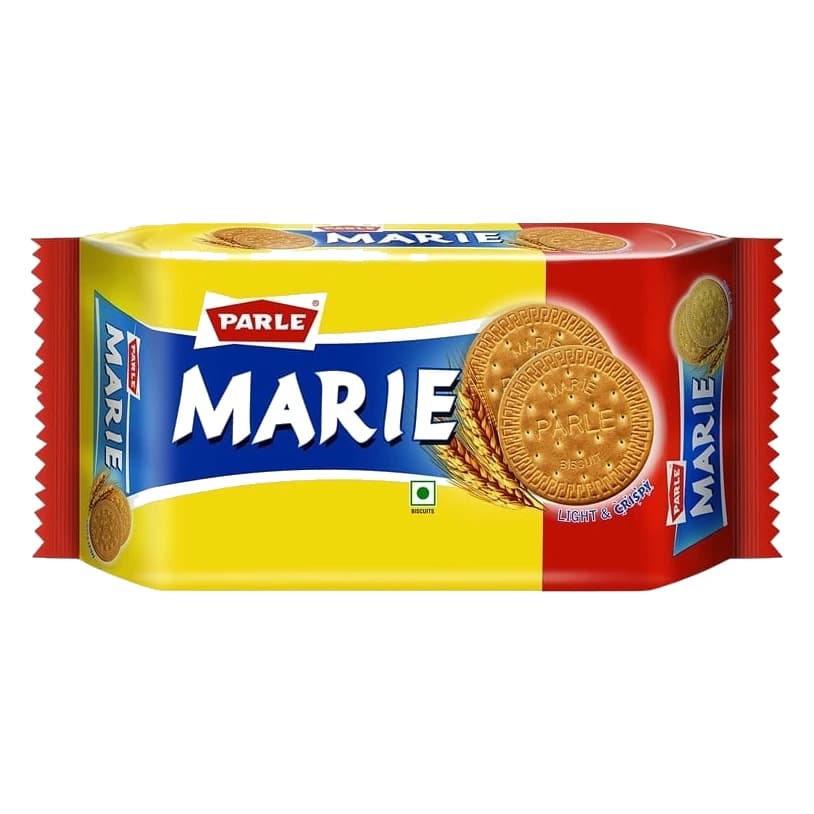
Parle Marie Biscuits
Red flags
- −Red flag: High saturated fat (5.8g)
- −Red flag: Refined flour (maida) base
- −Red flag: Palm oil listed
Green flags
- +Green flag: Source of protein (7.4g)
Ingredients, decoded
9 listed- Refined Wheat Flour (Maida) (72%)
- Sugar
- Refined Palm Oil
- Invert Sugar Syrup
- Raising Agents (503(ii), 500(ii), 341(i))
- Milk Solids
- Iodised Salt
- Flour Treatment Agents (223, 1101(ii))
- Emulsifier of vegetable origin (Diacetyltartaric and Fatty Acid Esters of Glycerol)
Our take
CleanPlate reviewMarie biscuits: 22 g sugar, maida first
Parle Marie Biscuits is a plain tea biscuit made from refined wheat flour (maida, 72%), sugar, refined palm oil and invert sugar syrup, with raising agents, milk solids, iodised salt, flour treatment agents and an emulsifier. The pack is 263.2 g and the panel is printed per 100 g.
CleanPlate scores it EC4. The E for nutrition is low: almost no credited protein, fibre or micronutrients per 100 g; its 7.4 g of protein earns no credit because it is under 2.75 g per 100 kcal. The C for ingredients reflects mostly refined or industrial ingredients (led by refined wheat flour, sugar and refined palm oil), with additives that cost points: calcium phosphates, sodium metabisulphite, DATEM and artificial flavouring substances - milk, butter & vanilla. The 4 for risk comes mainly from free sugar (21.3 g per 100 g) and saturated fat (5.8 g per 100 g).
How EC4 breaks down
Each grade is scored on its own. Here are the label numbers behind each one, per 100 g.
Very low nutrient density
- Protein
- 7.4 g
- Fibre
- Not declared
- Vitamins and minerals
- None declared
- Energy
- 451 kcal
Scored on protein, fibre and twelve vitamins and minerals, against the Codex and FSSAI "source" and "high" levels, per 100 g and per 100 kcal.
Mixed processing and additives
- Base
- Refined Wheat Flour
- Main fat
- Refined Palm Oil
- Sweeteners
- Sugar, Invert Sugar Syrup
- Additives
- 6
- Flagged
- Maida, Palm oil
Scored on how processed the ingredients are, which additives are used and why, and whether the label keeps its promises.
High risk
- Total sugar
- 22 g
- Sodium
- 251 mg
- Saturated fat
- 5.8 g
- Trans fat
- 0 g
Scored on free sugar, sodium, saturated fat and trans fat, each weighed by how strong the evidence of harm is.
A closer look
Does the label add up?
Refined wheat flour (maida, 72%), sugar, refined palm oil, invert sugar syrup, raising agents (503(ii), 500(ii), 341(i)), milk solids, iodised salt, flour treatment agents (223, 1101(ii)) and an emulsifier of vegetable origin (diacetyltartaric and fatty acid esters of glycerol, 472e). Artificial flavouring substances (milk, butter and vanilla) are declared after the list.
Per 100 g: 451 kcal, 12.4 g fat of which 5.8 g saturated, 22 g sugar, 7.4 g protein, 251 mg sodium. Energy matches the Atwater sum (451 kcal) and trans fat is printed as 0 g. The photographed panel prints no added-sugar line and no sodium; sodium (251 mg per 100 g) is taken from the pack on your word, and the sugar split is estimated from the ingredient list. The printed net weight is 263.2 g.
Ingredients to watch
- SugarWorth watching
22 g of sugars per 100 g, with sugar and invert sugar syrup both listed, close to the 22.5 g high line.
- Saturated fatWorth watching
5.8 g per 100 g, above the 5 g high line, from refined palm oil.
- AdditivesWorth watching
Calcium phosphates cost 4 points, sodium metabisulphite 3, the emulsifier DATEM and the artificial flavouring 2 each.
- Refined flourWorth watching
72% maida, with no fibre declared and no whole grain.
Common misconceptions
Myth: "Marie biscuits are a light, healthy biscuit"
They are refined flour, sugar and palm oil: 451 kcal, 22 g sugar and 5.8 g saturated fat per 100 g, with no fibre.
Myth: "Easy to digest means good for you"
Easy to digest describes refined flour, not nutrition; the biscuit delivers almost no protein credit, fibre or vitamins.
How often, and how
- Healthy adultsOccasionally
- ChildrenRarely
- Diabetes or prediabetesLimit
Smarter ways to eat it
Count the biscuits
The pack prints no serving size, so keep to a few biscuits and judge by the 451 kcal per 100 g.
Have them with milk or tea, unsweetened
Skipping sugar in the cup keeps the biscuit the only sugar in the snack.
Common questions
Is Parle Marie Biscuits healthy?
Parle Marie Biscuits scores EC4 (Poor) on CleanPlate, which makes it best kept as a rare treat rather than a regular buy. The main concerns are: High saturated fat (5.8g); Refined flour (maida) base; Palm oil listed. On the plus side: Source of protein (7.4g).
What does the EC4 score mean?
The first letter (E) grades nutritional value: very low nutrient density. The second letter (C) grades ingredient and label integrity: mixed processing and additives. The number (4) grades risk nutrients (sugar, sodium, saturated fat): high risk.
Which ingredients in Parle Marie Biscuits should I watch?
Refined Wheat Flour (Maida) (72%) (Maida), Refined Palm Oil (Palm oil).
Last reviewed October 19, 2026. Scored with the CleanPlate method from the published label.
Better Biscuits & Cookies
All 33 →- Unibic Oats Digestive Cookies
- −Red flag: High added sugar (16.6g per 100g)
- −Red flag: High sodium (655.7mg per 100g)
- Britannia NutriChoice 5 Grain Digestive Biscuit
- −Red flag: High added sugar (17.3g per 100g)
- −Red flag: High saturated fat (9.7g)
- Britannia NutriChoice Digestive High-Fibre Biscuit
- −Red flag: High added sugar (12.1g per 100g)
- −Red flag: High saturated fat (10.3g)
- Britannia NutriChoice Digestive Zero Biscuit
- −Red flag: High saturated fat (10.2g)
- −Red flag: Contains Maltodextrin