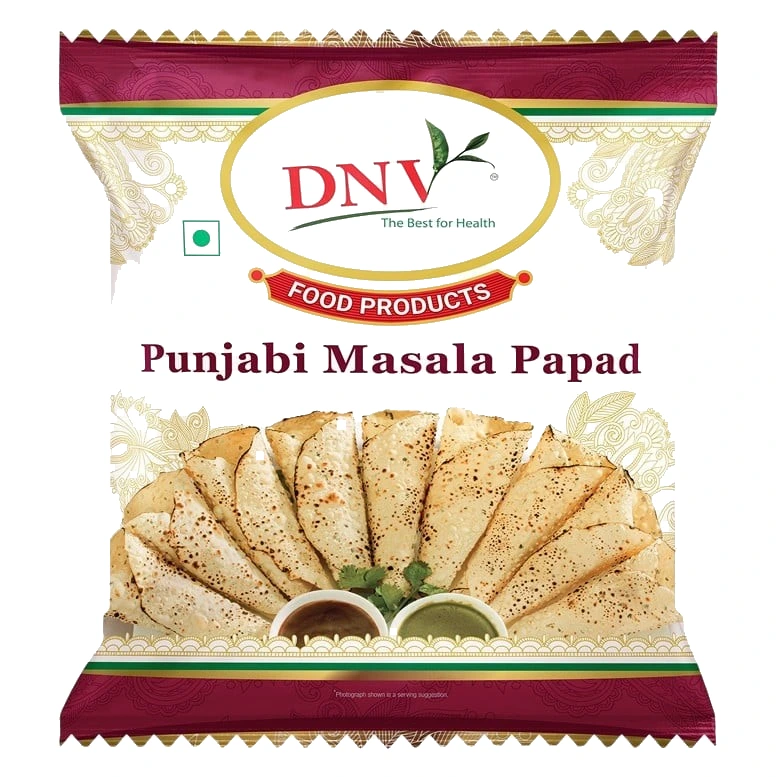
DNV Punjabi Masala Papad
Published
DNV Punjabi Masala Papad is a dry urad-flour papad seasoned with black pepper. It scores CA4: middling on nutrition because protein is solid but fibre is low, top marks on ingredients for a short, plain list, and a high risk grade because of the salt. A fine occasional crunch, as long as the salt is kept in mind.
Ingredients, decoded
5 listed- Urad Flour
- Edible Flour
- Groundnut Oil
- Black Pepper
- Iodised Salt And Papadkhar
0 teaspoon of sugar in every 100 g · 0 g total sugar, 5 g a teaspoon
| Energy | 326 kcal |
|---|---|
| Protein | 20.9 g |
| Carbohydrates | 59 g |
| Total sugars | 0 g |
| Added sugars | 0 g |
| Dietary fibre | 1.2 g |
| Total fat | 0.66 g |
| Saturated fat | 0.5 g |
| Trans fat | 0 g |
| Cholesterol | 0 mg |
| Sodium | 1390 mg |
| Iron | 4.6 mg |
| Calcium | 0 mg |
Think this score is wrong?
What to know about DNV Punjabi Masala Papad
A short, plain papad with 1,390 mg sodium
DNV Punjabi Masala Papad is a dry papad made from urad flour, an unnamed edible flour, groundnut oil, black pepper (6%), iodised salt and papadkhar. It is bought as a crisp, quick side or snack for meals and for instant snack cravings, with the pack suggesting a short spell in the sun before eating.
Per 100 g it gives 326 kcal, 20.94 g protein, 59.02 g carbohydrate, 0.66 g fat and 1.22 g fibre, with no sugar and no trans fat declared. Iron is 4.6 mg per 100 g. The cost is salt: 1,390 mg sodium per 100 g, roughly 3.5 g of salt. The pack prints its figures per 100 g and gives no weight per papad.
The name promises a Punjabi masala, and the only declared seasoning is black pepper at 6%. The listing also says high protein, high fibre and low calorie, and only the protein claim stands up to the numbers. CleanPlate scores it CA4.
Why DNV Punjabi Masala Papad scores CA4
Nutrition is a C on 20.94 g protein but only 1.22 g fibre per 100 g. Ingredients are an A for a short list with no additives, and risk is a 4 because sodium is 1,390 mg per 100 g.
Adequate nutrient density
- Protein
- 20.9 g
- Fibre
- 1.2 g
- Vitamins and minerals
- Iron, Calcium
- Energy
- 326 kcal
01 Nutrition density: why C
Protein is 20.94 g per 100 g, about a quarter of the calories, and it comes mainly from urad flour, a pulse. Fibre is only 1.22 g per 100 g, so there is little credit there.
Iron is declared at 4.6 mg per 100 g, which adds a small bonus. Calcium is 0 mg and no vitamins are declared, so the grade stops at the middle.
Scored on protein, fibre and twelve vitamins and minerals, against the Codex and FSSAI "source" and "high" levels, per 100 g and per 100 kcal. Protein also has to supply at least 12.5% of the calories to count, and 25% for full credit.
Clean, minimally processed
- Base
- Urad Flour
- Main fat
- Groundnut Oil
- Sweeteners
- None added
- Additives
- 0
- Flagged
- None
02 Ingredient integrity: why A
The list is short: urad flour, an edible flour, groundnut oil, black pepper, iodised salt and papadkhar. No additives, no sweeteners, no colours and no hydrogenated fat are listed, and the declared trans fat is accepted.
Percentages are given only for black pepper (6%), and the second flour is not named. Nothing in the claims is hollow, so no ingredient points are lost to the label.
Scored on how processed the ingredients are, which additives are used and why, and whether the label keeps its promises.
High risk
- Added sugar
- 0 g
- Sodium
- 1390 mg
- Saturated fat
- 0.5 g
- Trans fat
- 0 g
03 Load risk: why 4
Sodium drives the risk number: 1,390 mg per 100 g is almost all of it. Energy at 326 kcal adds a little, and saturated fat (up to 0.5 g per 100 g) adds very little.
Sugar is 0 g, so it plays no part. The risk grade is a 4 because of the salt alone.
Scored on free sugar, sodium, saturated fat and trans fat, each weighed by how strong the evidence of harm is.
Red flags
- −Red flag: High sodium (1390mg per 100g)
Green flags
- +Green flag: High protein (20.9g per 100g)
- +Green flag: No added sugar
- +Green flag: No additives
Does DNV Punjabi Masala Papad live up to its claims?
High protein holds at 20.94 g per 100 g. High fibre and low calorie do not fit the panel, at 1.22 g fibre and 326 kcal per 100 g, and gluten free cannot be confirmed from the list.
- Retail listingHolds
“High protein”
Protein is 20.94 g per 100 g, about a quarter of the calories, mostly from urad flour.
- Retail listingBe careful
“High fibre”
Fibre is 1.22 g per 100 g, which is modest for a food sold as high fibre.
- Retail listingBe careful
“They are low calorie”
The papad has 326 kcal per 100 g. A single papad weighs far less than 100 g, but the food itself is not low in calories by weight.
- Retail listingBe careful
“Gluten free”
Urad flour is gluten free, but the second ingredient is listed only as edible flour, so the list does not settle it.
- On the packPartly true
“Made from Quality Dals”
Urad flour leads the list, but it is the only dal named, and the edible flour that follows is not described.
What's in DNV Punjabi Masala Papad?
Urad flour leads, followed by an unnamed edible flour, groundnut oil, black pepper at 6% and salt. Salt is the one thing to watch.
The ingredient list, read for you
Urad flour comes first, so the papad is built on a pulse, followed by an unnamed edible flour and groundnut oil for the dough. Black pepper is the only declared seasoning, at 6%. Iodised salt and papadkhar, a traditional alkaline ingredient used in papad dough, finish the list.
Ingredients to watch
- SodiumConcern
1,390 mg per 100 g, about 3.5 g of salt. It is the main reason for the risk grade.
- Edible flour (not named)Worth watching
The second ingredient has no name and no percentage, so what it adds to the dough is not clear.
- Fibre and caloriesWorth watching
1.22 g fibre and 326 kcal per 100 g, so it is not a high-fibre or low-calorie food by weight.
- ProteinFine
20.94 g per 100 g, mostly from urad flour.
- Short, additive-free listFine
No additives, sweeteners, colours or hydrogenated fat are listed, and sugar is 0 g.
What it doesn’t have
- No percentages for most ingredients, only for black pepper.
- No weight per papad or serve is printed, so per-piece figures cannot be read from the pack.
Who should eat DNV Punjabi Masala Papad?
An occasional side for most adults and children. Rarely for anyone watching blood pressure, since sodium is 1,390 mg per 100 g.
- Most adultsOccasionally
1,390 mg sodium per 100 g makes it a salty food, though a papad or two is a small amount.
- ChildrenOccasionally
No sugar or additives, but 1,390 mg sodium per 100 g is high.
- High blood pressureRarely
Sodium is 1,390 mg per 100 g, about 3.5 g of salt.
- Weight managementOccasionally
Low in fat at 0.66 g per 100 g, but 326 kcal per 100 g and a lot of salt.
Recipes with DNV Punjabi Masala Papad
Roast or toast it as a crisp side for dal and rice, or crumble it over a salad. Go easy on any extra salt, since the papad is already salty.
Roasted masala papad topping
Top a roasted papad with chopped onion, tomato and lemon, and skip extra salt because the papad already has 1,390 mg sodium per 100 g.
Papad with dal and rice
Serve one papad beside dal and rice, so its protein (20.94 g per 100 g) adds to the meal rather than replacing it.
Crumbled papad over a salad
Break a papad over raw vegetables for crunch, and leave the salt shaker out of the dressing.
DNV Punjabi Masala Papad: common questions
What is the CleanPlate score of DNV Punjabi Masala Papad?
DNV Punjabi Masala Papad is a dry urad-flour papad seasoned with black pepper. It scores CA4: middling on nutrition because protein is solid but fibre is low, top marks on ingredients for a short, plain list, and a high risk grade because of the salt. A fine occasional crunch, as long as the salt is kept in mind. Nutrition C, ingredients A, load risk 4; nutrition and ingredients run A to E, risk runs 1 to 5, and A and 1 are best.
How many calories and how much protein are in DNV Punjabi Masala Papad?
Per 100 g, DNV Punjabi Masala Papad has 326 kcal, 20.9 g protein, 59 g carbohydrate, 0.66 g fat and 0.5 g saturated fat.
What are the ingredients in DNV Punjabi Masala Papad?
5 ingredients, in label order: Urad Flour, Edible Flour, Groundnut Oil, Black Pepper, Iodised Salt And Papadkhar.
Does DNV Punjabi Masala Papad live up to its claims?
5 claims checked: 1 holds, 1 is partly true, 3 need care. "High fibre" needs care: Fibre is 1.22 g per 100 g, which is modest for a food sold as high fibre. "They are low calorie" needs care: The papad has 326 kcal per 100 g. A single papad weighs far less than 100 g, but the food itself is not low in calories by weight.
Who should limit DNV Punjabi Masala Papad?
Most adults: occasionally. 1,390 mg sodium per 100 g makes it a salty food, though a papad or two is a small amount. Children: occasionally. No sugar or additives, but 1,390 mg sodium per 100 g is high. High blood pressure: rarely. Sodium is 1,390 mg per 100 g, about 3.5 g of salt.
How much sugar, salt and saturated fat does DNV Punjabi Masala Papad have?
Per 100 g, DNV Punjabi Masala Papad has 0 g added sugar, 1390 mg sodium (about 3.5 g salt) and 0.5 g saturated fat. The FSSAI and UK FSA "high" lines are 10 g added sugar, 600 mg sodium and 5 g saturated fat per 100 g. It is high in salt.
Last reviewed October 30, 2026. Scored with the CleanPlate method from the published label. Spotted a mistake? .
Label read on 30 October 2026, from photos of the pack. If the pack has changed since, tell us.
Score history (1)
| Date | Score | Method | Why |
|---|---|---|---|
| 30 October 2026 | CA4 | v5.0 | First scored |
Every change to this score is logged. See corrections and the method changelog.