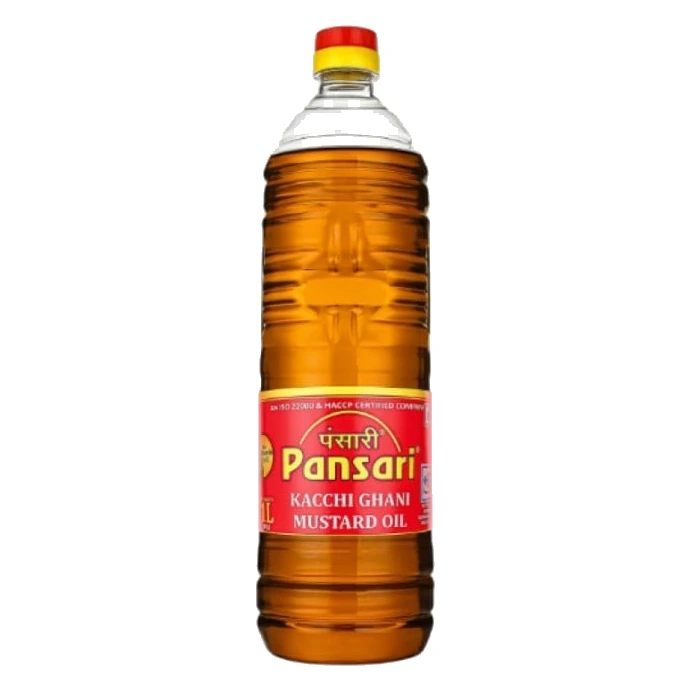
Pansari Kacchi Ghani Mustard Oil
Published
Pansari Kacchi Ghani Mustard Oil is a mustard seed oil with added vitamins A and D, sold for cooking and pickling. It scores [F]CB4: nutrition is middling only because of the added vitamins, ingredients are short and plain, and risk is high because oil is pure fat with a moderate share of saturated fat. Measure it by the spoonful rather than pouring freely.
Ingredients, decoded
3 listed- Mustard Seed Oil
- Vitamin A (Palmitate)
- Vitamin D2 (ergocalciferol)
0 teaspoon of sugar in every 100 g · 0 g total sugar, 5 g a teaspoon
| Energy | 900 kcal |
|---|---|
| Protein | 0 g |
| Carbohydrates | 0 g |
| Total sugars | 0 g |
| Added sugars | 0 g |
| Total fat | 100 g |
| Saturated fat | 12 g |
| Trans fat | 0 g |
| Sodium | 0 mg |
| Vitamin A | 750 µg |
| Vitamin D | 11.3 µg |
Think this score is wrong?
What to know about Pansari Kacchi Ghani Mustard Oil
Plain mustard oil, with the calories of any oil
Pansari Kacchi Ghani Mustard Oil is a 1 L bottle of mustard seed oil with two added vitamins, vitamin A (palmitate) and vitamin D2 (ergocalciferol). It is sold for everyday cooking, pickling and as a flavour oil, to buyers who want the sharp aroma of the traditional kacchi ghani style.
The panel is simple because oil is simple: 100 g of fat, no protein, carbohydrate, sugar or sodium, and 900 kcal. Saturated fat is 12 g, monounsaturated fat 36 g and polyunsaturated fat 16 g per 100 g, with no trans fat. The pack's 20 g serve gives 180 kcal and 2.4 g saturated fat. The added vitamins come to 750 mcg of vitamin A and 11.25 mcg of vitamin D per 100 g, or 150 mcg and 2.25 mcg per serve.
The pack promises omega fats, a traditional process and a cholesterol-free oil. The list does back up the name, since mustard seed oil is the only oil in it, but the omega claim is not broken down on the panel. CleanPlate scores it [F]CB4.
Why Pansari Kacchi Ghani Mustard Oil scores [F]CB4
Nutrition is a C only because of added vitamins A and D, ingredients are a B for a one-oil list, and risk is a 4 on 900 kcal and 12 g saturated fat per 100 g.
Adequate nutrient density
- Protein
- 0 g
- Fibre
- Not declared
- Vitamins and minerals
- Vitamin A, Vitamin D
- Energy
- 900 kcal
01 Nutrition density: why C
The core score is zero: there is no protein, no fibre and nothing in the oil beyond fat. The grade rises to a C only through the added vitamins, 750 mcg vitamin A and 11.25 mcg vitamin D per 100 g, which add 2 points.
Without that fortification the grade would be an E. The vitamins are added, not natural to mustard oil, so the C should be read as a small lift on a base that has nothing else to offer.
Scored on protein, fibre and twelve vitamins and minerals, against the Codex and FSSAI "source" and "high" levels, per 100 g and per 100 kcal. Protein also has to supply at least 12.5% of the calories to count, and 25% for full credit.
Good, few concerning additives
- Base
- Mustard Seed Oil
- Main fat
- Mustard Seed Oil
- Sweeteners
- None added
- Additives
- 0
- Flagged
- None
02 Ingredient integrity: why B
The list is three items: mustard seed oil, vitamin A palmitate and vitamin D2. There are no additives of concern, no hydrogenated fat and no flavouring, which keeps the ingredient grade at a B.
Nothing on the pack is a hollow promise, so no label integrity points are lost.
Scored on how processed the ingredients are, which additives are used and why, and whether the label keeps its promises.
High risk
- Added sugar
- 0 g
- Sodium
- 0 mg
- Saturated fat
- 12 g
- Trans fat
- 0 g
03 Load risk: why 4
Energy is the biggest driver: 900 kcal per 100 g, 180 per 20 g serve. Saturated fat adds to it at 12 g per 100 g, more than twice the 5 g high line, or 2.4 g per serve.
Sugar, sodium and trans fat are all 0, so they play no part. The risk number is high because oil is concentrated fat, not because of anything hidden in the list.
Scored on free sugar, sodium, saturated fat and trans fat, each weighed by how strong the evidence of harm is.
[F] Added vitamins or minerals meaningfully lift this product's nutrition grade. Without them it would score lower.
Red flags
- −Red flag: High saturated fat (12g)
Green flags
- +Green flag: No added sugar
- +Green flag: Low sodium
- +Green flag: No additives
Does Pansari Kacchi Ghani Mustard Oil live up to its claims?
The name and the added vitamins hold. The omega, PUFA and cholesterol-free claims are true but framed, and the digestion claim has no support on the panel.
- Product nameHolds
“Kacchi Ghani Mustard Oil”
The only oil in the list is mustard seed oil, which matches the name. The pressing process itself is a pack statement the label cannot confirm.
- On the packBe careful
“Rich in Omega 3&6”
The panel gives 16 g polyunsaturated fat per 100 g but does not split omega-3 from omega-6. Monounsaturated fat is higher, at 36 g.
- On the packBe careful
“Naturally Cholesterol Free”
True of a plant oil, but it says nothing about fat. Saturated fat is 12 g per 100 g and energy is 900 kcal.
- On the packHolds
“Vitamin A and Vitamin D2 added”
Both are listed and declared: 750 mcg vitamin A and 11.25 mcg vitamin D per 100 g, or 150 mcg and 2.25 mcg per 20 g serve.
- On the packBe careful
“Wards off indigestion”
Nothing on the panel or in the list supports a digestive effect. It reads as a traditional belief, not a measured property of the oil.
What's in Pansari Kacchi Ghani Mustard Oil?
Mustard seed oil leads, followed by two added vitamins. There are no additives, sugar or salt, so energy and saturated fat are what to watch.
The ingredient list, read for you
Mustard seed oil is the only oil and the first ingredient, so the bottle is a single-oil product. Vitamin A (palmitate) and vitamin D2 (ergocalciferol) follow as added nutrients, the only other items on the list.
Ingredients to watch
- EnergyConcern
900 kcal per 100 g, 180 kcal in a 20 g serve. This is the largest part of the risk number.
- Saturated fatConcern
12 g per 100 g, more than twice the 5 g high line. A 20 g serve has 2.4 g.
- Omega claim not quantifiedWorth watching
Polyunsaturated fat is 16 g per 100 g, but the panel does not give omega-3 and omega-6 separately.
- Added vitamins A and DFine
750 mcg vitamin A and 11.25 mcg vitamin D per 100 g. They lift the nutrition grade, but they are added.
- No sugar, sodium or trans fatFine
All three are 0 on the panel, and no hydrogenated fat is listed.
What it doesn’t have
- The panel does not split omega-3 from omega-6, despite the omega claim on the front.
Who should eat Pansari Kacchi Ghani Mustard Oil?
An occasional, measured fat for most adults. Children, people watching blood sugar and anyone managing weight should keep servings small, at 180 kcal per 20 g.
- Most adultsOccasionally
A 20 g serve is 180 kcal and 2.4 g saturated fat, so use it sparingly.
- ChildrenOccasionally
No additives, but 12 g saturated fat per 100 g and dense calories.
- Diabetes or prediabetesOccasionally
No sugar or carbohydrate, but 180 kcal per serve adds up.
- Weight managementOccasionally
900 kcal per 100 g, so measure it instead of pouring.
Recipes with Pansari Kacchi Ghani Mustard Oil
Use it where its sharp flavour matters, in pickles, tadkas and sabzis, and measure it, since each 20 g serve is 180 kcal.
Mango or mixed pickle
The pack lists pickling as a use. Mustard oil's sharp flavour carries the spices, and a measured amount keeps each 20 g serve to 180 kcal.
Dal tadka
Heat a spoonful of oil for the tempering, so the flavour reaches the whole pot without more than a serve of 180 kcal.
Measured sabzi
Use a spoonful for a stir-fried vegetable and let the aroma do the work. Each 20 g of oil carries 2.4 g saturated fat.
Pansari Kacchi Ghani Mustard Oil: common questions
What is the CleanPlate score of Pansari Kacchi Ghani Mustard Oil?
Pansari Kacchi Ghani Mustard Oil is a mustard seed oil with added vitamins A and D, sold for cooking and pickling. It scores [F]CB4: nutrition is middling only because of the added vitamins, ingredients are short and plain, and risk is high because oil is pure fat with a moderate share of saturated fat. Measure it by the spoonful rather than pouring freely. Nutrition C, ingredients B, load risk 4; nutrition and ingredients run A to E, risk runs 1 to 5, and A and 1 are best.
How many calories and how much protein are in Pansari Kacchi Ghani Mustard Oil?
Per 100 g, Pansari Kacchi Ghani Mustard Oil has 900 kcal, 0 g protein, 0 g carbohydrate, 100 g fat and 12 g saturated fat. One serve (20 g serve, as printed on the pack) has 180 kcal and 0 g protein.
What are the ingredients in Pansari Kacchi Ghani Mustard Oil?
3 ingredients, in label order: Mustard Seed Oil, Vitamin A (Palmitate), Vitamin D2 (ergocalciferol).
Does Pansari Kacchi Ghani Mustard Oil live up to its claims?
5 claims checked: 2 hold, 3 need care. "Rich in Omega 3&6" needs care: The panel gives 16 g polyunsaturated fat per 100 g but does not split omega-3 from omega-6. Monounsaturated fat is higher, at 36 g. "Naturally Cholesterol Free" needs care: True of a plant oil, but it says nothing about fat. Saturated fat is 12 g per 100 g and energy is 900 kcal.
Who should limit Pansari Kacchi Ghani Mustard Oil?
Most adults: occasionally. A 20 g serve is 180 kcal and 2.4 g saturated fat, so use it sparingly. Children: occasionally. No additives, but 12 g saturated fat per 100 g and dense calories. Diabetes or prediabetes: occasionally. No sugar or carbohydrate, but 180 kcal per serve adds up.
How much sugar, salt and saturated fat does Pansari Kacchi Ghani Mustard Oil have?
Per 100 g, Pansari Kacchi Ghani Mustard Oil has 0 g added sugar, 0 mg sodium (about 0 g salt) and 12 g saturated fat. The FSSAI and UK FSA "high" lines are 10 g added sugar, 600 mg sodium and 5 g saturated fat per 100 g. It is high in saturated fat.
Last reviewed October 30, 2026. Scored with the CleanPlate method from the published label. Spotted a mistake? .
Label read on 30 October 2026, from photos of the pack. If the pack has changed since, tell us.
Score history (1)
| Date | Score | Method | Why |
|---|---|---|---|
| 30 October 2026 | CB4 | v5.0 | First scored |
Every change to this score is logged. See corrections and the method changelog.