Amul Khoa
Published
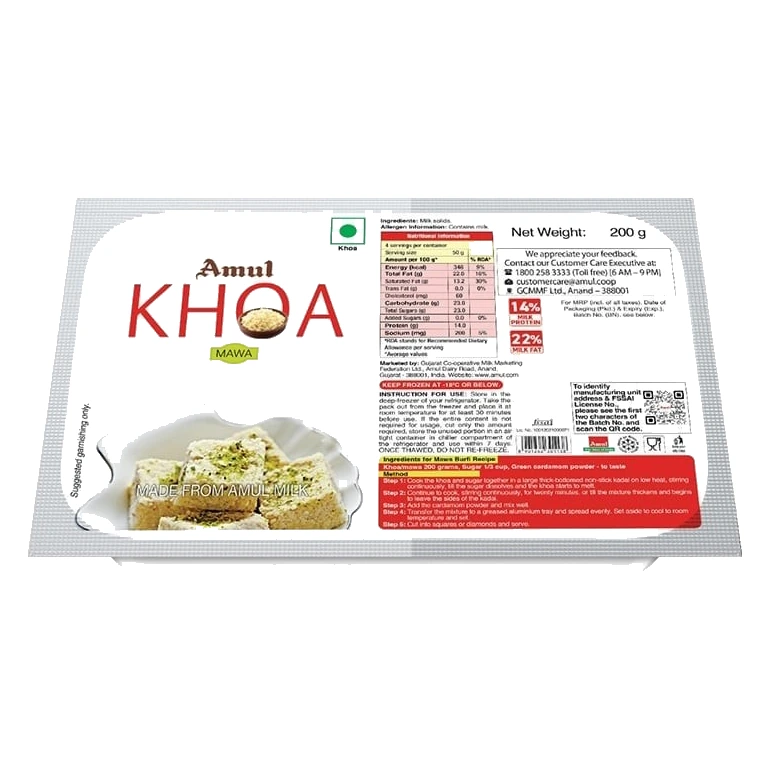
Amul Khoa is a single-ingredient mawa made from milk solids, used in Indian sweets. It scores DA3: nutrition is low because it is mostly fat and milk sugar with no vitamins declared, ingredients are as clean as they come with milk solids alone, and risk is moderate because of the saturated fat. Best used in small amounts in sweets, not eaten by the bowl.
Ingredients, decoded
1 listed- Milk solids
4½ teaspoons of sugar in every 100 g · 23 g total sugar, 5 g a teaspoon
| Energy | 346 kcal |
|---|---|
| Protein | 14 g |
| Carbohydrates | 23 g |
| Total sugars | 23 g |
| Added sugars | 0 g |
| Total fat | 22 g |
| Saturated fat | 13.2 g |
| Trans fat | 0 g |
| Sodium | 200 mg |
Think this score is wrong?
What to know about Amul Khoa
One ingredient, but a fat-heavy 346 kcal per 100 g
Amul Khoa, sold on the front as Mawa, is a 200 g pack of concentrated milk. The ingredient list has one line, milk solids, so no percentages are declared and nothing else is added. It is bought by people who make mithai at home and want the base ready made. The pack is kept frozen at -18°C or below.
Per 100 g it has 346 kcal, 14 g protein, 22 g fat and 23 g sugar, with 0 g added sugar. The pack prints a 50 g serve, four to a pack, which is 173 kcal, 7 g protein and 6.6 g saturated fat. Saturated fat is 13.2 g per 100 g, well above the 5 g high line, and sodium is a modest 200 mg per 100 g.
The pack's promises are plain: made from Amul milk, 14% milk protein and 22% milk fat, and the panel agrees with each. There is no hollow claim and no additive to mark it down. What holds it back is the fat, not the ingredients. CleanPlate scores it DA3.
Why Amul Khoa scores DA3
Nutrition is a D, as protein of 14 g per 100 g sits alongside 22 g fat and no declared vitamins. Ingredients are an A with milk solids alone, and risk is a 3 on 13.2 g saturated fat per 100 g.
Low nutrient density
- Protein
- 14 g
- Fibre
- Not declared
- Vitamins and minerals
- None declared
- Energy
- 346 kcal
01 Nutrition density: why D
Protein is 14 g per 100 g, about 16% of the 346 kcal, which is 4 g per 100 kcal. It all comes from milk solids. In a 50 g serve that is 7 g protein.
The rest of the panel is fat and sugar: 22 g fat and 23 g total sugar per 100 g. No vitamins or minerals are declared, so nothing lifts the grade further.
Scored on protein, fibre and twelve vitamins and minerals, against the Codex and FSSAI "source" and "high" levels, per 100 g and per 100 kcal. Protein also has to supply at least 12.5% of the calories to count, and 25% for full credit.
Clean, minimally processed
- Base
- Milk solids
- Sweeteners
- None added
- Additives
- 0
- Flagged
- None
02 Ingredient integrity: why A
The list is a single line, milk solids. There are no additives, no sweetener, no flavouring and no fat added, so there is nothing that costs ingredient points.
The pack's claims match the panel and no label promise is hollow, so label integrity loses nothing and the grade is the top one.
Scored on how processed the ingredients are, which additives are used and why, and whether the label keeps its promises.
Moderate risk
- Added sugar
- 0 g
- Sodium
- 200 mg
- Saturated fat
- 13.2 g
- Trans fat
- 0 g
03 Load risk: why 3
Saturated fat is the main driver: 13.2 g per 100 g, over twice the 5 g high line. A 50 g serve has 6.6 g.
Energy at 346 kcal per 100 g and sodium at 200 mg per 100 g add smaller amounts. Added sugar is 0 g, so sugar plays no part in the risk number. Trans fat is declared as 0 g.
Scored on free sugar, sodium, saturated fat and trans fat, each weighed by how strong the evidence of harm is.
Red flags
- −Red flag: High sugar (23g per 100g)
- −Red flag: High saturated fat (13.2g)
Green flags
- +Green flag: Source of protein (14g)
- +Green flag: No added sugar
- +Green flag: No additives
Does Amul Khoa live up to its claims?
The milk protein, milk fat and added sugar claims all hold against the panel. The 0 g added sugar sits beside 23 g of sugar per 100 g that comes from the milk itself.
- On the packHolds
“Made from Amul milk”
The only ingredient listed is milk solids, with nothing else added.
- On the packHolds
“14% Milk Protein”
The panel shows 14 g protein per 100 g, so about 7 g in a 50 g serve.
- On the packHolds
“22% Milk Fat”
The panel shows 22 g fat per 100 g, of which 13.2 g is saturated.
- On the packBe careful
“Added Sugars 0.0 g”
True, as no sugar is in the list. But the panel still shows 23 g total sugar per 100 g, which comes from the milk itself.
What's in Amul Khoa?
The list is one line: milk solids. There is no additive, no added sugar and nothing hidden, so the fat is the only thing to watch.
The ingredient list, read for you
The ingredient list is one line: milk solids. With a single ingredient there is no percentage to declare, and the protein, fat and sugar on the panel all come from the milk.
Ingredients to watch
- Saturated fatConcern
13.2 g per 100 g, over twice the 5 g high line. A 50 g serve has 6.6 g.
- Milk sugarWorth watching
23 g total sugar per 100 g, all from the milk, with 0 g added sugar. It still counts as sugar on the panel.
- EnergyWorth watching
346 kcal per 100 g, 173 kcal in a 50 g serve.
- Single ingredientFine
Milk solids only: no additive, no sweetener, no flavouring and no added fat.
- ProteinFine
14 g per 100 g from milk solids, about 7 g in a 50 g serve.
What it doesn’t have
- No vitamins or minerals are declared on the panel.
Who should eat Amul Khoa?
A few times a week for most adults in small portions. Heart health and children call for less often, and anyone with lactose intolerance should rarely choose it.
- Most adultsA few times a week
6.6 g saturated fat in a 50 g serve, but no additives.
- ChildrenOccasionally
Clean list, but 13.2 g saturated fat per 100 g.
- Heart healthOccasionally
13.2 g saturated fat per 100 g is over twice the 5 g high line.
- Lactose intoleranceRarely
Made only from milk solids, with 23 g milk sugar per 100 g.
Recipes with Amul Khoa
Use it as the base for sweets such as burfi or kheer, in a small portion, since 50 g carries 6.6 g saturated fat before any sugar or ghee is added.
Mawa burfi
The pack's own recipe uses 200 g khoa, half a cup of sugar and cardamom powder. The khoa has 0 g added sugar, so all the added sugar is yours to adjust.
Kheer with a spoon of khoa
Stir in a small portion, about 25 g, for richness and 3.5 g protein, instead of using the full 50 g serve.
Khoa-stuffed sweets
Use it as a filling in small pieces, so each one carries only a fraction of the 6.6 g saturated fat in a 50 g serve.
Amul Khoa: common questions
What is the CleanPlate score of Amul Khoa?
Amul Khoa is a single-ingredient mawa made from milk solids, used in Indian sweets. It scores DA3: nutrition is low because it is mostly fat and milk sugar with no vitamins declared, ingredients are as clean as they come with milk solids alone, and risk is moderate because of the saturated fat. Best used in small amounts in sweets, not eaten by the bowl. Nutrition D, ingredients A, load risk 3; nutrition and ingredients run A to E, risk runs 1 to 5, and A and 1 are best.
How many calories and how much protein are in Amul Khoa?
Per 100 g, Amul Khoa has 346 kcal, 14 g protein, 23 g carbohydrate, 22 g fat and 13.2 g saturated fat. One serve (50 g, one of four servings in the pack) has 173 kcal and 7 g protein.
What are the ingredients in Amul Khoa?
1 ingredient, in label order: Milk solids.
Does Amul Khoa live up to its claims?
4 claims checked: 3 hold, 1 needs care. "Added Sugars 0.0 g" needs care: True, as no sugar is in the list. But the panel still shows 23 g total sugar per 100 g, which comes from the milk itself.
Who should limit Amul Khoa?
Most adults: a few times a week. 6.6 g saturated fat in a 50 g serve, but no additives. Children: occasionally. Clean list, but 13.2 g saturated fat per 100 g. Heart health: occasionally. 13.2 g saturated fat per 100 g is over twice the 5 g high line.
How much sugar, salt and saturated fat does Amul Khoa have?
Per 100 g, Amul Khoa has 0 g added sugar, 200 mg sodium (about 0.5 g salt) and 13.2 g saturated fat. The FSSAI and UK FSA "high" lines are 10 g added sugar, 600 mg sodium and 5 g saturated fat per 100 g. It is high in sugar and saturated fat.
Last reviewed October 29, 2026. Scored with the CleanPlate method from the published label. Spotted a mistake? .
Label read on 29 October 2026, from photos of the pack. If the pack has changed since, tell us.
Score history (1)
| Date | Score | Method | Why |
|---|---|---|---|
| 29 October 2026 | DA3 | v5.0 | First scored |
Every change to this score is logged. See corrections and the method changelog.
More Dairy Products
All Dairy Products →- Brik Oven Sour Cream
- −Red flag: High saturated fat (10.1g)
- Amul Sweetened Condensed Milk Classic
- −Red flag: High added sugar (43g per 100g)
- +Green flag: Low sodium
- Amul Sweetened Condensed Milk Gold
- −Red flag: High added sugar (43g per 100g)
- +Green flag: Low sodium
- Country Delight Desi Danedar Cow Ghee
- −Red flag: High saturated fat (61g)
- −Red flag: Contains trans fat (2.2g)