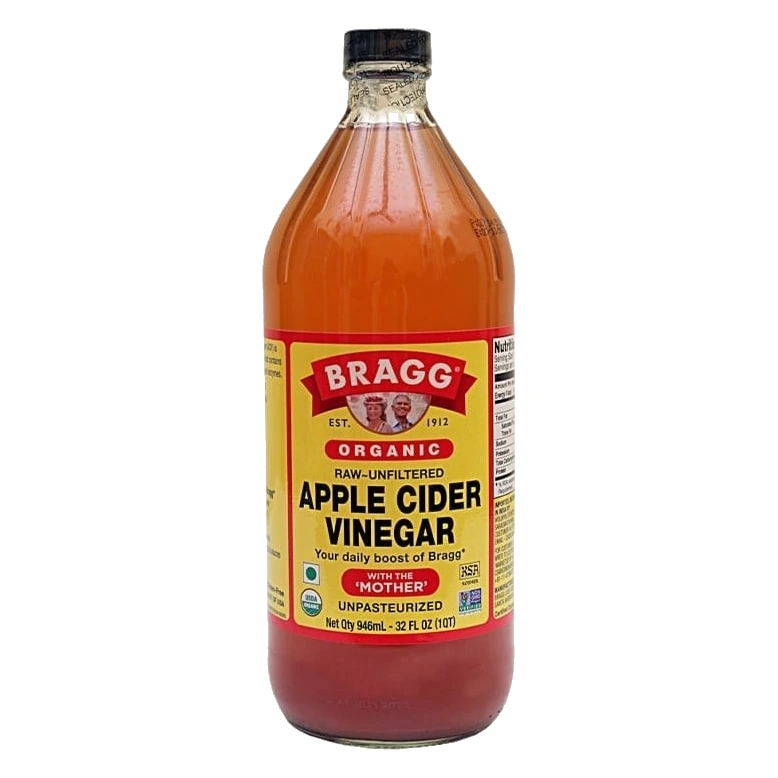
Bragg Organic Apple Cider Vinegar
Published
Bragg Organic Apple Cider Vinegar is a raw, unfiltered vinegar made from organic apples and water, used in drinks and dressings. It scores EB1: nutrition sits at the bottom because it carries no calories, protein or fibre, ingredients are just vinegar and water, and risk is minimal. Use it by the spoonful in water or dressings, not as a remedy.
Ingredients, decoded
2 listed- Organic Apple Cider Vinegar
- Water
The label gives no sugar figure, so there is nothing to count in teaspoons.
| Energy | 0 kcal |
|---|---|
| Protein | 0 g |
| Carbohydrates | 0 g |
| Total fat | 0 g |
| Saturated fat | 0 g |
| Trans fat | 0 g |
| Sodium | 0 mg |
| Potassium | 73.3 mg |
Think this score is wrong?
What to know about Bragg Organic Apple Cider Vinegar
Zero calories, and little else to count
Bragg Organic Apple Cider Vinegar is a 946 mL bottle of raw, unfiltered, unpasteurised vinegar that still holds the cloudy 'Mother'. The ingredient list is two lines long: organic apple cider vinegar and water, diluted to 5% acidity. No percentages are declared. People buy it to splash into water, smoothies and salad dressings.
What you get is almost nothing in nutrition terms, and that is the point. One 15 mL tablespoon has 0 kcal, 0 g fat, 0 g carbohydrate, 0 g protein and 0 mg sodium. The only nutrient on the panel is potassium: 11 mg a tablespoon, which is 73.33 mg per 100 ml. The bottle holds 63 tablespoons.
The name and the front panel describe what is in the bottle: organic, raw, unfiltered, with the Mother. The back adds benefit statements about appetite, blood sugar and cholesterol that the nutrition panel does not back with any number. CleanPlate scores it EB1.
Why Bragg Organic Apple Cider Vinegar scores EB1
Nutrition is an E because there are 0 kcal, 0 g protein and no fibre to earn credit. Ingredients are a B for a two-item list with no additives, and risk is a 1 because every risk number is zero.
Very low nutrient density
- Protein
- 0 g
- Fibre
- Not declared
- Vitamins and minerals
- Potassium
- Energy
- 0 kcal
01 Nutrition density: why E
The panel shows 0 kcal, 0 g protein, 0 g carbohydrate and 0 g fat per 100 ml, and no fibre. With nothing to measure, nutrition earns no credit.
Potassium is the only nutrient declared: 73.33 mg per 100 ml, 11 mg per tablespoon, about 0.34% of the daily need according to the pack. That is too small to lift the grade.
Scored on protein, fibre and twelve vitamins and minerals, against the Codex and FSSAI "source" and "high" levels, per 100 g and per 100 kcal. Protein also has to supply at least 12.5% of the calories to count, and 25% for full credit.
Good, few concerning additives
- Base
- Organic Apple Cider Vinegar
- Sweeteners
- None added
- Additives
- 0
- Flagged
- None
02 Ingredient integrity: why B
The list is organic apple cider vinegar and water. No sweetener, preservative, colour, flavouring or thickener is listed, so nothing costs ingredient points.
No label promise is hollow here, so nothing is lost on label integrity. The one gap is that the share of vinegar and water is not declared.
Scored on how processed the ingredients are, which additives are used and why, and whether the label keeps its promises.
Clean
- Sodium
- 0 mg
- Saturated fat
- 0 g
- Trans fat
- 0 g
03 Load risk: why 1
Sugar, saturated fat, sodium, trans fat and energy are all 0 per 100 ml, and no sugar-type ingredient is listed. Risk lands on the lowest number, a 1.
Even a 1 to 2 tablespoon dose has 0 kcal and 0 mg sodium, so the risk grade does not move with how much you use.
Scored on free sugar, sodium, saturated fat and trans fat, each weighed by how strong the evidence of harm is.
Red flags
No major red flags on the label.
Green flags
- +Green flag: Low sodium
- +Green flag: No additives
Does Bragg Organic Apple Cider Vinegar live up to its claims?
The organic, raw, unfiltered and zero-calorie claims fit the label. The back-of-pack benefit statements on appetite, blood sugar and cholesterol come with no figure on the panel to support them.
- Product nameHolds
“Organic”
The ingredient is listed as organic apple cider vinegar, and the back carries a certified organic mark from Organic Certifiers.
- On the packHolds
“Raw-Unfiltered, Unpasteurized”
The ingredient list is only vinegar and water, which fits a raw, unfiltered product. The cloudiness is why the pack says to shake gently.
- On the packBe careful
“With the 'Mother'”
The back says the Mother is home to organic acids and enzymes, but the panel gives no amounts. The only nutrient declared is 11 mg potassium per tablespoon.
- Retail listingHolds
“Zero calories”
The panel declares 0 kcal per 15 mL tablespoon, and 0 g fat, carbohydrate and protein.
- On the packBe careful
“Help control appetite and manage weight”
The back lists appetite, blood sugar and cholesterol benefits. The panel shows 0 kcal and no protein or fibre, so no number on the label backs these statements.
What's in Bragg Organic Apple Cider Vinegar?
Organic apple cider vinegar leads, followed by water, diluted to 5% acidity. There are no additives, and the one thing to note is that no percentages are given.
The ingredient list, read for you
Organic apple cider vinegar comes first, then water, and the pack says it is diluted to 5% acidity. There are no added sugars, flavours, colours or preservatives, and no percentages are declared. The unfiltered Mother is the cloudy part left in the bottle.
Ingredients to watch
- Benefit statementsWorth watching
The back lists appetite, blood sugar and cholesterol benefits and suggests it 2 to 3 times daily. The panel has no number behind these statements.
- No percentages declaredWorth watching
The share of vinegar and water is not stated, only that it is diluted to 5% acidity.
- No additivesFine
Two ingredients, vinegar and water. Nothing costs ingredient points.
- Calories, sugar and sodiumFine
All 0 per 100 ml, and 0 per 15 mL tablespoon.
What it doesn’t have
- No protein, fibre, vitamins or other minerals are declared, only 11 mg potassium per tablespoon.
Who should eat Bragg Organic Apple Cider Vinegar?
Fine every day for most adults, and for anyone watching sodium or calories, at 0 mg and 0 kcal per tablespoon. Children should have it only occasionally, well diluted.
- Most adultsEveryday
0 kcal and 0 mg sodium per 15 mL tablespoon, with no additives.
- ChildrenOccasionally
Nothing to add nutritionally, and it is a sharp 5% acidity vinegar that needs diluting.
- High blood pressureEveryday
0 mg sodium per tablespoon.
- Weight managementEveryday
0 kcal per tablespoon, though the label gives no figure showing it changes weight.
Recipes with Bragg Organic Apple Cider Vinegar
Use it in salad dressings, marinades or a glass of water. At 0 kcal a tablespoon, it adds sharpness without adding calories.
Simple vinaigrette
Whisk 1 tablespoon of vinegar, which has 0 kcal, with oil, salt and pepper for a quick salad dressing.
Vinegar water
Mix 1 to 2 tablespoons in a glass of filtered or sparkling water, as the pack suggests, for a sharp drink with no calories from the vinegar.
Quick pickling splash
Add a spoonful to sliced onion or cucumber with salt for a fast tangy side, and shake the bottle gently first.
Bragg Organic Apple Cider Vinegar: common questions
What is the CleanPlate score of Bragg Organic Apple Cider Vinegar?
Bragg Organic Apple Cider Vinegar is a raw, unfiltered vinegar made from organic apples and water, used in drinks and dressings. It scores EB1: nutrition sits at the bottom because it carries no calories, protein or fibre, ingredients are just vinegar and water, and risk is minimal. Use it by the spoonful in water or dressings, not as a remedy. Nutrition E, ingredients B, load risk 1; nutrition and ingredients run A to E, risk runs 1 to 5, and A and 1 are best.
How many calories and how much protein are in Bragg Organic Apple Cider Vinegar?
Per 100 g, Bragg Organic Apple Cider Vinegar has 0 kcal, 0 g protein, 0 g carbohydrate, 0 g fat and 0 g saturated fat. One serve (1 Tbsp, 15 mL) has 0 kcal and 0 g protein.
What are the ingredients in Bragg Organic Apple Cider Vinegar?
2 ingredients, in label order: Organic Apple Cider Vinegar, Water.
Does Bragg Organic Apple Cider Vinegar live up to its claims?
5 claims checked: 3 hold, 2 need care. "With the 'Mother'" needs care: The back says the Mother is home to organic acids and enzymes, but the panel gives no amounts. The only nutrient declared is 11 mg potassium per tablespoon. "Help control appetite and manage weight" needs care: The back lists appetite, blood sugar and cholesterol benefits. The panel shows 0 kcal and no protein or fibre, so no number on the label backs these statements.
Who should limit Bragg Organic Apple Cider Vinegar?
Most adults: everyday. 0 kcal and 0 mg sodium per 15 mL tablespoon, with no additives. Children: occasionally. Nothing to add nutritionally, and it is a sharp 5% acidity vinegar that needs diluting. High blood pressure: everyday. 0 mg sodium per tablespoon.
How much sugar, salt and saturated fat does Bragg Organic Apple Cider Vinegar have?
Per 100 g, Bragg Organic Apple Cider Vinegar has 0 mg sodium (about 0 g salt) and 0 g saturated fat. The FSSAI and UK FSA "high" lines are 10 g added sugar, 600 mg sodium and 5 g saturated fat per 100 g. It is under all three lines.
Last reviewed October 29, 2026. Scored with the CleanPlate method from the published label. Spotted a mistake? .
Label read on 29 October 2026, from photos of the pack. If the pack has changed since, tell us.
Score history (1)
| Date | Score | Method | Why |
|---|---|---|---|
| 29 October 2026 | EB1 | v5.0 | First scored |
Every change to this score is logged. See corrections and the method changelog.