Veerabhadra Sabudana Papad
Published · Updated
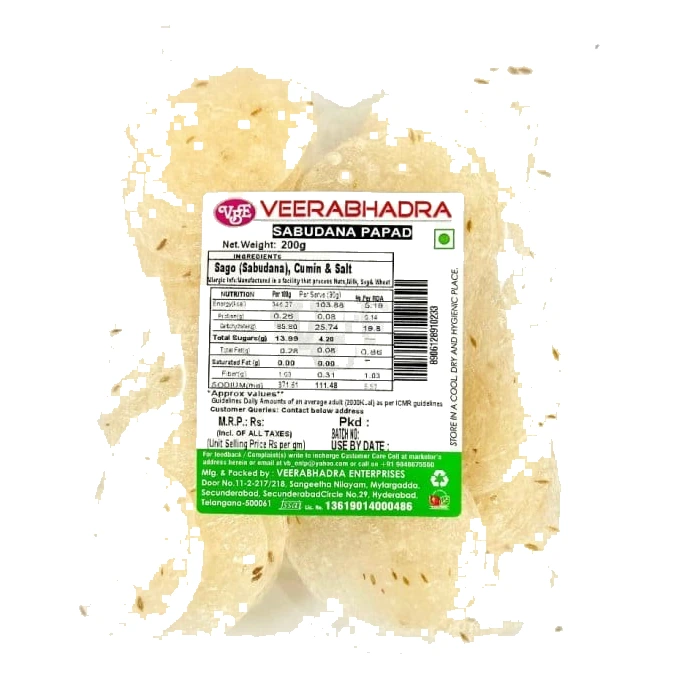
Veerabhadra Sabudana Papad is a dry papad made from just sago, cumin and salt. It scores EB2: nutrition is lowest because it is almost all starch with next to no protein or fibre, ingredients are strong for a three-item list with no additives, and risk is low because there is no saturated fat. Best as an occasional crunchy side.
Ingredients, decoded
3 listed- Sago (Sabudana)
- Cumin
- Salt
3 teaspoons of sugar in every 100 g · 14 g total sugar, 5 g a teaspoon
| Energy | 346.3 kcal |
|---|---|
| Protein | 0.26 g |
| Carbohydrates | 85.8 g |
| Total sugars | 14 g |
| Dietary fibre | 1 g |
| Total fat | 0.28 g |
| Saturated fat | 0 g |
| Sodium | 371.6 mg |
Think this score is wrong?
What to know about Veerabhadra Sabudana Papad
Three clean ingredients, almost all starch
Veerabhadra Sabudana Papad is a dry papad sold in a 200 g pack. It is built from three things: sago (sabudana), cumin and salt. It is bought as a crunchy, spiced side for tea, coffee or a meal. No percentages are declared for any of the three.
What you get is energy and little else. Per 100 g the papad has 346 kcal, 85.8 g carbohydrate, 0.26 g protein and 1.03 g fibre. One 30 g serve has about 104 kcal and 111 mg sodium. The panel prints 13.99 g total sugars per 100 g, yet no sugar ingredient is listed, so free sugar is scored as 0 g. The figures are for the papad as sold, and any oil used to cook it would add to them.
The name is plain and the list matches it: sago leads, with cumin and salt after it, and no additive, colour or preservative. The gap is nutritional, not in the ingredients. CleanPlate scores it EB2.
Why Veerabhadra Sabudana Papad scores EB2
Nutrition is an E because protein is 0.26 g and fibre 1.03 g per 100 g. Ingredients are a B on a three-item list with no additives, and risk is a 2, driven mostly by 371.61 mg sodium per 100 g.
Very low nutrient density
- Protein
- 0.26 g
- Fibre
- 1 g
- Vitamins and minerals
- None declared
- Energy
- 346 kcal
01 Nutrition density: why E
Protein is 0.26 g per 100 g and fibre is 1.03 g, so neither earns credit. Carbohydrate is 85.8 g per 100 g, nearly all of the 346 kcal.
No vitamins or minerals are declared, and no protein-rich ingredient is in the list. Nothing lifts the grade above the lowest.
Scored on protein, fibre and twelve vitamins and minerals, against the Codex and FSSAI "source" and "high" levels, per 100 g and per 100 kcal. Protein also has to supply at least 12.5% of the calories to count, and 25% for full credit.
Good, few concerning additives
- Base
- Sago
- Sweeteners
- None added
- Additives
- 0
- Flagged
- None
02 Ingredient integrity: why B
Sago, cumin and salt is a very short list with no additive, no sweetener, no colour and no hydrogenated fat, so nothing costs ingredient points. The label makes no claim that the list fails to support.
The one gap is that no percentages are declared for the three ingredients, which stops the grade going higher.
Scored on how processed the ingredients are, which additives are used and why, and whether the label keeps its promises.
Low risk
- Total sugar
- 14 g
- Sodium
- 371.6 mg
- Saturated fat
- 0 g
03 Load risk: why 2
Sodium is the main driver: 371.61 mg per 100 g, about 111 mg in a 30 g serve. Energy adds a smaller part at 346 kcal per 100 g.
Free sugar is scored as 0 g because no sugar ingredient is listed, and saturated fat is 0 g, so neither adds to the risk number.
Scored on free sugar, sodium, saturated fat and trans fat, each weighed by how strong the evidence of harm is.
Red flags
No major red flags on the label.
Green flags
- +Green flag: No additives
Does Veerabhadra Sabudana Papad live up to its claims?
The name holds: sago leads the list, followed by cumin and salt. The only other promise worth checking is that kids like it, which is true of the taste but says nothing about nutrition.
- Product nameHolds
“Sabudana Papad”
Sago is the first ingredient, followed by cumin and salt. No percentage is declared, but the list matches the name.
- Retail listingBe careful
“An all time favorite for kids”
Nothing in the list is a concern for children, but a serve has only 0.08 g protein and 0.31 g fibre. It is mostly starch.
What's in Veerabhadra Sabudana Papad?
Sago, cumin and salt, in that order, with no additive. What to watch is the missing protein and fibre and the sodium, not the ingredients.
The ingredient list, read for you
Sago (sabudana) comes first, so the papad is essentially starch from tapioca pearls. Cumin gives the spice and salt the seasoning. No percentages are declared, and there is no additive, colour, preservative or added fat in the list.
Ingredients to watch
- Almost no protein or fibreConcern
0.26 g protein and 1.03 g fibre per 100 g, so the calories come almost entirely from starch. This is what holds the nutrition grade at the bottom.
- SodiumWorth watching
371.61 mg per 100 g, about 111 mg in a 30 g serve, 6% of the daily value on the pack.
- Total sugarsWorth watching
13.99 g per 100 g is printed, about 4.2 g per serve, but no sugar ingredient is listed, so free sugar is scored as 0 g.
- Short, additive-free listFine
Sago, cumin and salt only. No colour, preservative, sweetener or hydrogenated fat.
- Saturated fatFine
0 g per 100 g, with total fat at 0.28 g.
What it doesn’t have
- No vitamins or minerals are declared on the panel.
- No percentages are given for sago, cumin or salt.
Who should eat Veerabhadra Sabudana Papad?
A few times a week for most adults. Children and anyone watching blood pressure or weight can have it too, in small portions and not as a main snack.
- Most adultsA few times a week
About 104 kcal per 30 g serve, mostly starch, with little protein or fibre.
- ChildrenA few times a week
No additive in the list, but a serve has 0.08 g protein.
- High blood pressureA few times a week
111 mg sodium per serve is modest, but extra pieces add up.
- Weight managementA few times a week
104 kcal per serve with almost no protein or fibre to fill you up.
Veerabhadra Sabudana Papad: common questions
What is the CleanPlate score of Veerabhadra Sabudana Papad?
Veerabhadra Sabudana Papad is a dry papad made from just sago, cumin and salt. It scores EB2: nutrition is lowest because it is almost all starch with next to no protein or fibre, ingredients are strong for a three-item list with no additives, and risk is low because there is no saturated fat. Best as an occasional crunchy side. Nutrition E, ingredients B, load risk 2; nutrition and ingredients run A to E, risk runs 1 to 5, and A and 1 are best.
How many calories and how much protein are in Veerabhadra Sabudana Papad?
Per 100 g, Veerabhadra Sabudana Papad has 346 kcal, 0.26 g protein, 85.8 g carbohydrate, 0.28 g fat and 0 g saturated fat. One serve (30 g serve) has 104 kcal and 0.1 g protein.
What are the ingredients in Veerabhadra Sabudana Papad?
3 ingredients, in label order: Sago (Sabudana), Cumin, Salt.
Does Veerabhadra Sabudana Papad live up to its claims?
2 claims checked: 1 holds, 1 needs care. "An all time favorite for kids" needs care: Nothing in the list is a concern for children, but a serve has only 0.08 g protein and 0.31 g fibre. It is mostly starch.
Who should limit Veerabhadra Sabudana Papad?
Most adults: a few times a week. About 104 kcal per 30 g serve, mostly starch, with little protein or fibre. Children: a few times a week. No additive in the list, but a serve has 0.08 g protein. High blood pressure: a few times a week. 111 mg sodium per serve is modest, but extra pieces add up.
How much sugar, salt and saturated fat does Veerabhadra Sabudana Papad have?
Per 100 g, Veerabhadra Sabudana Papad has 14 g sugar, 372 mg sodium (about 0.9 g salt) and 0 g saturated fat. The FSSAI and UK FSA "high" lines are 10 g added sugar, 600 mg sodium and 5 g saturated fat per 100 g. It is under all three lines.
Last reviewed October 31, 2026. Scored with the CleanPlate method from the published label. Spotted a mistake? .
Label read on 31 October 2026, from photos of the pack. If the pack has changed since, tell us.
Score history (1)
| Date | Score | Method | Why |
|---|---|---|---|
| 31 October 2026 | EB2 | v5.0 | First scored |
Every change to this score is logged. See corrections and the method changelog.
Better Khakhra & Papad
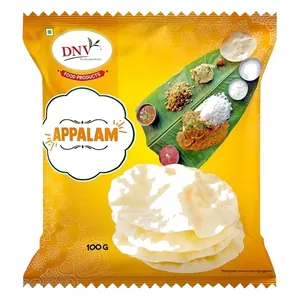
All Khakhra & Papad →- DNV Appalam Papad
- +Green flag: Source of protein (18.5g)
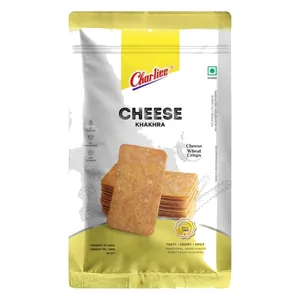
- Charliee Cheese Khakhra
- −Red flag: High sodium (769mg per 100g)
- −Red flag: High saturated fat (9.7g)
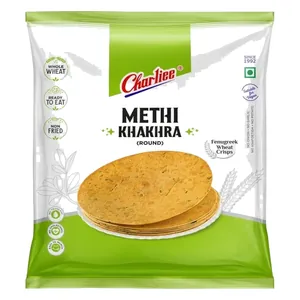
- Charliee Methi Khakhra
- −Red flag: High sodium (803.5mg per 100g)
- −Red flag: High saturated fat (9.5g)
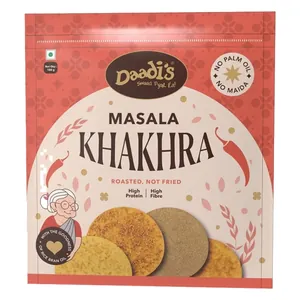
- Daadi's Masala Khakhra
- −Red flag: High sodium (681mg per 100g)
- +Green flag: High fibre (13.4g)