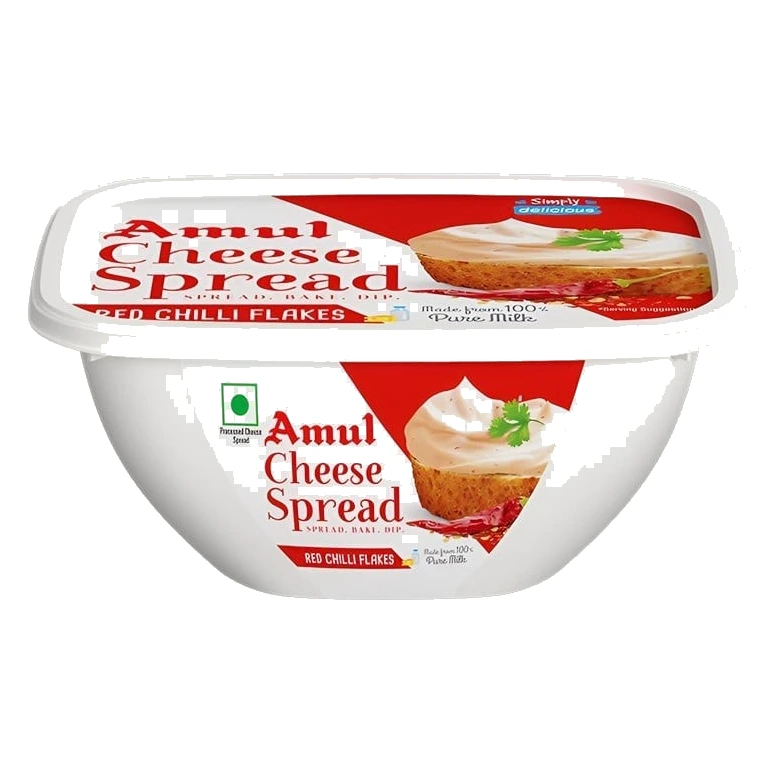
Amul Cheese Spread Red Chilli Flakes
Published · Updated
Amul Cheese Spread Red Chilli Flakes is a soft, spreadable processed cheese with a little chilli, sold for sandwiches, baking and dips. It scores DB4: low on nutrition for its calories, ingredients are fairly plain apart from the phosphate emulsifiers, and risk is high because of the saturated fat and salt. Best as a thin spread now and then, not a daily layer.
Ingredients, decoded
7 listed- Milk solids
- cheese
- emulsifying salts (452, 339, 331, 471)
- iodized salt
- chilli flakes (1%)
- preservatives (200, 234)
- natural flavouring substances
2½ teaspoons of sugar in every 100 g · 12.8 g total sugar, 5 g a teaspoon
| Energy | 277 kcal |
|---|---|
| Protein | 11.5 g |
| Carbohydrates | 12.8 g |
| Total sugars | 12.8 g |
| Added sugars | 0 g |
| Total fat | 20 g |
| Saturated fat | 13 g |
| Trans fat | 0 g |
| Cholesterol | 60 mg |
| Sodium | 900 mg |
Think this score is wrong?
What to know about Amul Cheese Spread Red Chilli Flakes
A creamy chilli cheese spread heavy on saturated fat and salt
A 200 g tub of processed cheese spread built from milk solids and cheese, softened with emulsifying salts and seasoned with iodized salt and chilli flakes (1%). Two preservatives, 200 and 234, keep it for the shelf, and natural flavouring rounds it out. It is bought for sandwiches, toast, baking and dips.
A 20 g serve, which is one tenth of the tub, gives 55 kcal, 2.3 g protein, 2.6 g saturated fat and 180 mg sodium. Per 100 g that is 277 kcal, 11.5 g protein, 20 g fat and 900 mg sodium. Added sugar is 0 g, and the 12.8 g of total sugar per 100 g is not added.
The name promises chilli flakes, and they are there, but at 1% they are a seasoning rather than a main ingredient. The front says made from 100% pure milk, while the list also carries emulsifying salts, preservatives and flavouring. There is no hydrogenated fat and no label promise that fails. CleanPlate scores it DB4.
Why Amul Cheese Spread Red Chilli Flakes scores DB4
Nutrition is a D on 277 kcal and 11.5 g protein per 100 g. Ingredients are a B, held back by phosphate emulsifiers, and risk is a 4 on 13 g saturated fat and 900 mg sodium per 100 g.
Low nutrient density
- Protein
- 11.5 g
- Fibre
- Not declared
- Vitamins and minerals
- None declared
- Energy
- 277 kcal
01 Nutrition density: why D
Protein is 11.5 g per 100 g, or 2.3 g in a 20 g serve, but it comes with 277 kcal and 20 g fat per 100 g. The calories are mostly fat, so the protein does not lift the grade far.
No vitamins or minerals are declared on the pack, so nothing else adds to the grade.
Scored on protein, fibre and twelve vitamins and minerals, against the Codex and FSSAI "source" and "high" levels, per 100 g and per 100 kcal. Protein also has to supply at least 12.5% of the calories to count, and 25% for full credit.
Good, few concerning additives
- Base
- Milk solids
- Sweeteners
- None added
- Additives
- 6
- Flagged
- None
02 Ingredient integrity: why B
Milk solids and cheese lead the list, which is a short and recognisable base. There is no hydrogenated fat, no dye, and no label promise that fails, so nothing is lost on label integrity.
Sodium phosphates (339) and polyphosphates (452) cost ingredient points, as do the mono- and diglycerides (471) and the natural flavouring. Sorbic acid (200), nisin (234) and sodium citrates (331) cost nothing. Only the chilli flakes carry a declared percentage.
Scored on how processed the ingredients are, which additives are used and why, and whether the label keeps its promises.
High risk
- Added sugar
- 0 g
- Sodium
- 900 mg
- Saturated fat
- 13 g
- Trans fat
- 0 g
03 Load risk: why 4
Saturated fat is the biggest driver: 13 g per 100 g, well over the 5 g high line. A 20 g serve has 2.6 g.
Sodium adds to it at 900 mg per 100 g, or 180 mg per serve. Added sugar is 0 g and trans fat is 0 g, so neither plays a part.
Scored on free sugar, sodium, saturated fat and trans fat, each weighed by how strong the evidence of harm is.
Red flags
- −Red flag: High sodium (900mg per 100g)
- −Red flag: High saturated fat (13g)
Green flags
- +Green flag: Source of protein (11.5g)
- +Green flag: No added sugar
Does Amul Cheese Spread Red Chilli Flakes live up to its claims?
The chilli is real but only 1% of the tub, and the pure milk line leaves out the added salts. The retailer page mentions calcium, which the pack does not declare.
- Product namePartly true
“Red Chilli Flakes”
Chilli flakes are real and listed, but at 1% they season the spread rather than define it.
- On the packBe careful
“Made from 100% Pure Milk”
Milk solids and cheese lead the list, but it also has emulsifying salts, iodized salt, two preservatives and natural flavouring.
- Retail listingBe careful
“Packed with Protein and Calcium”
The retailer page says protein and calcium, but the pack shows no calcium figure. Protein is 11.5 g per 100 g, or 2.3 g per 20 g serve.
- On the packHolds
“Spread. Bake. Dip.”
It is soft enough to spread and works warm or cold in dips. A 20 g serve has 55 kcal.
What's in Amul Cheese Spread Red Chilli Flakes?
Milk solids and cheese lead, followed by emulsifying salts, salt, chilli and two preservatives. The phosphates, the saturated fat and the salt are what to watch.
The ingredient list, read for you
Milk solids and cheese come first, so the spread is mostly dairy. Emulsifying salts (452, 339, 331, 471) keep it smooth and meltable, iodized salt seasons it, and chilli flakes (1%) add the heat. Preservatives 200 and 234 extend the shelf life, and natural flavouring finishes it.
Ingredients to watch
- Saturated fatConcern
13 g per 100 g, over twice the 5 g high line. A 20 g serve has 2.6 g.
- SodiumConcern
900 mg per 100 g, so 180 mg in a 20 g serve. A thick spread of 40 g would bring 360 mg.
- Phosphate emulsifiers (339, 452)Worth watching
Sodium phosphates and polyphosphates cost ingredient points. Mono- and diglycerides (471) and the natural flavouring cost a little more.
- Preservatives 200 and 234Worth watching
Sorbic acid and nisin are listed. They cost no ingredient points, but they are additives in a product that says pure milk.
- ProteinFine
11.5 g per 100 g, mostly from cheese and milk solids. A serve gives 2.3 g.
What it doesn’t have
- No calcium is declared on the pack, though the retailer page mentions it.
- No percentage is given for milk solids or cheese, only for the chilli flakes.
Who should eat Amul Cheese Spread Red Chilli Flakes?
An occasional spread for most adults, and a lighter hand for anyone watching blood pressure or weight. A 20 g serve has 180 mg sodium.
- Most adultsOccasionally
13 g saturated fat per 100 g and 180 mg sodium in a 20 g serve.
- ChildrenOccasionally
Salt and saturated fat add up fast, and 900 mg sodium per 100 g is a lot for a small body.
- Diabetes or prediabetesOccasionally
No added sugar, but 277 kcal per 100 g and 13 g saturated fat.
- Weight managementOccasionally
55 kcal per 20 g serve is modest, but it is easy to use three times that.
Recipes with Amul Cheese Spread Red Chilli Flakes
Use it as a thin spread, a baked topping or a dip base, in 20 g servings of 55 kcal each, and add vegetables to stretch it.
Thin spread on toast
Spread one 20 g serve, 55 kcal, over whole grain toast and add cucumber or tomato for bulk.
Cheese dip for vegetable sticks
Serve a 20 g spoonful per person with carrot, cucumber or capsicum. Sodium stays near 180 mg per serve.
Baked cheese topping
Spread a thin layer over a bake and let the 13 g saturated fat per 100 g stay small by keeping to a 20 g serve.
Dip for paneer pakodas
A small portion of 20 g is enough alongside the pakodas, since the fried pakodas already add fat.
Amul Cheese Spread Red Chilli Flakes: common questions
What is the CleanPlate score of Amul Cheese Spread Red Chilli Flakes?
Amul Cheese Spread Red Chilli Flakes is a soft, spreadable processed cheese with a little chilli, sold for sandwiches, baking and dips. It scores DB4: low on nutrition for its calories, ingredients are fairly plain apart from the phosphate emulsifiers, and risk is high because of the saturated fat and salt. Best as a thin spread now and then, not a daily layer. Nutrition D, ingredients B, load risk 4; nutrition and ingredients run A to E, risk runs 1 to 5, and A and 1 are best.
How many calories and how much protein are in Amul Cheese Spread Red Chilli Flakes?
Per 100 g, Amul Cheese Spread Red Chilli Flakes has 277 kcal, 11.5 g protein, 12.8 g carbohydrate, 20 g fat and 13 g saturated fat. One serve (1 serve, 20 g) has 55 kcal and 2.3 g protein.
What are the ingredients in Amul Cheese Spread Red Chilli Flakes?
7 ingredients, in label order: Milk solids, cheese, emulsifying salts (452, 339, 331, 471), iodized salt, chilli flakes (1%), preservatives (200, 234), natural flavouring substances.
Does Amul Cheese Spread Red Chilli Flakes live up to its claims?
4 claims checked: 1 holds, 1 is partly true, 2 need care. "Red Chilli Flakes" is partly true: Chilli flakes are real and listed, but at 1% they season the spread rather than define it. "Made from 100% Pure Milk" needs care: Milk solids and cheese lead the list, but it also has emulsifying salts, iodized salt, two preservatives and natural flavouring.
Who should limit Amul Cheese Spread Red Chilli Flakes?
Most adults: occasionally. 13 g saturated fat per 100 g and 180 mg sodium in a 20 g serve. Children: occasionally. Salt and saturated fat add up fast, and 900 mg sodium per 100 g is a lot for a small body. Diabetes or prediabetes: occasionally. No added sugar, but 277 kcal per 100 g and 13 g saturated fat.
How much sugar, salt and saturated fat does Amul Cheese Spread Red Chilli Flakes have?
Per 100 g, Amul Cheese Spread Red Chilli Flakes has 0 g added sugar, 900 mg sodium (about 2.3 g salt) and 13 g saturated fat. The FSSAI and UK FSA "high" lines are 10 g added sugar, 600 mg sodium and 5 g saturated fat per 100 g. It is high in salt and saturated fat.
Last reviewed October 31, 2026. Scored with the CleanPlate method from the published label. Spotted a mistake? .
Label read on 31 October 2026, from photos of the pack. If the pack has changed since, tell us.
Score history (1)
| Date | Score | Method | Why |
|---|---|---|---|
| 31 October 2026 | DB4 | v5.0 | First scored |
Every change to this score is logged. See corrections and the method changelog.