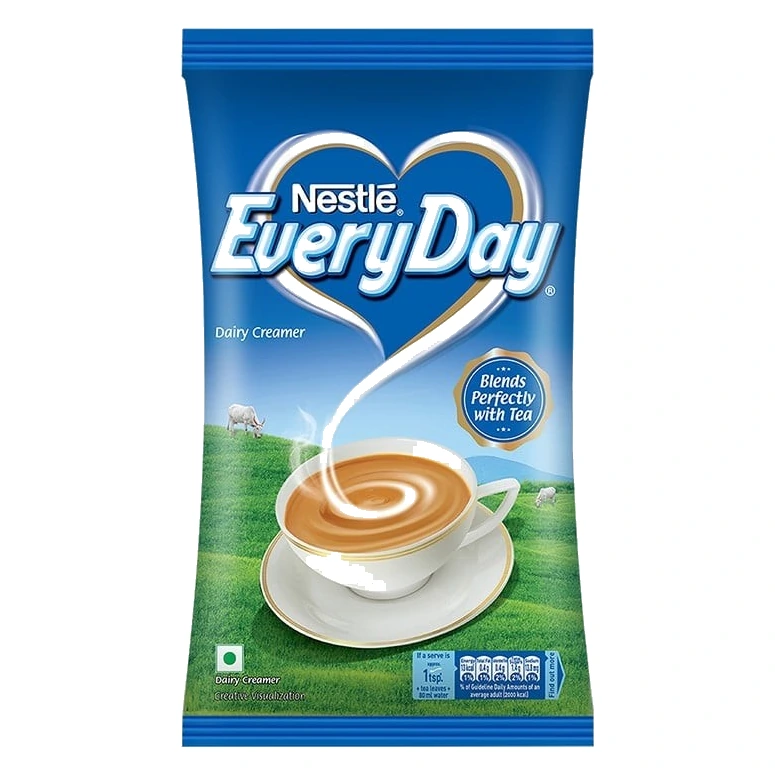
Nestle Everyday Dairy Whitener
Published
Nestle Everyday Dairy Whitener is a milk powder creamer for tea, built from milk solids, sugar, maltodextrin and lactose. It scores DB4: low on nutrition as it is mostly sugars and milk solids, sound on ingredients bar one phosphate additive, and high on risk from sugar and saturated fat. Fine by the teaspoon in tea, not as a milk replacement.
Ingredients, decoded
5 listed- Milk solids
- Sugar
- Maltodextrin (7.7%)
- Lactose (5.3%)
- stabilizer 339 (iii)
9½ teaspoons of sugar in every 100 g · 46.9 g total sugar, 5 g a teaspoon
| Energy | 429 kcal |
|---|---|
| Protein | 18.5 g |
| Carbohydrates | 56 g |
| Total sugars | 46.9 g |
| Added sugars | 22.1 g |
| Total fat | 14.5 g |
| Saturated fat | 10.5 g |
| Cholesterol | 43.3 mg |
| Sodium | 460 mg |
Think this score is wrong?
What to know about Nestle Everyday Dairy Whitener
A tea creamer that is mostly sugars and milk solids
Nestle Everyday Dairy Whitener is a spoonable milk powder sold as a dairy creamer for tea. The list is short: milk solids, sugar, maltodextrin (7.7%), lactose (5.3%) and a stabilizer, sodium phosphate (339 iii). It is bought by chai drinkers who want a thick, creamy cup without boiling milk, and the pack holds about 333 servings of one teaspoon.
Per 100 g the powder has 429 kcal, 18.5 g protein, 56 g carbohydrate, 46.9 g total sugar of which 22.1 g is added, 14.5 g fat, 10.5 g saturated fat and 460 mg sodium. The pack's serve is a 3 g teaspoon, which gives about 13 kcal, 0.7 g added sugar and 0.3 g saturated fat. The numbers look large per 100 g, but nobody eats the powder by the 100 g.
The front says Dairy Creamer and Blends Perfectly with Tea, and the list matches: milk solids lead, then sugar. Percentages are printed only for maltodextrin and lactose, so the shares of milk solids and sugar are not known. CleanPlate scores it DB4.
Why Nestle Everyday Dairy Whitener scores DB4
Nutrition is a D because the powder is mostly sugars and milk solids with no fibre declared. Ingredients are a B, held back by one phosphate additive. Risk is a 4 on 22.1 g added sugar and 10.5 g saturated fat per 100 g.
Low nutrient density
- Protein
- 18.5 g
- Fibre
- Not declared
- Vitamins and minerals
- None declared
- Energy
- 429 kcal
01 Nutrition density: why D
Protein is 18.5 g per 100 g, mostly from milk solids, which is the biggest protein source in the list. Against that, carbohydrate is 56 g and total sugar is 46.9 g per 100 g, so the powder is mainly sugars.
No fibre, vitamins or minerals are declared, so nothing else lifts the grade. At a 3 g serve the contribution to a day's food is tiny, but the grade is set on the powder per 100 g.
Scored on protein, fibre and twelve vitamins and minerals, against the Codex and FSSAI "source" and "high" levels, per 100 g and per 100 kcal. Protein also has to supply at least 12.5% of the calories to count, and 25% for full credit.
Good, few concerning additives
- Base
- Milk solids
- Sweeteners
- Sugar, Maltodextrin
- Additives
- 1
- Flagged
- Maltodextrin
02 Ingredient integrity: why B
The list is short and plain: milk solids, sugar, maltodextrin, lactose and a stabilizer. No hydrogenated fat, dye, sweetener or flavouring is listed, and nothing on the pack promises more than it holds.
The sodium phosphate stabilizer (339 iii) costs ingredient points, and percentages are printed only for maltodextrin and lactose, not for the milk solids and sugar that lead the list.
Scored on how processed the ingredients are, which additives are used and why, and whether the label keeps its promises.
High risk
- Added sugar
- 22.1 g
- Sodium
- 460 mg
- Saturated fat
- 10.5 g
03 Load risk: why 4
Added sugar is 22.1 g per 100 g and is the largest single driver of the risk number. Saturated fat at 10.5 g and sodium at 460 mg per 100 g add to it, with energy at 429 kcal per 100 g.
No trans fat is declared and no hydrogenated fat is listed. In one 3 g serve the sugar is about 0.7 g and the saturated fat about 0.3 g, which is why the risk is a 4 rather than higher.
Scored on free sugar, sodium, saturated fat and trans fat, each weighed by how strong the evidence of harm is.
Red flags
- −Red flag: High added sugar (22.1g per 100g)
- −Red flag: High saturated fat (10.5g)
- −Red flag: Contains Maltodextrin
Green flags
- +Green flag: Source of protein (18.5g)
Does Nestle Everyday Dairy Whitener live up to its claims?
The Dairy Creamer name holds, since milk solids lead the list. The taste and quality-check claims are framed promises that the label cannot confirm. Nothing on the pack is hollow.
- Holds
“Dairy Creamer”
Milk solids lead the list, followed by sugar, maltodextrin and lactose. The pack labels it as a proprietary dairy creamer.
- On the packBe careful
“Blends Perfectly with Tea”
This is a taste claim. The list is milk solids and sugar, which is what makes tea creamy and sweeter, but the label cannot confirm how well it blends.
- On the packBe careful
“144 Quality checks”
The pack also gives 37 checks including antibiotics and aflatoxin, and 24 checks before it reaches you. These are process claims that nothing on the panel can verify.
- On the packHolds
“1% energy per serve”
A 3 g serve gives about 13 kcal, which fits the pack's 1% of the daily energy figure.
What's in Nestle Everyday Dairy Whitener?
Milk solids, sugar, maltodextrin and lactose make up the list, with one sodium phosphate stabilizer. The sugar and the saturated fat are what to watch.
The ingredient list, read for you
Milk solids lead the list, then sugar, so the powder is mainly milk and sweetener. Maltodextrin (7.7%) is a starch-derived bulking carbohydrate and lactose (5.3%) is milk sugar. The stabilizer is sodium phosphate (339 iii), which keeps the powder from clumping and helps it mix in hot tea. The pack says it contains milk.
Ingredients to watch
- Added sugarConcern
22.1 g per 100 g, the largest driver of the risk grade. A 3 g serve has about 0.7 g.
- Saturated fatConcern
10.5 g per 100 g, from the milk solids. A 3 g serve has about 0.3 g, and heaped spoons add up.
- Sodium phosphate stabilizer (339 iii)Worth watching
An additive that costs ingredient points. It is the only additive in the list.
- Maltodextrin and lactoseWorth watching
Maltodextrin (7.7%) and lactose (5.3%) add carbohydrate and sweetness on top of the sugar. Lactose matters to anyone who avoids it.
- ProteinFine
18.5 g per 100 g, mostly from milk solids, though a 3 g serve gives only about 0.6 g.
What it doesn’t have
- No fibre, vitamins or minerals are declared on the panel.
- No percentage is printed for the milk solids or the sugar, the two leading ingredients.
Who should eat Nestle Everyday Dairy Whitener?
Occasionally for most adults and children, and rarely for anyone with heart concerns or lactose intolerance. A 3 g spoon is small, but the powder is rich in sugar and saturated fat.
- Most adultsOccasionally
22.1 g added sugar and 10.5 g saturated fat per 100 g, though a 3 g serve is small.
- ChildrenOccasionally
Added sugar of 22.1 g per 100 g, with little else of value.
- Heart healthRarely
10.5 g saturated fat per 100 g and 43.3 mg cholesterol.
- Lactose intoleranceRarely
Milk solids plus 5.3% added lactose, and the pack states it contains milk.
Nestle Everyday Dairy Whitener: common questions
What is the CleanPlate score of Nestle Everyday Dairy Whitener?
Nestle Everyday Dairy Whitener is a milk powder creamer for tea, built from milk solids, sugar, maltodextrin and lactose. It scores DB4: low on nutrition as it is mostly sugars and milk solids, sound on ingredients bar one phosphate additive, and high on risk from sugar and saturated fat. Fine by the teaspoon in tea, not as a milk replacement. Nutrition D, ingredients B, load risk 4; nutrition and ingredients run A to E, risk runs 1 to 5, and A and 1 are best.
How many calories and how much protein are in Nestle Everyday Dairy Whitener?
Per 100 g, Nestle Everyday Dairy Whitener has 429 kcal, 18.5 g protein, 56 g carbohydrate, 14.5 g fat and 10.5 g saturated fat. One serve (1 tsp, 3 g) has 13 kcal and 0.6 g protein.
What are the ingredients in Nestle Everyday Dairy Whitener?
5 ingredients, in label order: Milk solids, Sugar, Maltodextrin (7.7%), Lactose (5.3%), stabilizer 339 (iii). Flagged: Maltodextrin (low concern).
Does Nestle Everyday Dairy Whitener live up to its claims?
4 claims checked: 2 hold, 2 need care. "Blends Perfectly with Tea" needs care: This is a taste claim. The list is milk solids and sugar, which is what makes tea creamy and sweeter, but the label cannot confirm how well it blends. "144 Quality checks" needs care: The pack also gives 37 checks including antibiotics and aflatoxin, and 24 checks before it reaches you. These are process claims that nothing on the panel can verify.
Who should limit Nestle Everyday Dairy Whitener?
Most adults: occasionally. 22.1 g added sugar and 10.5 g saturated fat per 100 g, though a 3 g serve is small. Children: occasionally. Added sugar of 22.1 g per 100 g, with little else of value. Heart health: rarely. 10.5 g saturated fat per 100 g and 43.3 mg cholesterol.
How much sugar, salt and saturated fat does Nestle Everyday Dairy Whitener have?
Per 100 g, Nestle Everyday Dairy Whitener has 22.1 g added sugar, 460 mg sodium (about 1.1 g salt) and 10.5 g saturated fat. The FSSAI and UK FSA "high" lines are 10 g added sugar, 600 mg sodium and 5 g saturated fat per 100 g. It is high in sugar and saturated fat.
Last reviewed October 30, 2026. Scored with the CleanPlate method from the published label. Spotted a mistake? .
Label read on 30 October 2026, from photos of the pack. If the pack has changed since, tell us.
Score history (1)
| Date | Score | Method | Why |
|---|---|---|---|
| 30 October 2026 | DB4 | v5.0 | First scored |
Every change to this score is logged. See corrections and the method changelog.
Better Dairy Products
All Dairy Products →- Amul Khoa
- −Red flag: High sugar (23g per 100g)
- −Red flag: High saturated fat (13.2g)
- Brik Oven Sour Cream
- −Red flag: High saturated fat (10.1g)
- Amul Sweetened Condensed Milk Classic
- −Red flag: High added sugar (43g per 100g)
- +Green flag: Low sodium
- Amul Sweetened Condensed Milk Gold
- −Red flag: High added sugar (43g per 100g)
- +Green flag: Low sodium