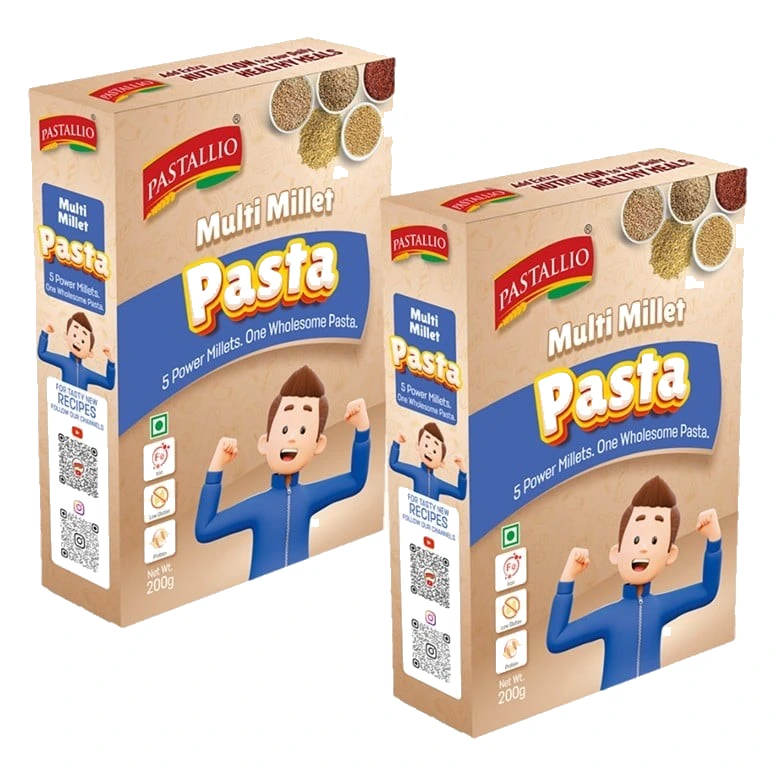
Pastallio Multi Millet Pasta
Published · Last updated
A realistic serve of Pastallio Multi Millet Pasta (1 serve, 70 g dry pasta) has 260 kcal, 9.1 g protein, 55 g carbohydrate, 0.3 g fat, 0.5 g sugar and 9 mg sodium. Per 100 g it has 371 kcal, 13 g protein, 78.5 g carbohydrate, 0.5 g fat, 0 g saturated fat, 0.75 g sugar, 4.3 g fibre and 12 mg sodium.
Pastallio Multi Millet Pasta is a dry pasta made from a blend of five millet flours and durum wheat semolina in equal shares. It scores [L]CA2: nutrition is middling because the base is still starchy, ingredients are short and clean, and risk is low, but the pack calls it rich in fibre when the fibre is modest. Fine as a regular pasta.
Ingredients, decoded
6 listed- Proprietary Blend Of Five Millets Flour
- Sorghum
- Finger
- Pearl
- Barnyard
- Prosso Millets
- Durum Wheat Semolina
<½ teaspoon of sugar in every 100 g · 0.8 g total sugar, 5 g a teaspoon
Score and nutrition facts for Pastallio Multi Millet Pasta:
| Energy | 371 kcal |
|---|---|
| Protein | 13 g |
| Carbohydrates | 78.5 g |
| Total sugars | 0.75 g |
| Dietary fibre | 4.3 g |
| Total fat | 0.5 g |
| Saturated fat | 0 g |
| Trans fat | 0 g |
| Cholesterol | 0 mg |
| Sodium | 12.3 mg |
| Iron | 4 mg |
| Calcium | 65 mg |
Think this score is wrong?
Why Pastallio Multi Millet Pasta scores [L]CA2
Nutrition is a C on 13 g protein and 4.3 g fibre per 100 g. Ingredients are an A on a two-ingredient list, with a small deduction for the fibre claim, and risk is a 2, driven only by energy.
Adequate nutrient density
- Protein
- 13 g
- Fibre
- 4.3 g
- Vitamins and minerals
- Iron, Calcium
- Energy
- 371 kcal
01 Nutrition density: why C
Protein is 13 g per 100 g, mostly from the durum wheat semolina, and fibre is 4.3 g. In a 70 g serve that is about 9.1 g protein and 3 g fibre.
Iron (4 mg per 100 g) and calcium (65 mg per 100 g) are declared and add a small bonus, but the base is 78.5 g of carbohydrate per 100 g, which holds the grade at a C.
Scored on protein, fibre and twelve vitamins and minerals, against the Codex and FSSAI "source" and "high" levels, per 100 g and per 100 kcal. Protein also has to supply at least 12.5% of the calories to count, and 25% for full credit.
Clean, minimally processed
- Base
- Proprietary Blend Of Five Mil...
- Sweeteners
- None added
- Additives
- 0
- Flagged
- None
02 Ingredient integrity: why A
The list has only two items, a millet flour blend and durum wheat semolina, with no additives, no added sugar and no fat of concern. That earns a strong ingredient grade.
The pack says Rich in Fiber, but fibre is 4.3 g per 100 g, under 6 g, and 1.16 g per 100 kcal, under 3 g. That hollow promise costs ingredient points and sets the [L] flag.
Scored on how processed the ingredients are, which additives are used and why, and whether the label keeps its promises.
Low risk
- Total sugar
- 0.75 g
- Sodium
- 12.3 mg
- Saturated fat
- 0 g
- Trans fat
- 0 g
03 Load risk: why 2
Risk is a 2, and almost all of it is energy at 371 kcal per 100 g. Sugar is 0 g free sugar, saturated fat is 0 g, trans fat is 0 g and sodium is only 12.25 mg per 100 g.
Nothing in the pasta itself adds risk. What goes on top, such as a cream or cheese sauce, will change the picture more than the pasta does.
Scored on free sugar, sodium, saturated fat and trans fat, each weighed by how strong the evidence of harm is.
[L] The name or pack claims promise more than the ingredient list delivers. See Claims vs reality.
Red flags
No major red flags on the label.
Green flags
- +Green flag: Source of protein (13g)
- +Green flag: Source of fibre
- +Green flag: Low sodium
Does Pastallio Multi Millet Pasta live up to its claims?
The 50% millet and iron claims hold. Rich in Fiber does not: 4.3 g per 100 g is under the 6 g line, and that sets the [L] flag.
- On the packMisleading
“Rich in Fiber”
Fibre is 4.3 g per 100 g, under the 6 g needed, and 1.16 g per 100 kcal, under 3 g. A 70 g serve has about 3 g.
- On the packBe careful
“HIGH PROTEIN & FIBER”
Protein is 13 g per 100 g, about 9.1 g a serve, which is real. The fibre half of the claim falls short at 4.3 g per 100 g.
- On the packHolds
“Lower Gluten with 50% Millets”
The five-millet blend is 50% and durum wheat semolina is the other 50%. Wheat is still half the pasta, so it contains gluten.
- On the packHolds
“Source of Iron”
Iron is 4 mg per 100 g, about 2.8 mg in a 70 g serve.
- On the packBe careful
“Low Glycemic Index”
No glycemic index figure is printed. The pasta has 78.5 g carbohydrate per 100 g, about 55 g in a serve.
What's in Pastallio Multi Millet Pasta?
A millet flour blend and durum wheat semolina, 50% each, with no additives. The only thing to watch is the fibre claim.
6 ingredients listed. None of them is an additive or watched ingredient in our research.
The ingredient list, read for you
Two ingredients make up the whole pasta: a blend of five millet flours (sorghum, finger, pearl, barnyard and prosso) at 50%, and durum wheat semolina at 50%. The millets give the variety, and the semolina gives the pasta its shape and most of its protein. No additives, sugar or oil are listed.
Ingredients to watch
- Rich in Fiber claimConcern
Fibre is 4.3 g per 100 g, under the 6 g needed for the claim. It costs ingredient points and sets the [L] flag.
- Carbohydrate and energyWorth watching
78.5 g carbohydrate and 371 kcal per 100 g. A 70 g serve has about 55 g carbohydrate and 260 kcal before sauce.
- ProteinFine
13 g per 100 g, about 9.1 g in a 70 g serve, mostly from the durum wheat.
- Salt, saturated fat and sugarFine
Sodium is 12.25 mg per 100 g, saturated fat 0 g and total sugar 0.75 g.
- Short ingredient listFine
Millet flours and durum wheat semolina only, with no additives.
What it doesn’t have
- No glycemic index figure is printed to back the low glycemic index claim.
What to know about Pastallio Multi Millet Pasta
Half millet, half durum wheat, and not rich in fibre
Pastallio Multi Millet Pasta is a dry pasta with only two ingredients on the list: a blend of five millet flours (sorghum, finger, pearl, barnyard and prosso millets) at 50%, and durum wheat semolina at 50%. It is bought by people who want to bring jowar, ragi and bajra into a familiar pasta dinner without changing the way they cook.
Per 100 g it has 371 kcal, 13 g protein, 4.3 g fibre, 0.75 g total sugar, 0.5 g fat and no saturated fat. Salt is almost absent at 12.25 mg sodium. The pack suggests a 70 g serve, three to a 200 g pack, which is about 260 kcal, 9.1 g protein and 3 g fibre before any sauce. Iron is 4 mg per 100 g, about 2.8 mg per serve.
The front promises five power millets, and the list delivers them, though half the pasta is still durum wheat. The back says rich in fibre, and 4.3 g per 100 g does not reach that level. That hollow promise sets the [L] flag. CleanPlate scores it [L]CA2.
Who should eat Pastallio Multi Millet Pasta?
Suitable as a regular pasta for most adults and active people. Anyone managing blood sugar should watch the 55 g of carbohydrate in a serve.
- Most adultsEveryday
260 kcal a serve with almost no salt, sugar or saturated fat.
- ChildrenEveryday
No additives or sweeteners, and 9.1 g protein per 70 g serve.
- Diabetes or prediabetesA few times a week
About 55 g carbohydrate per serve and only 3 g fibre.
- Active peopleEveryday
Carbohydrate for energy and 9.1 g protein per serve.
Recipes with Pastallio Multi Millet Pasta
Boil, strain and toss with a vegetable or paneer sauce. Added vegetables and pulses lift the fibre that the pasta alone does not.
Vegetable millet pasta
Boil, strain and toss with sauteed vegetables and tomato sauce to lift the 3 g fibre a 70 g serve gives on its own.
Paneer or dal pasta bowl
Add cubed paneer or a spoon of cooked dal to build on the 9.1 g protein in a serve.
Cold pasta salad
Cool the boiled pasta and mix with cucumber, tomato and lemon for a light meal that keeps added fat low.
Pastallio Multi Millet Pasta: common questions
Is Pastallio Multi Millet Pasta healthy?
Pastallio Multi Millet Pasta is not high in sugar, salt or saturated fat, so it can be a regular part of your diet.
How many calories and how much protein are in Pastallio Multi Millet Pasta?
Per 100 g, Pastallio Multi Millet Pasta has 371 kcal, 13 g protein, 78.5 g carbohydrate, 0.5 g fat and 0 g saturated fat. One serve (1 serve, 70 g dry pasta) has 260 kcal and 9.1 g protein.
What are the ingredients in Pastallio Multi Millet Pasta?
6 ingredients, in label order: Proprietary Blend Of Five Millets Flour (Sorghum, Finger, Pearl, Barnyard, Prosso Millets), Durum Wheat Semolina.
Does Pastallio Multi Millet Pasta live up to its claims?
5 claims checked: 2 hold, 2 need care, 1 is misleading. "Rich in Fiber" is misleading: Fibre is 4.3 g per 100 g, under the 6 g needed, and 1.16 g per 100 kcal, under 3 g. A 70 g serve has about 3 g. "HIGH PROTEIN & FIBER" needs care: Protein is 13 g per 100 g, about 9.1 g a serve, which is real. The fibre half of the claim falls short at 4.3 g per 100 g.
Who should limit Pastallio Multi Millet Pasta?
Most adults: everyday. 260 kcal a serve with almost no salt, sugar or saturated fat. Children: everyday. No additives or sweeteners, and 9.1 g protein per 70 g serve. Diabetes or prediabetes: a few times a week. About 55 g carbohydrate per serve and only 3 g fibre.
How much sugar, salt and saturated fat does Pastallio Multi Millet Pasta have?
Per 100 g, Pastallio Multi Millet Pasta has 0.75 g sugar, 12 mg sodium (about 0 g salt) and 0 g saturated fat. The FSSAI and UK FSA "high" lines are 10 g added sugar, 600 mg sodium and 5 g saturated fat per 100 g. It is under all three lines.
What does the CA2 score mean for Pastallio Multi Millet Pasta?
The first letter (C) grades nutrition density on A to E, the second (A) grades ingredient integrity on A to E, and the number (2) grades load risk on 1 to 5. A and 1 are best. Nutrition: Protein is 13 g per 100 g, mostly from the durum wheat semolina, and fibre is 4.3 g. In a 70 g serve that is about 9.1 g protein and 3 g fibre. Ingredients: The list has only two items, a millet flour blend and durum wheat semolina, with no additives, no added sugar and no fat of concern. That earns a strong ingredient grade. Load risk: Risk is a 2, and almost all of it is energy at 371 kcal per 100 g. Sugar is 0 g free sugar, saturated fat is 0 g, trans fat is 0 g and sodium is only 12.25 mg per 100 g.
Last reviewed October 31, 2026. Scored with the CleanPlate method from the published label. Spotted a mistake? .
Reference values: FSSAI labelling regulations, Codex Alimentarius, ICMR-NIN and the UK front of pack guidance. Where our label data comes from.
Label read on 31 October 2026, from photos of the pack. If the pack has changed since, tell us.
Score history (1)
| Date | Score | Method | Why |
|---|---|---|---|
| 31 October 2026 | CA2 | v5.0 | First scored |
Every change to this score is logged. See corrections and the method changelog.