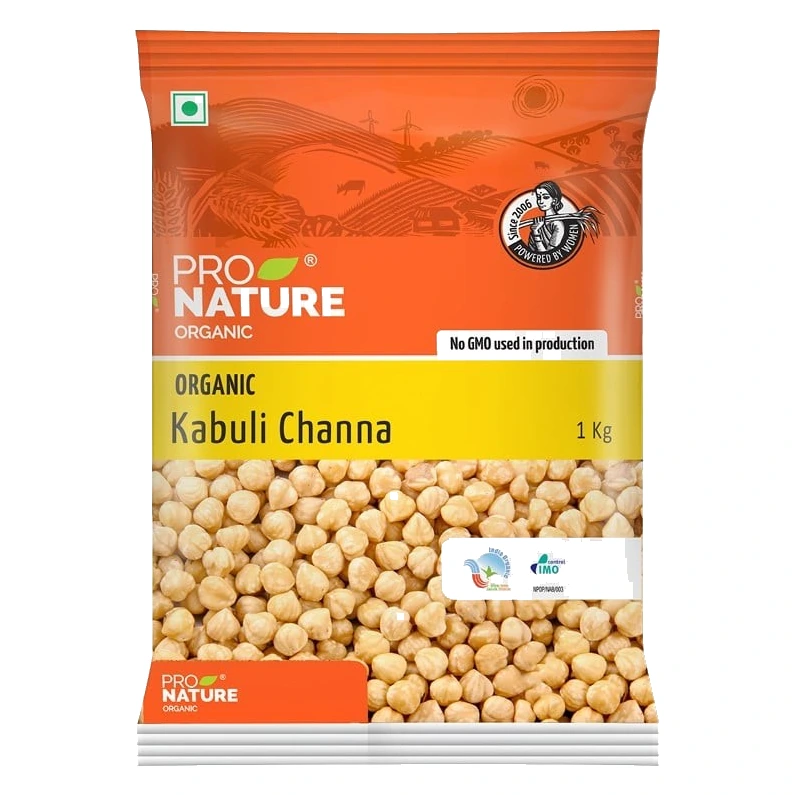
Pro Nature Organic Kabuli Chana
Published · Last updated
A realistic serve of Pro Nature Organic Kabuli Chana (50 g dry, typical serve) has 186 kcal, 10.5 g protein, 31.4 g carbohydrate, 2.9 g fat, 5.8 g sugar and 14 mg sodium. Per 100 g it has 372 kcal, 20.9 g protein, 62.8 g carbohydrate, 5.8 g fat, 0 g saturated fat, 11.6 g sugar, 11.6 g fibre and 28 mg sodium.
Pro Nature Organic Kabuli Chana is a pack of dried organic chickpeas, a single-ingredient pantry staple that needs cooking. It scores BA2: nutrition is strong on protein and fibre, ingredients are as clean as they come with nothing added, and risk is low, held up only by the calories of a dry pulse. Eat it often, cooked in dishes like chole or salads.
Ingredients, decoded
1 listed- Organic Kabuli Channa
2½ teaspoons of sugar in every 100 g · 11.6 g total sugar, 5 g a teaspoon
Score and nutrition facts for Pro Nature Organic Kabuli Chana:
| Energy | 372 kcal |
|---|---|
| Protein | 20.9 g |
| Carbohydrates | 62.8 g |
| Total sugars | 11.6 g |
| Dietary fibre | 11.6 g |
| Total fat | 5.8 g |
| Saturated fat | 0 g |
| Sodium | 28 mg |
Think this score is wrong?
Why Pro Nature Organic Kabuli Chana scores BA2
Nutrition is a B on 20.93 g protein and 11.6 g fibre per 100 g. Ingredients are an A with one ingredient and no additives. Risk is a 2, set only by the 372 kcal of dry grain.
Good nutrient density
- Protein
- 20.9 g
- Fibre
- 11.6 g
- Vitamins and minerals
- None declared
- Energy
- 372 kcal
01 Nutrition density: why B
Protein is 20.93 g per 100 g and fibre is 11.6 g, both from the chickpea itself. In a typical 50 g dry serve that is about 10.5 g protein and 5.8 g fibre.
No vitamins or minerals are declared, so the grade rests on protein and fibre alone.
Scored on protein, fibre and twelve vitamins and minerals, against the Codex and FSSAI "source" and "high" levels, per 100 g and per 100 kcal. Protein also has to supply at least 12.5% of the calories to count, and 25% for full credit.
Clean, minimally processed
- Base
- Organic Kabuli Channa
- Sweeteners
- None added
- Additives
- 0
- Flagged
- None
02 Ingredient integrity: why A
The list is one ingredient, organic kabuli channa. No additive, no refined fat, no sweetener and no flavour appears, and no claim on the pack is contradicted, so nothing costs ingredient points.
Scored on how processed the ingredients are, which additives are used and why, and whether the label keeps its promises.
Low risk
- Total sugar
- 11.6 g
- Sodium
- 28 mg
- Saturated fat
- 0 g
03 Load risk: why 2
Energy is what sets the risk number: 372 kcal per 100 g of dry grain. Free sugar is 0 g because no sugar ingredient is listed, saturated fat is 0 g and sodium is just 28 mg.
The panel also shows 11.63 g total sugar per 100 g, which comes with the chickpea itself and is not added, so it does not count toward the risk grade.
Scored on free sugar, sodium, saturated fat and trans fat, each weighed by how strong the evidence of harm is.
Red flags
No major red flags on the label.
Green flags
- +Green flag: Source of protein (20.9g)
- +Green flag: High fibre (11.6g)
- +Green flag: Low sodium
Does Pro Nature Organic Kabuli Chana live up to its claims?
The organic and no-preservatives claims hold on a one-ingredient list. The no-GMO and Gently Grown lines are framing the list cannot confirm, and nothing on the pack is hollow.
- On the packHolds
“Organic”
The single ingredient is listed as organic, and the back of the pack sets out the certification steps, including three years in conversion and an annual audit.
- On the packBe careful
“No GMO used in production”
The list shows only chickpeas, but how the crop was grown cannot be seen from the label. It rests on the certification process the pack describes.
- On the packHolds
“No preservatives, artificial colours or flavourings”
The only ingredient is organic kabuli channa, so nothing of the kind is in the list.
- On the packBe careful
“Gently Grown Food”
This is a brand line about farming and people, not a measurable nutrition claim. The label gives no figure that tests it.
What's in Pro Nature Organic Kabuli Chana?
The list is one item: organic kabuli channa. There are no additives, sweeteners or oils, so what to watch is the dry-weight calories and the allergen note.
1 ingredient listed. None of them is an additive or watched ingredient in our research.
The ingredient list, read for you
One ingredient, organic kabuli channa, which is the large pale chickpea. No percentage is printed because it is the whole product. There is no oil, salt, sugar or additive, so the list is exactly what the name says.
Ingredients to watch
- Energy as dry grainWorth watching
372 kcal per 100 g, about 186 kcal in a 50 g dry serve. This is the dry weight, and cooked chickpeas carry fewer calories per 100 g because they absorb water.
- Allergen adviceWorth watching
The back of the pack says it is processed in a facility that also processes wheat, soy and nuts.
- CarbohydrateWorth watching
62.8 g per 100 g, with 11.63 g total sugar. No sugar ingredient is listed, so free sugar is 0 g.
- Protein and fibreFine
20.93 g protein and 11.6 g fibre per 100 g, from the chickpea alone.
- Sodium and saturated fatFine
28 mg sodium per 100 g and no saturated fat.
- Single ingredientFine
No additives, preservatives, colours or flavours are listed.
What it doesn’t have
- No vitamins or minerals are declared on the panel, and the panel is marked as approximate.
- The pack prints no serve size, only values per 100 g.
What to know about Pro Nature Organic Kabuli Chana
Plain dry chickpeas: 21 g protein, nothing added
Pro Nature Organic Kabuli Chana is a 1 kg pack of dried white chickpeas. The label lists one ingredient, organic kabuli channa, with no percentage because there is nothing else in the bag. It is bought by home cooks who want a pantry staple for chole, hummus, salads and soups, and who prefer organic produce.
Per 100 g of dry chickpeas you get 372 kcal, 20.93 g protein, 11.6 g fibre and 62.8 g carbohydrate. Fat is 5.81 g with no saturated fat, and sodium is only 28 mg. The pack prints no serve size, so for a typical dry serve of 50 g that is about 186 kcal, 10.5 g protein and 5.8 g fibre.
The pack promises organic, no GMO and no preservatives, colours or flavours. With a single ingredient on the list, nothing contradicts any of that, though the organic and no-GMO claims rest on certification the list cannot show. CleanPlate scores it BA2.
Who should eat Pro Nature Organic Kabuli Chana?
Suitable every day for most adults and children. People watching carbohydrate should measure the dry serve, since there are 62.8 g carbohydrate per 100 g.
- Most adultsEveryday
Only 28 mg sodium and no saturated fat per 100 g, with 20.93 g protein.
- ChildrenEveryday
One ingredient with no sweetener, dye or added fat.
- Diabetes or prediabetesA few times a week
62.8 g carbohydrate per 100 g dry, so measure the serve and ask your doctor about portions.
- Weight managementEveryday
372 kcal per 100 g dry, about 186 kcal in a 50 g serve, with 11.6 g fibre.
Recipes with Pro Nature Organic Kabuli Chana
Chickpeas suit chole, hummus, salads and soups, and each dish uses the protein and fibre. The salt and oil you add decide the rest, since the grain has just 28 mg sodium.
Chole
Cook the chickpeas in a spiced onion and tomato gravy; the 50 g dry serve brings about 10.5 g protein, and the oil and salt you add set the rest.
Homemade hummus
Blend cooked chickpeas with lemon, garlic and a little tahini; the grain itself adds 11.6 g fibre per 100 g dry.
Chickpea salad
Toss cooked chickpeas with chopped cucumber, onion and lemon for a cold dish with almost no sodium from the grain, at 28 mg per 100 g.
Chickpea soup
Simmer the chickpeas with vegetables and spices, and season lightly, since the chickpeas bring only 28 mg sodium per 100 g.
Pro Nature Organic Kabuli Chana: common questions
Is Pro Nature Organic Kabuli Chana healthy?
Pro Nature Organic Kabuli Chana is not high in sugar, salt or saturated fat, so it can be a regular part of your diet.
How many calories and how much protein are in Pro Nature Organic Kabuli Chana?
Per 100 g, Pro Nature Organic Kabuli Chana has 372 kcal, 20.9 g protein, 62.8 g carbohydrate, 5.8 g fat and 0 g saturated fat. One serve (50 g dry, typical serve) has 186 kcal and 10.5 g protein.
What are the ingredients in Pro Nature Organic Kabuli Chana?
1 ingredient, in label order: Organic Kabuli Channa.
Does Pro Nature Organic Kabuli Chana live up to its claims?
4 claims checked: 2 hold, 2 need care. "No GMO used in production" needs care: The list shows only chickpeas, but how the crop was grown cannot be seen from the label. It rests on the certification process the pack describes. "Gently Grown Food" needs care: This is a brand line about farming and people, not a measurable nutrition claim. The label gives no figure that tests it.
Who should limit Pro Nature Organic Kabuli Chana?
Most adults: everyday. Only 28 mg sodium and no saturated fat per 100 g, with 20.93 g protein. Children: everyday. One ingredient with no sweetener, dye or added fat. Diabetes or prediabetes: a few times a week. 62.8 g carbohydrate per 100 g dry, so measure the serve and ask your doctor about portions.
How much sugar, salt and saturated fat does Pro Nature Organic Kabuli Chana have?
Per 100 g, Pro Nature Organic Kabuli Chana has 11.6 g sugar, 28 mg sodium (about 0.1 g salt) and 0 g saturated fat. The FSSAI and UK FSA "high" lines are 10 g added sugar, 600 mg sodium and 5 g saturated fat per 100 g. It is under all three lines.
What does the BA2 score mean for Pro Nature Organic Kabuli Chana?
The first letter (B) grades nutrition density on A to E, the second (A) grades ingredient integrity on A to E, and the number (2) grades load risk on 1 to 5. A and 1 are best. Nutrition: Protein is 20.93 g per 100 g and fibre is 11.6 g, both from the chickpea itself. In a typical 50 g dry serve that is about 10.5 g protein and 5.8 g fibre. Ingredients: The list is one ingredient, organic kabuli channa. No additive, no refined fat, no sweetener and no flavour appears, and no claim on the pack is contradicted, so nothing costs ingredient points. Load risk: Energy is what sets the risk number: 372 kcal per 100 g of dry grain. Free sugar is 0 g because no sugar ingredient is listed, saturated fat is 0 g and sodium is just 28 mg.
Last reviewed October 31, 2026. Scored with the CleanPlate method from the published label. Spotted a mistake? .
Reference values: FSSAI labelling regulations, Codex Alimentarius, ICMR-NIN and the UK front of pack guidance. Where our label data comes from.
Label read on 31 October 2026, from photos of the pack. If the pack has changed since, tell us.
Score history (1)
| Date | Score | Method | Why |
|---|---|---|---|
| 31 October 2026 | BA2 | v5.0 | First scored |
Every change to this score is logged. See corrections and the method changelog.