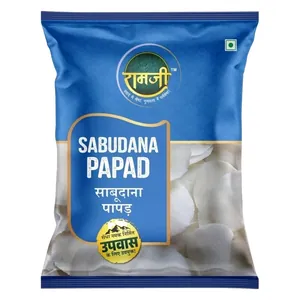
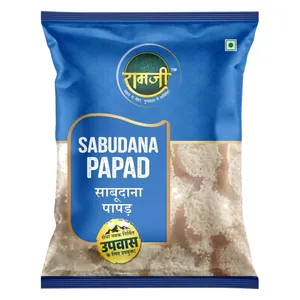
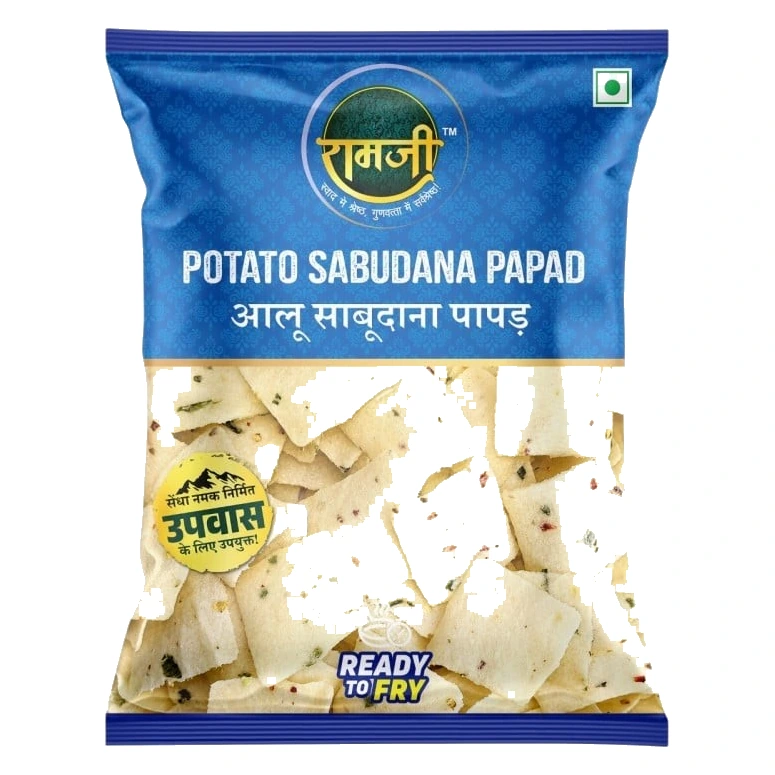
Ramji Sabudana Potato Papad
Published · Last updated
A realistic serve of Ramji Sabudana Potato Papad (25 g serve, dry papad (6 per pack)) has 85 kcal, 0.2 g protein, 21.1 g carbohydrate, 0 g fat, 0.1 g added sugar and 321 mg sodium. Per 100 g it has 341 kcal, 0.7 g protein, 84.2 g carbohydrate, 0.19 g fat, 0.1 g saturated fat, 0.5 g added sugar and 1284 mg sodium.
Ramji Sabudana Potato Papad is a ready-to-fry papad made from tapioca pearls, potato flakes and rock salt, sold for fasting days. It scores EB4: nutrition is lowest because it is nearly all starch with almost no protein, ingredients are strong thanks to a short plain list, and risk is high because of the salt. Best as an occasional fried side.
Ingredients, decoded
6 listed- Sabudana (Tapioca)
- Potato Flakes
- Sabudana Starch
- Rock Salt
- Food Grade Sodium Bicarbonate INS 500 (ii)
- Refined Vegetable Oil
<½ teaspoon of sugar in every 100 g · 0.5 g total sugar, 5 g a teaspoon
Score and nutrition facts for Ramji Sabudana Potato Papad:
| Energy | 341.5 kcal |
|---|---|
| Protein | 0.7 g |
| Carbohydrates | 84.2 g |
| Total sugars | 0.5 g |
| Added sugars | 0.5 g |
| Total fat | 0.19 g |
| Saturated fat | 0.1 g |
| Trans fat | 0.01 g |
| Cholesterol | 0.5 mg |
| Sodium | 1284 mg |
Think this score is wrong?
Why Ramji Sabudana Potato Papad scores EB4
Nutrition is an E because the papad is almost all starch with 0.7 g protein per 100 g. Ingredients are a B on a short, plain list. Risk is a 4 because sodium is 1,284 mg per 100 g.
Very low nutrient density
- Protein
- 0.7 g
- Fibre
- Not declared
- Vitamins and minerals
- None declared
- Energy
- 341 kcal
01 Nutrition density: why E
Energy is 341 kcal per 100 g, nearly all from 84 g of carbohydrate. Protein is 0.7 g per 100 g, and the largest contributor is the potato flakes, so the protein earns no credit.
No vitamins, minerals or fibre add to the grade, so nutrition sits at the bottom of the scale. This is typical of a starch-only crisp rather than a fault of the recipe.
Scored on protein, fibre and twelve vitamins and minerals, against the Codex and FSSAI "source" and "high" levels, per 100 g and per 100 kcal. Protein also has to supply at least 12.5% of the calories to count, and 25% for full credit.
Good, few concerning additives
- Base
- Sabudana
- Main fat
- Refined Vegetable Oil
- Sweeteners
- None added
- Additives
- 1
- Flagged
- None
02 Ingredient integrity: why B
The list is six items long: sabudana, potato flakes, sabudana starch, rock salt, sodium bicarbonate and refined vegetable oil. There are no colours, sweeteners, flavour enhancers or hydrogenated fats.
Sodium bicarbonate (INS 500 ii) is the only additive and it costs no ingredient points. No label promise is hollow, so nothing is lost for integrity. Percentages are not declared, which is the one gap in an otherwise clean list.
Scored on how processed the ingredients are, which additives are used and why, and whether the label keeps its promises.
High risk
- Added sugar
- 0.5 g
- Sodium
- 1284 mg
- Saturated fat
- 0.1 g
- Trans fat
- 0.01 g
03 Load risk: why 4
Sodium is the whole story: 1,284 mg per 100 g, 321 mg in a 25 g serve, and it accounts for almost all of the risk number, which lands on a 4.
Energy adds a little. Sugar is 0.5 g, saturated fat 0.1 g and trans fat 0.01 g per 100 g, so they play almost no part. Frying will add some oil, which is not in the panel.
Scored on free sugar, sodium, saturated fat and trans fat, each weighed by how strong the evidence of harm is.
Red flags
- −Red flag: High sodium (1284mg per 100g)
Green flags
Nothing stands out in its favour.
Does Ramji Sabudana Potato Papad live up to its claims?
The potato, rock salt, no-preservatives and fasting claims hold on the list. The rock salt line is true but still means high sodium, and the potato is not the main ingredient.
- Product namePartly true
“Potato Sabudana Papad”
Both are real and listed, but sabudana leads and potato flakes come second. No percentage is declared for either.
- On the packHolds
“Suitable for fast”
The list is tapioca, potato, rock salt, sodium bicarbonate and refined vegetable oil, with no grain flour.
- On the packBe careful
“Made with rock salt”
Rock salt is in the list, but it is still salt: the papad has 1,284 mg sodium per 100 g, 321 mg per serve.
- Retail listingHolds
“No preservatives”
No preservative is listed. The only additive is sodium bicarbonate (INS 500 ii).
What's in Ramji Sabudana Potato Papad?
Sabudana, potato flakes and sabudana starch lead a six-item list. The salt is what to watch; the sodium bicarbonate costs no ingredient points.
6 ingredients listed. None of them is an additive or watched ingredient in our research. 1 more entry looks like an additive we have not researched yet.
The ingredient list, read for you
Sabudana (tapioca), potato flakes and sabudana starch come first, so the papad is a starch dough. Rock salt seasons it, sodium bicarbonate helps it puff and crisp when fried, and refined vegetable oil is the last item. No percentages are declared.
Not in our additive research yet: Food Grade Sodium Bicarbonate INS 500 (ii).
Ingredients to watch
- SodiumConcern
1,284 mg per 100 g, about 3.2 g of salt. One 25 g serve has 321 mg, before any salt you add at the table.
- Starch-only baseWorth watching
Tapioca, potato flakes and sabudana starch give 84 g carbohydrate and 0.7 g protein per 100 g, so there is little to fill you up.
- Refined vegetable oilWorth watching
The oil type is not named. The panel is for the dry papad, and frying adds more oil.
- Sodium bicarbonate (INS 500 ii)Fine
The only additive, and it costs no ingredient points.
- Sugar and saturated fatFine
0.5 g sugar and 0.1 g saturated fat per 100 g, with no hydrogenated fat listed.
What it doesn’t have
- No vitamins or minerals are declared on the panel.
- No ingredient percentages are given, so the share of potato is unknown.
What to know about Ramji Sabudana Potato Papad
A plain starch papad with a salty edge
Ramji Sabudana Potato Papad is a dry, ready-to-fry papad in a 150 g pack. It is built from sabudana (tapioca), potato flakes and sabudana starch, seasoned with rock salt, with sodium bicarbonate and refined vegetable oil to finish. It is bought for upwas (fasting) days and as a crisp side for a meal. The label declares no ingredient percentages.
The panel is for the dry papad, per 25 g serve, and the pack holds six serves. One serve gives 85 kcal, 0.18 g protein, 21 g carbohydrate and 321 mg sodium. Per 100 g that is 341 kcal, 0.7 g protein and 1,284 mg sodium, about 3.2 g of salt. Sugar and saturated fat are close to nil. Frying adds oil on top of these numbers.
The name and the front deliver what they say: sabudana and potato lead the list, rock salt is in it, and there are no added colours or sweeteners. What the pack does not say is how much salt rock salt still means. CleanPlate scores it EB4.
Who should eat Ramji Sabudana Potato Papad?
An occasional side for most adults and children. Anyone watching blood pressure should go rarely, since one serve has 321 mg sodium.
- Most adultsOccasionally
One 25 g serve has 321 mg sodium and little else of nutritional value.
- ChildrenOccasionally
Clean ingredients, but 321 mg sodium per serve and almost no protein.
- High blood pressureRarely
Sodium is 1,284 mg per 100 g, and rock salt is still sodium.
- Weight managementOccasionally
85 kcal per dry serve is light, but frying adds oil and it is almost all starch.
Recipes with Ramji Sabudana Potato Papad
Fry on low flame for 8 to 12 seconds as directed, then serve with curd or vegetables to add what the papad lacks.
Quick-fried papad
Fry on low flame for 8 to 12 seconds as the pack says, then drain on paper, since frying adds oil to a dry papad with 0.19 g fat per 100 g.
Upwas plate
Serve one or two papads with plain curd and cucumber, so the 0.7 g protein per 100 g papad is backed by something more filling.
Papad with a salt-free sabzi
Pair with a vegetable dish cooked with little added salt, because the papad already brings 321 mg sodium per serve.
Ramji Sabudana Potato Papad: common questions
Is Ramji Sabudana Potato Papad healthy?
Ramji Sabudana Potato Papad is high in salt, so occasional and moderate intake is fine and won't affect your health in any major way, but it shouldn't be a frequent treat.
How many calories and how much protein are in Ramji Sabudana Potato Papad?
Per 100 g, Ramji Sabudana Potato Papad has 341 kcal, 0.7 g protein, 84.2 g carbohydrate, 0.19 g fat and 0.1 g saturated fat. One serve (25 g serve, dry papad (6 per pack)) has 85 kcal and 0.2 g protein.
What are the ingredients in Ramji Sabudana Potato Papad?
6 ingredients, in label order: Sabudana (Tapioca), Potato Flakes, Sabudana Starch, Rock Salt, Food Grade Sodium Bicarbonate INS 500 (ii), Refined Vegetable Oil.
Does Ramji Sabudana Potato Papad live up to its claims?
4 claims checked: 2 hold, 1 is partly true, 1 needs care. "Potato Sabudana Papad" is partly true: Both are real and listed, but sabudana leads and potato flakes come second. No percentage is declared for either. "Made with rock salt" needs care: Rock salt is in the list, but it is still salt: the papad has 1,284 mg sodium per 100 g, 321 mg per serve.
Who should limit Ramji Sabudana Potato Papad?
Most adults: occasionally. One 25 g serve has 321 mg sodium and little else of nutritional value. Children: occasionally. Clean ingredients, but 321 mg sodium per serve and almost no protein. High blood pressure: rarely. Sodium is 1,284 mg per 100 g, and rock salt is still sodium.
How much sugar, salt and saturated fat does Ramji Sabudana Potato Papad have?
Per 100 g, Ramji Sabudana Potato Papad has 0.5 g added sugar, 1284 mg sodium (about 3.2 g salt) and 0.1 g saturated fat. The FSSAI and UK FSA "high" lines are 10 g added sugar, 600 mg sodium and 5 g saturated fat per 100 g. It is high in salt.
What does the EB4 score mean for Ramji Sabudana Potato Papad?
The first letter (E) grades nutrition density on A to E, the second (B) grades ingredient integrity on A to E, and the number (4) grades load risk on 1 to 5. A and 1 are best. Nutrition: Energy is 341 kcal per 100 g, nearly all from 84 g of carbohydrate. Protein is 0.7 g per 100 g, and the largest contributor is the potato flakes, so the protein earns no credit. Ingredients: The list is six items long: sabudana, potato flakes, sabudana starch, rock salt, sodium bicarbonate and refined vegetable oil. There are no colours, sweeteners, flavour enhancers or hydrogenated fats. Load risk: Sodium is the whole story: 1,284 mg per 100 g, 321 mg in a 25 g serve, and it accounts for almost all of the risk number, which lands on a 4.
Last reviewed October 31, 2026. Scored with the CleanPlate method from the published label. Spotted a mistake? .
Reference values: FSSAI labelling regulations, Codex Alimentarius, ICMR-NIN and the UK front of pack guidance. Where our label data comes from.
Label read on 31 October 2026, from photos of the pack. If the pack has changed since, tell us.
Score history (1)
| Date | Score | Method | Why |
|---|---|---|---|
| 31 October 2026 | EB4 | v5.0 | First scored |
Every change to this score is logged. See corrections and the method changelog.
Better Khakhra & Papad
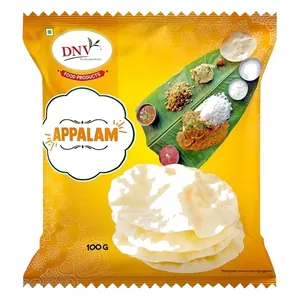
All Khakhra & Papad →- DNV Appalam Papad
- +Green flag: Source of protein (18.5g)
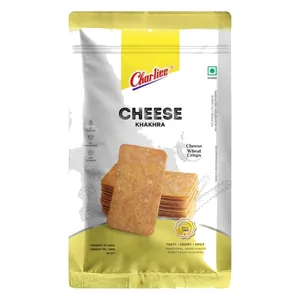
- Charliee Cheese Khakhra
- −Red flag: High sodium (769mg per 100g)
- −Red flag: High saturated fat (9.7g)
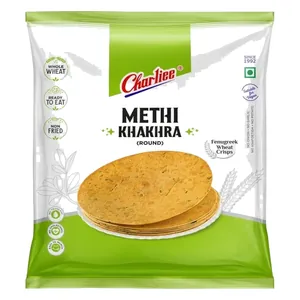
- Charliee Methi Khakhra
- −Red flag: High sodium (803.5mg per 100g)
- −Red flag: High saturated fat (9.5g)
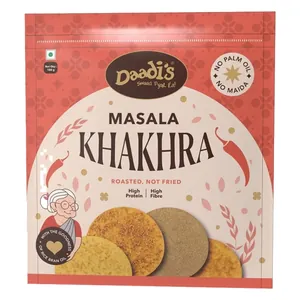
- Daadi's Masala Khakhra
- −Red flag: High sodium (681mg per 100g)
- +Green flag: High fibre (13.4g)