Double Horse Rice Palada Poha
Published · Last updated
A realistic serve of Double Horse Rice Palada Poha (1/4 cup, 45 g dry) has 171 kcal, 2.7 g protein, 40 g carbohydrate, 0 g fat, 0 g sugar and 0 mg sodium. Per 100 g it has 380 kcal, 6 g protein, 89 g carbohydrate, 0 g fat, 0 g saturated fat, 0 g sugar, 2 g fibre and 0 mg sodium.
Double Horse Rice Palada Poha is dry rice pasta bits made from rice flour alone, sold for making a traditional dessert. It scores EB2: low on nutrition because it is almost all starch, clean on ingredients with a single item and no additives, and low on risk with no sugar, fat or sodium declared. Use it now and then as a dessert base.
Ingredients, decoded
1 listed- Rice Flour
0 teaspoon of sugar in every 100 g · 0 g total sugar, 5 g a teaspoon
Score and nutrition facts for Double Horse Rice Palada Poha:
| Energy | 380 kcal |
|---|---|
| Protein | 6 g |
| Carbohydrates | 89 g |
| Total sugars | 0 g |
| Dietary fibre | 2 g |
| Total fat | 0 g |
| Saturated fat | 0 g |
| Trans fat | 0 g |
| Cholesterol | 0 mg |
| Sodium | 0 mg |
| Calcium | 12 mg |
Think this score is wrong?
Why Double Horse Rice Palada Poha scores EB2
Nutrition is an E because 100 g is 380 kcal of mostly starch, with 6 g protein and 2 g fibre. Ingredients are a B for one plain item. Risk is a 2, set only by energy.
Very low nutrient density
- Protein
- 6 g
- Fibre
- 2 g
- Vitamins and minerals
- Calcium
- Energy
- 380 kcal
01 Nutrition density: why E
Energy is 380 kcal per 100 g, with 89 g carbohydrate, 6 g protein and 2 g fibre. The protein comes from rice flour, so it is modest for the calories, and the fibre is low.
Only calcium is declared among minerals, at 12 mg per 100 g, and no vitamins. Nothing else adds to the grade, which is why it lands at the bottom.
Scored on protein, fibre and twelve vitamins and minerals, against the Codex and FSSAI "source" and "high" levels, per 100 g and per 100 kcal. Protein also has to supply at least 12.5% of the calories to count, and 25% for full credit.
Good, few concerning additives
- Base
- Rice Flour
- Sweeteners
- None added
- Additives
- 0
- Flagged
- None
02 Ingredient integrity: why B
The list is a single item, rice flour. There are no additives, no hydrogenated fat and no sweetener, so no ingredient points are lost.
The pack makes no promise that the list contradicts, so there is no label-integrity cost. The one gap is that no percentage is printed for the rice flour.
Scored on how processed the ingredients are, which additives are used and why, and whether the label keeps its promises.
Low risk
- Total sugar
- 0 g
- Sodium
- 0 mg
- Saturated fat
- 0 g
- Trans fat
- 0 g
03 Load risk: why 2
Sugar, saturated fat, trans fat and sodium are all declared as 0, so they add nothing to the risk number. The grade comes only from energy: 380 kcal per 100 g, or about 172 kcal per 45 g serve.
That energy floor puts risk at a 2. The grade would rise with a sweetened or fat-rich preparation, because those are added at home, not in the pack.
Scored on free sugar, sodium, saturated fat and trans fat, each weighed by how strong the evidence of harm is.
Red flags
No major red flags on the label.
Green flags
- +Green flag: Low sodium
- +Green flag: No additives
Does Double Horse Rice Palada Poha live up to its claims?
The name and pasta-bits claims hold, and no preservative is listed. The retailer page shows poha and rice ada flakes, while the pack shows rice flour pasta bits.
- Product nameHolds
“Rice Palada”
The only ingredient is rice flour, shaped into pasta bits for the dessert palada pradaman.
- On the packHolds
“Rice Pasta Bits”
The list is rice flour alone, which matches pasta bits made from rice.
- Retail listingHolds
“No Preservatives”
Rice flour is the only ingredient, so no preservative or other additive is listed.
- Retail listingBe careful
“Made from rice ada flakes”
The retailer page shows poha and rice ada flakes, the pack shows Rice Palada and Rice Pasta Bits made from rice flour.
What's in Double Horse Rice Palada Poha?
Rice flour is the only ingredient, with no percentage printed and no additives. The thing to watch is the starch load, at 89 g carbohydrate per 100 g.
1 ingredient listed. None of them is an additive or watched ingredient in our research.
The ingredient list, read for you
The list has one ingredient, rice flour, with no percentage printed. It is the whole product: the starch that gives the bits their shape and the 89 g carbohydrate per 100 g. Nothing is added for taste, colour or keeping.
Ingredients to watch
- Starch loadWorth watching
89 g carbohydrate per 100 g, about 40 g in a 45 g serve, with only 2 g fibre per 100 g.
- Low protein for the caloriesWorth watching
6 g protein per 100 g, about 3 g per serve, against 380 kcal per 100 g.
- EnergyWorth watching
380 kcal per 100 g, about 172 kcal per serve of the dry bits. This sets the risk grade.
- Single ingredient, no additivesFine
Rice flour only, with no preservative, sweetener, colour or flavouring listed.
- Sugar, fat and sodiumFine
Printed as 0 g sugar, 0 g fat and 0 mg sodium.
What it doesn’t have
- No percentage is printed for the rice flour.
- No vitamins are declared, and calcium is the only mineral shown, at 12 mg per 100 g.
What to know about Double Horse Rice Palada Poha
Plain rice pasta bits: clean list, almost all starch
Double Horse Rice Palada Poha is a 200 g pack of dry rice pasta bits, sold on the pack as Rice Palada and Rice Pasta Bits. The ingredient list has one item, rice flour, with no percentage given. It is bought to make palada pradaman, the traditional dessert named on the back of the pack.
Per 100 g it has 380 kcal, 89 g carbohydrate, 6 g protein, 2 g fibre and 12 mg calcium. Sugar, fat, saturated fat, trans fat and sodium are all printed as 0. The pack's serve is 1/4 cup, 45 g, which gives about 172 kcal, 40 g carbohydrate and 3 g protein. A 200 g pack holds about four and a half serves.
The pack is honest about what it is: rice flour shaped into pasta bits. The online listing calls it poha and describes rice ada flakes, which is not what the pack prints. CleanPlate scores it EB2.
Who should eat Double Horse Rice Palada Poha?
Fine a few times a week for most adults in a measured serve. Anyone watching blood sugar should keep it occasional, since 45 g has about 40 g carbohydrate.
- Most adultsA few times a week
About 172 kcal per 45 g serve, nearly all starch, with no sugar or sodium.
- ChildrenA few times a week
Plain rice flour with no additives, but only 3 g protein per serve.
- Diabetes or prediabetesOccasionally
About 40 g carbohydrate per serve and only 1 g fibre.
- Active peopleA few times a week
Carbohydrate energy at 380 kcal per 100 g, but low in protein.
Recipes with Double Horse Rice Palada Poha
Palada pradaman is the dish the pack names. Keep the serve near 45 g dry and decide the milk and sweetener yourself, since the bits have no sugar.
Palada pradaman
The dessert the pack names: cook about 45 g of dry bits per serve, which gives 40 g carbohydrate before any milk or sweetener.
Lighter-sweet palada dessert
The bits carry 0 g sugar, so you can sweeten lightly and keep the bowl closer to the 172 kcal the serve starts with.
Protein-topped palada bowl
Add milk or chopped nuts to a serve that has only 3 g protein, so the dessert is less of a pure starch bowl.
Double Horse Rice Palada Poha: common questions
Is Double Horse Rice Palada Poha healthy?
Double Horse Rice Palada Poha is not high in sugar, salt or saturated fat, so a few servings a week is fine.
How many calories and how much protein are in Double Horse Rice Palada Poha?
Per 100 g, Double Horse Rice Palada Poha has 380 kcal, 6 g protein, 89 g carbohydrate, 0 g fat and 0 g saturated fat. One serve (1/4 cup, 45 g dry) has 171 kcal and 2.7 g protein.
What are the ingredients in Double Horse Rice Palada Poha?
1 ingredient, in label order: Rice Flour.
Does Double Horse Rice Palada Poha live up to its claims?
4 claims checked: 3 hold, 1 needs care. "Made from rice ada flakes" needs care: The retailer page shows poha and rice ada flakes, the pack shows Rice Palada and Rice Pasta Bits made from rice flour.
Who should limit Double Horse Rice Palada Poha?
Most adults: a few times a week. About 172 kcal per 45 g serve, nearly all starch, with no sugar or sodium. Children: a few times a week. Plain rice flour with no additives, but only 3 g protein per serve. Diabetes or prediabetes: occasionally. About 40 g carbohydrate per serve and only 1 g fibre.
How much sugar, salt and saturated fat does Double Horse Rice Palada Poha have?
Per 100 g, Double Horse Rice Palada Poha has 0 g sugar, 0 mg sodium (about 0 g salt) and 0 g saturated fat. The FSSAI and UK FSA "high" lines are 10 g added sugar, 600 mg sodium and 5 g saturated fat per 100 g. It is under all three lines.
What does the EB2 score mean for Double Horse Rice Palada Poha?
The first letter (E) grades nutrition density on A to E, the second (B) grades ingredient integrity on A to E, and the number (2) grades load risk on 1 to 5. A and 1 are best. Nutrition: Energy is 380 kcal per 100 g, with 89 g carbohydrate, 6 g protein and 2 g fibre. The protein comes from rice flour, so it is modest for the calories, and the fibre is low. Ingredients: The list is a single item, rice flour. There are no additives, no hydrogenated fat and no sweetener, so no ingredient points are lost. Load risk: Sugar, saturated fat, trans fat and sodium are all declared as 0, so they add nothing to the risk number. The grade comes only from energy: 380 kcal per 100 g, or about 172 kcal per 45 g serve.
Last reviewed October 31, 2026. Scored with the CleanPlate method from the published label. Spotted a mistake? .
Reference values: FSSAI labelling regulations, Codex Alimentarius, ICMR-NIN and the UK front of pack guidance. Where our label data comes from.
Label read on 31 October 2026, from photos of the pack. If the pack has changed since, tell us.
Score history (1)
| Date | Score | Method | Why |
|---|---|---|---|
| 31 October 2026 | EB2 | v5.0 | First scored |
Every change to this score is logged. See corrections and the method changelog.
Better Breakfast Cereals
All Breakfast Cereals →- Yoga Bar 0% Added Sugar Super Muesli
- +Green flag: Source of protein (15g)
- +Green flag: High fibre (14g)
- GOAT Life High Protein Overnight Oats Tiramisu
- +Green flag: High protein (26.7g per 100g)
- +Green flag: High fibre (8g)
- Kellogg's Muesli 0% Added SugarFortified
- +Green flag: High fibre (6.4g)
- +Green flag: No added sugar
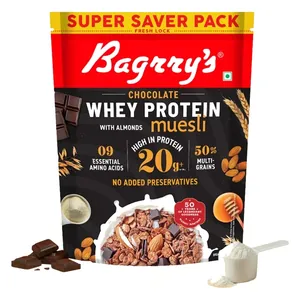
- Bagrry's Chocolate Whey Protein Muesli with Almonds
- −Red flag: High added sugar (11g per 100g)
- +Green flag: Source of protein (20.3g)
More from Double Horse
All Double Horse →- Double Horse Nano Soya Chunks
- +Green flag: High protein (54g per 100g)
- +Green flag: Source of fibre
- Double Horse Easy Palappam Instant Mix
- +Green flag: Low sodium
- +Green flag: No additives
- Double Horse Modak Flour
- +Green flag: Low sodium
- +Green flag: No additives
- Double Horse White Puttupodi Rice Flour
- +Green flag: Low sodium
- +Green flag: No additives