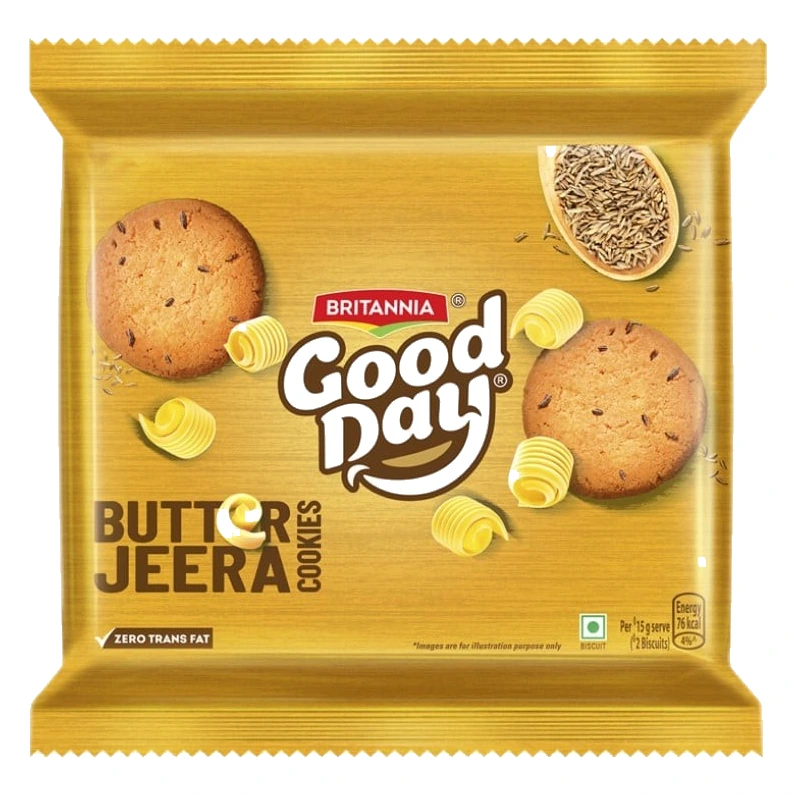
Good Day Butter Jeera Cookies
Published · Last updated
A realistic serve of Good Day Butter Jeera Cookies (2 biscuits, 15 g) has 76 kcal, 1 g protein, 10.2 g carbohydrate, 3.5 g fat, 3 g added sugar and 89 mg sodium. Per 100 g it has 506 kcal, 6.4 g protein, 68.2 g carbohydrate, 23.1 g fat, 11.5 g saturated fat, 20 g added sugar and 592 mg sodium.
Good Day Butter Jeera Cookies are a salty-sweet biscuit built on refined flour and palm oil, with cumin and ajwain. It scores EC5: nutrition is lowest because of the refined base, ingredients sit in the middle with several additives costing points, and risk is highest on sugar, saturated fat and salt. Best kept for the occasional cup of chai.
Ingredients, decoded
11 listed- Refined Wheat Flour (Maida)
- Refined Palm Oil
- Sugar
- Spices [Cumin (2.4%) & Ajwain]
- Invert Sugar Syrup
- Raising Agents [500(ii), 503(ii) & 450(i)]
- Butter
- Iodised Salt
- Milk Solids
- Emulsifiers [322(i), 471 & 472e]
- Natural & Nature-Identical Flavouring Substances
4 teaspoons of sugar in every 100 g · 20.8 g total sugar, 5 g a teaspoon
Score and nutrition facts for Good Day Butter Jeera Cookies:
| Energy | 506 kcal |
|---|---|
| Protein | 6.4 g |
| Carbohydrates | 68.2 g |
| Total sugars | 20.8 g |
| Added sugars | 20 g |
| Total fat | 23.1 g |
| Saturated fat | 11.5 g |
| Trans fat | 0 g |
| Cholesterol | 4.2 mg |
| Sodium | 592 mg |
Think this score is wrong?
Why Good Day Butter Jeera Cookies scores EC5
Nutrition is an E: the base is refined flour with small protein and no declared fibre. Ingredients are a C, and risk is a 5 on 11.5 g saturated fat, 20 g added sugar and 592 mg sodium per 100 g.
Very low nutrient density
- Protein
- 6.4 g
- Fibre
- Not declared
- Vitamins and minerals
- None declared
- Energy
- 506 kcal
01 Nutrition density: why E
Protein is 6.4 g per 100 g, and the largest share comes from refined wheat flour. That is not enough to earn credit, and no fibre is declared.
No vitamins or minerals are declared, so nothing lifts the grade. It sits at the bottom.
Scored on protein, fibre and twelve vitamins and minerals, against the Codex and FSSAI "source" and "high" levels, per 100 g and per 100 kcal. Protein also has to supply at least 12.5% of the calories to count, and 25% for full credit.
Mixed processing and additives
- Base
- Refined Wheat Flour
- Main fat
- Refined Palm Oil
- Sweeteners
- Sugar, Invert Sugar Syrup
- Additives
- 6
- Flagged
- Maida, Palm oil
02 Ingredient integrity: why C
Refined wheat flour, refined palm oil and sugar lead the list, with invert sugar syrup as a second sweetener. Butter is only 1.4%, and cumin is 2.4%.
Diphosphates (450) cost the most ingredient points. Nature-identical flavouring, lecithin (322), mono- and diglycerides (471) and DATEM (472e) cost further ingredient points.
The name stresses butter, and the share is small, which costs a small label point.
Scored on how processed the ingredients are, which additives are used and why, and whether the label keeps its promises.
Very high risk
- Added sugar
- 20 g
- Sodium
- 592 mg
- Saturated fat
- 11.5 g
- Trans fat
- 0 g
03 Load risk: why 5
Saturated fat is the biggest driver: 11.5 g per 100 g, more than twice the 5 g high line. Sodium at 592 mg and added sugar at 20 g also weigh on the number.
Energy is 506 kcal per 100 g. Trans fat is 0 g, so it plays no part. Together the numbers give the top risk grade.
Scored on free sugar, sodium, saturated fat and trans fat, each weighed by how strong the evidence of harm is.
Red flags
- −Red flag: High added sugar (20g per 100g)
- −Red flag: High saturated fat (11.5g)
- −Red flag: Refined flour (maida) base
- −Red flag: Palm oil listed
Green flags
Nothing stands out in its favour.
Does Good Day Butter Jeera Cookies live up to its claims?
Zero trans fat holds, and the butter and jeera in the name are real but small, at 1.4% and 2.4%. The retailer page shows a different panel from the pack.
- Product namePartly true
“Butter Jeera”
Butter is real but small at 1.4%, and cumin is 2.4%. Refined flour and palm oil make up most of the biscuit.
- On the packHolds
“Zero Trans Fat”
The panel shows 0 g trans fat per 100 g, and no hydrogenated fat is listed. Saturated fat is still 11.5 g per 100 g from palm oil and butter.
- On the packBe careful
“Buttery goodness that melts in your mouth”
The richness comes mainly from refined palm oil, which is ahead of butter in the list. Butter is 1.4%.
- Retail listingBe careful
“521 kcal per 100 g”
The retailer page shows 521 kcal, 25.8 g fat and 566 mg sodium per 100 g, while the pack shows 506 kcal, 23.1 g fat and 592 mg sodium. The pack figures are used.
What's in Good Day Butter Jeera Cookies?
Refined flour, palm oil and sugar lead the list. Several emulsifiers, a raising agent and flavouring cost ingredient points.
11 ingredients listed. Additives and watched ingredients we rate: 2 low concern. 1 more entry looks like an additive we have not researched yet.
The ingredient list, read for you
Refined wheat flour (maida), refined palm oil and sugar come first, so the biscuit is mostly flour, fat and sweetener. Cumin (2.4%) and ajwain give the savoury flavour, and invert sugar syrup adds more sweetness.
Butter is 1.4%, with milk solids, iodised salt and raising agents 500(ii), 503(ii) and 450(i) to make it rise. Emulsifiers 322(i), 471 and 472e keep the dough even and the texture crisp, and nature-identical flavouring finishes it.
The label numbers, read for you
The numbers that decide the score are saturated fat at 11.5 g per 100 g and added sugar at 20 g per 100 g, with sodium at 592 mg. In a 15 g serve of 2 biscuits that is 1.7 g saturated fat, 3 g added sugar and about 89 mg sodium, with 76 kcal.
Protein is small at 6.4 g per 100 g, about 1 g per serve. No fibre, vitamins or minerals are declared on the panel.
What the additives do
Maida (low concern): cheap, soft base flour. Refined wheat flour with the bran and germ removed. Low in fibre and quick to digest. More on Maida.
Palm oil (low concern): cheap, heat-stable frying fat. A cheap, stable frying oil that is about half saturated fat. Very common in Indian packaged snacks. More on Palm oil.
Not in our additive research yet: Emulsifiers [322(i), 471 & 472e].
Ingredients to watch
- 450(i) DiphosphatesWorth watching
A raising agent that helps the dough puff and bake light and crisp. It costs ingredient points.
- Natural & nature-identical flavouring substancesWorth watching
Adds a buttery note that the small amount of butter does not give on its own. It costs ingredient points.
- 472e DATEMWorth watching
An emulsifier that strengthens the dough so the biscuit holds its shape and texture. It costs ingredient points.
- 322(i) LecithinWorth watching
An emulsifier that helps the fat and flour mix evenly in the dough. It costs ingredient points.
- 471 Mono- and diglycerides of fatty acidsFine
An emulsifier that keeps the fat spread through the dough for a smooth, crisp bite. It costs ingredient points.
What it doesn’t have
- No fibre, vitamins or minerals are declared on the panel.
What to know about Good Day Butter Jeera Cookies
A cumin biscuit with 11.5 g saturated fat per 100 g
Good Day Butter Jeera Cookies from Britannia are a crisp biscuit made from refined wheat flour (maida), refined palm oil and sugar, flavoured with spices (cumin 2.4% and ajwain). Butter is 1.4% of the list, with milk solids, invert sugar syrup, raising agents, iodised salt, emulsifiers and flavouring. It is bought as a tea-time biscuit that tastes a little savoury and a little sweet.
Per 100 g you get 506 kcal, 6.4 g protein, 20 g added sugar, 11.5 g saturated fat and 592 mg sodium. A serve of 2 biscuits (15 g) is 76 kcal, with 3 g added sugar and 1.7 g saturated fat. The pack is 450 g, made of six 75 g packs.
The name leads with butter, but palm oil comes well before it in the list and butter is a small share. The front also says zero trans fat, which the panel supports. CleanPlate scores it EC5.
Who should eat Good Day Butter Jeera Cookies?
Rarely for most adults, and rarely for children, anyone watching blood sugar or anyone managing weight, since the saturated fat and sugar are high.
- Most adultsRarely
11.5 g saturated fat per 100 g is more than twice the high line.
- ChildrenRarely
20 g added sugar per 100 g on a refined flour and palm oil base.
- Diabetes or prediabetesRarely
Refined flour plus 20 g added sugar per 100 g, with no fibre declared.
- Weight managementRarely
506 kcal per 100 g, and the biscuits are easy to keep eating.
Good Day Butter Jeera Cookies: common questions
Is Good Day Butter Jeera Cookies healthy?
Good Day Butter Jeera Cookies is high in sugar, saturated fat and calories, so it is best kept as a rare treat.
How many calories and how much protein are in Good Day Butter Jeera Cookies?
Per 100 g, Good Day Butter Jeera Cookies has 506 kcal, 6.4 g protein, 68.2 g carbohydrate, 23.1 g fat and 11.5 g saturated fat. One serve (2 biscuits, 15 g) has 76 kcal and 1 g protein.
What are the ingredients in Good Day Butter Jeera Cookies?
11 ingredients, in label order: Refined Wheat Flour (Maida), Refined Palm Oil, Sugar, Spices [Cumin (2.4%) & Ajwain], Invert Sugar Syrup, Raising Agents [500(ii), 503(ii) & 450(i)], Butter, Iodised Salt, Milk Solids, Emulsifiers [322(i), 471 & 472e], Natural & Nature-Identical Flavouring Substances. Flagged: Maida (low concern), Palm oil (low concern).
Does Good Day Butter Jeera Cookies live up to its claims?
4 claims checked: 1 holds, 1 is partly true, 2 need care. "Butter Jeera" is partly true: Butter is real but small at 1.4%, and cumin is 2.4%. Refined flour and palm oil make up most of the biscuit. "Buttery goodness that melts in your mouth" needs care: The richness comes mainly from refined palm oil, which is ahead of butter in the list. Butter is 1.4%.
Who should limit Good Day Butter Jeera Cookies?
Most adults: rarely. 11.5 g saturated fat per 100 g is more than twice the high line. Children: rarely. 20 g added sugar per 100 g on a refined flour and palm oil base. Diabetes or prediabetes: rarely. Refined flour plus 20 g added sugar per 100 g, with no fibre declared.
How much sugar, salt and saturated fat does Good Day Butter Jeera Cookies have?
Per 100 g, Good Day Butter Jeera Cookies has 20 g added sugar, 592 mg sodium (about 1.5 g salt) and 11.5 g saturated fat. The FSSAI and UK FSA "high" lines are 10 g added sugar, 600 mg sodium and 5 g saturated fat per 100 g. It is high in sugar and saturated fat.
What does the EC5 score mean for Good Day Butter Jeera Cookies?
The first letter (E) grades nutrition density on A to E, the second (C) grades ingredient integrity on A to E, and the number (5) grades load risk on 1 to 5. A and 1 are best. Nutrition: Protein is 6.4 g per 100 g, and the largest share comes from refined wheat flour. That is not enough to earn credit, and no fibre is declared. Ingredients: Refined wheat flour, refined palm oil and sugar lead the list, with invert sugar syrup as a second sweetener. Butter is only 1.4%, and cumin is 2.4%. Load risk: Saturated fat is the biggest driver: 11.5 g per 100 g, more than twice the 5 g high line. Sodium at 592 mg and added sugar at 20 g also weigh on the number.
Last reviewed November 3, 2026. Scored with the CleanPlate method from the published label. Spotted a mistake? .
Reference values: FSSAI labelling regulations, Codex Alimentarius, ICMR-NIN and the UK front of pack guidance. Where our label data comes from.
Label read on 3 November 2026, from photos of the pack. If the pack has changed since, tell us.
Score history (1)
| Date | Score | Method | Why |
|---|---|---|---|
| 3 November 2026 | EC5 | v5.0 | First scored |
Every change to this score is logged. See corrections and the method changelog.
Better Biscuits & Cookies
All Biscuits & Cookies →- The Cinnamon Kitchen Almond Flour & Cacao Protein Cookies
- +Green flag: Source of protein (21.4g)
- +Green flag: Source of fibre
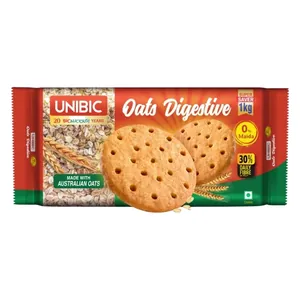
- Unibic Oats Digestive Cookies
- −Red flag: High added sugar (16.6g per 100g)
- −Red flag: High sodium (655.7mg per 100g)
- BRB Shortcuts Protein Wafer Bites Classic Peanut Butter
- −Red flag: High added sugar (14g per 100g)
- −Red flag: High saturated fat (8g)
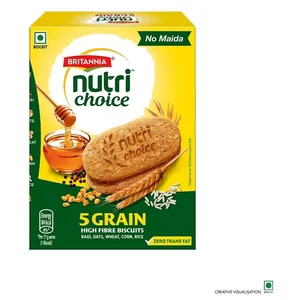
- Britannia NutriChoice 5 Grain Digestive Biscuit
- −Red flag: High added sugar (17.3g per 100g)
- −Red flag: High saturated fat (9.7g)
More from Britannia
All Britannia →- Britannia Come Alive Paneer, 200 g
- −Red flag: High saturated fat (16.2g)
- −Red flag: Contains trans fat (0.5g)
- Britannia Multigrain Bread
- −Red flag: Palm oil listed
- −Red flag: Contains Calcium Propionate
- Britannia Breakfast Slice White BreadFortified
- −Red flag: Refined flour (maida) base
- −Red flag: Contains Calcium Propionate
- Britannia Milk BreadFortified
- −Red flag: High added sugar (11.3g per 100g)
- −Red flag: Refined flour (maida) base