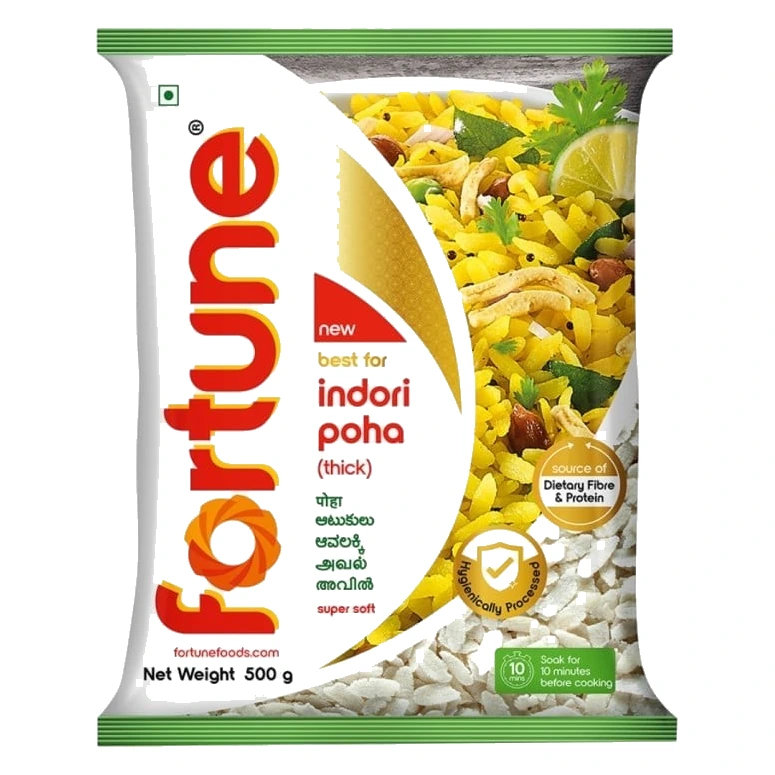
Fortune Indori Poha (Thick)
Published · Last updated
A realistic serve of Fortune Indori Poha (30 g dry flakes, one serve) has 108 kcal, 2.3 g protein, 23.1 g carbohydrate, 0.4 g fat, 0 g added sugar and 0 mg sodium. Per 100 g it has 360 kcal, 7.7 g protein, 77.1 g carbohydrate, 1.3 g fat, 0.3 g saturated fat, 0 g added sugar, 4.3 g fibre and 1 mg sodium.
Fortune Indori Poha (Thick) is plain flattened rice flakes, sold as a soft base for the classic Indore breakfast. It scores DB2: low on nutrition as it is mostly starch with modest protein and fibre, high on ingredients for a one-item list, and low on risk with almost no sugar, salt or saturated fat. Suits regular breakfasts, best with vegetables or protein added.
Ingredients, decoded
1 listed- Rice flakes
<½ teaspoon of sugar in every 100 g · 0.5 g total sugar, 5 g a teaspoon
Score and nutrition facts for Fortune Indori Poha (Thick):
| Energy | 359.9 kcal |
|---|---|
| Protein | 7.7 g |
| Carbohydrates | 77.1 g |
| Total sugars | 0.5 g |
| Added sugars | 0 g |
| Dietary fibre | 4.3 g |
| Total fat | 1.3 g |
| Saturated fat | 0.3 g |
| Trans fat | 0.01 g |
| Sodium | 0.8 mg |
| Phosphorus | 182.8 mg |
Think this score is wrong?
Why Fortune Indori Poha scores DB2
Nutrition is a D because the flakes are mostly starch, with 7.7 g protein and 4.3 g fibre per 100 g. Ingredients are a B for a single plain ingredient, and risk is a 2, driven only by energy.
Low nutrient density
- Protein
- 7.7 g
- Fibre
- 4.3 g
- Vitamins and minerals
- Phosphorus
- Energy
- 360 kcal
01 Nutrition density: why D
Protein is 7.7 g per 100 g and fibre is 4.3 g. In one 30 g serve that is 2.3 g protein and 1.3 g fibre. All of the protein comes from rice, which keeps the protein credit low.
Only phosphorus (182.8 mg per 100 g) is declared, so there are no vitamins or minerals to add to the grade. Energy is 359.9 kcal per 100 g, almost all from 77.1 g of carbohydrate.
Scored on protein, fibre and twelve vitamins and minerals, against the Codex and FSSAI "source" and "high" levels, per 100 g and per 100 kcal. Protein also has to supply at least 12.5% of the calories to count, and 25% for full credit.
Good, few concerning additives
- Base
- Rice flakes
- Sweeteners
- None added
- Additives
- 0
- Flagged
- None
02 Ingredient integrity: why B
The list is a single item, rice flakes. There are no additives, no sugar, no added fat and no flavouring, and no label promise is hollow, so nothing costs ingredient points.
The grade stops short of the top because the ingredient is a processed grain rather than a varied food, and the pack gives no percentage for the single ingredient.
Scored on how processed the ingredients are, which additives are used and why, and whether the label keeps its promises.
Low risk
- Added sugar
- 0 g
- Sodium
- 0.8 mg
- Saturated fat
- 0.3 g
- Trans fat
- 0.01 g
03 Load risk: why 2
Energy is the only real driver: 359.9 kcal per 100 g sets the risk number at 2. Added sugar is 0 g, saturated fat is 0.3 g and trans fat is 0.01 g.
Sodium is 0.8 mg per 100 g, close to none, so salt plays no part. The risk comes from the calorie density of a dry grain, which drops once the flakes are soaked and cooked.
Scored on free sugar, sodium, saturated fat and trans fat, each weighed by how strong the evidence of harm is.
Red flags
No major red flags on the label.
Green flags
- +Green flag: Source of fibre
- +Green flag: No added sugar
- +Green flag: Low sodium
Does Fortune Indori Poha live up to its claims?
The name and the fibre and protein statement hold up in a modest way. Origin and hygiene statements describe the process and cannot be checked from the numbers.
- Product nameHolds
“Indori Poha (thick)”
The only ingredient is rice flakes, so the name matches the contents. The pack shows no percentage, which is unneeded for a one-item list.
- On the packBe careful
“Source of Dietary Fibre & Protein”
True, but modest: 4.3 g fibre and 7.7 g protein per 100 g, which is 1.3 g and 2.3 g in a 30 g serve.
- On the packBe careful
“Made from Chhattisgarh Rice”
The ingredient list says only rice flakes and gives no origin. The claim is a statement about sourcing that the label data cannot confirm.
- On the packBe careful
“Hygienically Processed”
This describes how the flakes are made. It says nothing about nutrition, and no additive or preservative is listed.
What's in Fortune Indori Poha?
Rice flakes are the only ingredient, with no additives, no sugar and no oil listed. There is little to watch beyond the starch load.
1 ingredient listed. None of them is an additive or watched ingredient in our research.
The ingredient list, read for you
Rice flakes are the only ingredient, with no percentage given. They are flattened rice, so the list holds no sugar, oil, salt, preservative or flavouring. The pack's own suggestions are to rinse, soak for 10 minutes and garnish with ratlami sev and coriander.
Ingredients to watch
- Starch loadWorth watching
77.1 g carbohydrate per 100 g, about 23.1 g in a 30 g serve, with 359.9 kcal per 100 g. This is what holds the nutrition grade down.
- Modest proteinWorth watching
7.7 g per 100 g, 2.3 g per serve, all from rice. A plate of poha alone gives little protein.
- Single ingredientFine
Rice flakes only: no additives, no added sugar, no added fat.
- Sugar, saturated fat and sodiumFine
0 g added sugar, 0.3 g saturated fat and 0.8 mg sodium per 100 g.
What it doesn’t have
- No vitamins or minerals are declared apart from phosphorus.
What to know about Fortune Indori Poha
One-ingredient rice flakes with modest protein
Fortune Indori Poha (Thick) is a 500 g pack of thick flattened rice flakes. The ingredient list has one item, rice flakes, with no percentage. The pack says it is made from Chhattisgarh rice and is meant for Indori-style poha, soaked for 10 minutes and finished with ratlami sev and coriander.
A 30 g serve of dry flakes gives about 108 kcal, 2.3 g protein, 1.3 g fibre and 23.1 g carbohydrate. Per 100 g that is 359.9 kcal, 7.7 g protein, 4.3 g fibre, 77.1 g carbohydrate and 1.3 g fat. Sugar is 0.5 g, with 0 g added, and sodium is 0.8 mg.
The pack's claims are mostly about texture, origin and process: super soft, hygienically processed, a source of fibre and protein. The numbers support the fibre and protein statement in a modest way, and nothing on the label is hollow. CleanPlate scores it DB2.
Who should eat Fortune Indori Poha?
A reasonable everyday breakfast base for most adults and children. Those managing blood sugar should watch the 23.1 g carbohydrate per serve.
- Most adultsEveryday
One plain ingredient, 0.3 g saturated fat and almost no sodium per 100 g.
- ChildrenEveryday
No sugar or additives, but protein is only 2.3 g per serve, so add some.
- Diabetes or prediabetesA few times a week
About 23.1 g carbohydrate per 30 g serve, so pair it with vegetables or protein.
- Active peopleEveryday
Starchy fuel at 77.1 g carbohydrate per 100 g, with protein to be added.
Recipes with Fortune Indori Poha
Classic Indori poha, vegetable poha and a protein-topped plate all start from the same flakes. Vegetables and protein make up for what the flakes lack.
Classic Indori poha
Rinse and soak the flakes for 10 minutes, cook, then top with ratlami sev and coriander. The sev adds the fat and salt the flakes lack.
Vegetable poha
Cook peas, carrot or onion in with the flakes to add fibre beyond the 1.3 g in a 30 g serve.
Peanut or egg poha
Add roasted peanuts or serve with an egg to lift protein above the 2.3 g per serve the flakes give.
Fortune Indori Poha: common questions
Is Fortune Indori Poha (Thick) healthy?
Fortune Indori Poha is not high in sugar, salt or saturated fat, so it can be a regular part of your diet.
How many calories and how much protein are in Fortune Indori Poha (Thick)?
Per 100 g, Fortune Indori Poha (Thick) has 360 kcal, 7.7 g protein, 77.1 g carbohydrate, 1.3 g fat and 0.3 g saturated fat. One serve (30 g dry flakes, one serve) has 108 kcal and 2.3 g protein.
What are the ingredients in Fortune Indori Poha (Thick)?
1 ingredient, in label order: Rice flakes.
Does Fortune Indori Poha (Thick) live up to its claims?
4 claims checked: 1 holds, 3 need care. "Source of Dietary Fibre & Protein" needs care: True, but modest: 4.3 g fibre and 7.7 g protein per 100 g, which is 1.3 g and 2.3 g in a 30 g serve. "Made from Chhattisgarh Rice" needs care: The ingredient list says only rice flakes and gives no origin. The claim is a statement about sourcing that the label data cannot confirm.
Who should limit Fortune Indori Poha (Thick)?
Most adults: everyday. One plain ingredient, 0.3 g saturated fat and almost no sodium per 100 g. Children: everyday. No sugar or additives, but protein is only 2.3 g per serve, so add some. Diabetes or prediabetes: a few times a week. About 23.1 g carbohydrate per 30 g serve, so pair it with vegetables or protein.
How much sugar, salt and saturated fat does Fortune Indori Poha (Thick) have?
Per 100 g, Fortune Indori Poha (Thick) has 0 g added sugar, 1 mg sodium (about 0 g salt) and 0.3 g saturated fat. The FSSAI and UK FSA "high" lines are 10 g added sugar, 600 mg sodium and 5 g saturated fat per 100 g. It is under all three lines.
What does the DB2 score mean for Fortune Indori Poha (Thick)?
The first letter (D) grades nutrition density on A to E, the second (B) grades ingredient integrity on A to E, and the number (2) grades load risk on 1 to 5. A and 1 are best. Nutrition: Protein is 7.7 g per 100 g and fibre is 4.3 g. In one 30 g serve that is 2.3 g protein and 1.3 g fibre. All of the protein comes from rice, which keeps the protein credit low. Ingredients: The list is a single item, rice flakes. There are no additives, no sugar, no added fat and no flavouring, and no label promise is hollow, so nothing costs ingredient points. Load risk: Energy is the only real driver: 359.9 kcal per 100 g sets the risk number at 2. Added sugar is 0 g, saturated fat is 0.3 g and trans fat is 0.01 g.
Last reviewed October 31, 2026. Scored with the CleanPlate method from the published label. Spotted a mistake? .
Reference values: FSSAI labelling regulations, Codex Alimentarius, ICMR-NIN and the UK front of pack guidance. Where our label data comes from.
Label read on 31 October 2026, from photos of the pack. If the pack has changed since, tell us.
Score history (1)
| Date | Score | Method | Why |
|---|---|---|---|
| 31 October 2026 | DB2 | v5.0 | First scored |
Every change to this score is logged. See corrections and the method changelog.
Better Breakfast Cereals
All Breakfast Cereals →- Yoga Bar 0% Added Sugar Super Muesli
- +Green flag: Source of protein (15g)
- +Green flag: High fibre (14g)
- GOAT Life High Protein Overnight Oats Tiramisu
- +Green flag: High protein (26.7g per 100g)
- +Green flag: High fibre (8g)
- Kellogg's Muesli 0% Added SugarFortified
- +Green flag: High fibre (6.4g)
- +Green flag: No added sugar
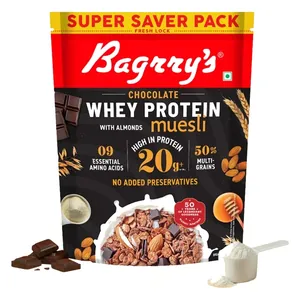
- Bagrry's Chocolate Whey Protein Muesli with Almonds
- −Red flag: High added sugar (11g per 100g)
- +Green flag: Source of protein (20.3g)
More from Fortune
All Fortune →- Fortune Mini Soya Chunks
- +Green flag: High protein (52.9g per 100g)
- +Green flag: High fibre (15.3g)
- Fortune Soya Chunks
- +Green flag: High protein (52.9g per 100g)
- +Green flag: High fibre (15.3g)
- Fortune Soya Granules
- +Green flag: High protein (52.9g per 100g)
- +Green flag: High fibre (15.3g)
- Fortune Chakki Fresh Atta (0% Maida)
- +Green flag: Source of protein (12.9g)
- +Green flag: High fibre (9.5g)